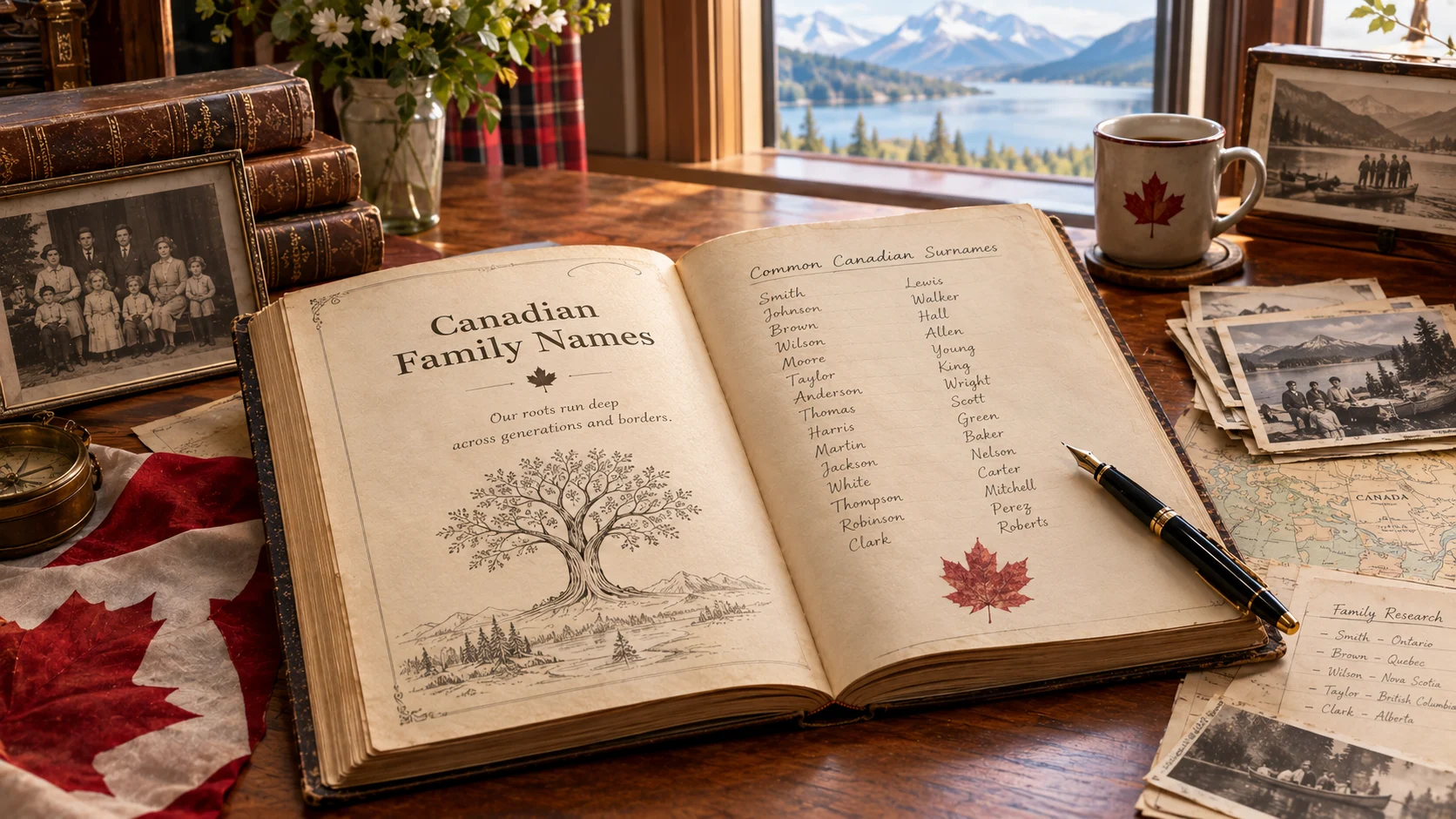
Canadian last names come from many traditions, including French, English, Scottish, Irish, Indigenous, and other immigrant cultures. Common examples include Smith, Tremblay, Martin, Wilson, Campbell, MacDonald, Gagnon, Roy, and Bouchard.
A last name can tell a tiny story without saying a single word. It may point toward a family’s language, occupation, homeland, or generations of history. That is one reason Canadian last names are so interesting. Canada has been shaped by French and British settlement, Indigenous cultures, immigration, and generations of families arriving from around the world.
Some Canadian surnames sound instantly familiar, while others carry a distinctly French, Scottish, Irish, or English flavor. Names such as Tremblay and Gagnon may remind readers of French Canadian heritage, while Campbell and MacDonald reflect strong Scottish connections.
Of course, a surname alone cannot prove someone’s ancestry. Families move, languages change, and names can be altered over time. Still, surnames offer fascinating clues.
Below, you’ll find ten well-known surname examples, along with their meanings, origins, style, personality feel, popularity, and best uses. You’re researching a family name, creating a character, or simply collecting name ideas, there’s plenty to explore.
Smith
Meaning: Blacksmith or metalworker
Origin: English and other European traditions
Personality: Strong, practical, dependable
Style: Classic, simple, timeless
Best For: Family research, fictional characters, baby-name inspiration, usernames
Popularity: Extremely familiar and traditional
Emotional Appeal: Smith has that rare quality of feeling completely natural almost anywhere. Its connection to the traditional occupation of a blacksmith gives it a hardworking, grounded character.
Pop Culture Reference: Smith is widely represented in English-speaking popular culture and appears as a surname for numerous fictional and real-world figures.
Similar Last Names: Taylor, Cooper, Baker, Carter, Miller
Why It Still Works Today: Its simplicity is its biggest strength. Smith is easy to spell, easy to pronounce, and instantly recognizable.
Among Canadian last names, Smith feels especially approachable because it fits comfortably into Canada’s English-speaking naming tradition while also appearing in many other countries.
Tremblay
Meaning: Generally associated with a place or landscape containing aspen or trembling trees
Origin: French
Personality: Refined, traditional, quietly distinctive
Style: French Canadian, elegant, classic
Best For: Family-history research, fictional Quebec characters, heritage-inspired naming
Popularity: Strongly associated with French Canadian naming traditions
Emotional Appeal: Tremblay has a distinctly French Canadian sound. It feels sophisticated without being overly formal, making it an appealing choice for readers interested in Quebec’s cultural heritage.
Pop Culture Reference: The surname is found among numerous Canadian public figures and fictional characters.
Similar Last Names: Gagnon, Bouchard, Girard, Beaulieu, Pelletier
Why It Still Works Today: Tremblay connects naturally with French-speaking Canadian history while still sounding recognizable to English-speaking audiences.
It is particularly useful when researching French Canadian last names, although a surname by itself cannot establish a person’s exact ancestry.
Martin
Meaning: Derived from Martin, associated with Mars and traditionally interpreted as “of Mars” or “warlike”
Origin: Latin, later widespread throughout Europe
Personality: Confident, friendly, established
Style: Classic, international, versatile
Best For: Baby-name inspiration, characters, family research, pen names
Popularity: Long-established and widespread
Emotional Appeal: Martin is one of those surnames that crosses borders effortlessly. It can sound French, English, European, or Canadian depending on the family and context.
Pop Culture Reference: Martin appears frequently across literature, entertainment, sports, and public life.
Similar Last Names: Thomas, Richard, Bernard, Laurent, Robert
Why It Still Works Today: Its international familiarity gives it staying power. It also works equally well for a historical character or a modern fictional family.
When discussing Canadian surnames, Martin is a useful example of how a name can have deep European roots while becoming established in Canadian communities.
Wilson
Meaning: Son of William
Origin: English and Scottish
Personality: Reliable, confident, approachable
Style: Traditional, polished, modern-classic
Best For: Characters, family names, baby-name inspiration, creative writing
Popularity: Longstanding and familiar
Emotional Appeal: Wilson has a warm, straightforward quality. Its patronymic structure gives it a clear historical connection to the practice of identifying someone through a parent’s name.
Pop Culture Reference: Wilson appears throughout movies, television, literature, and sports.
Similar Last Names: Williamson, Johnson, Watson, Jackson, Harrison
Why It Still Works Today: It sounds established without feeling old-fashioned. That balance makes Wilson a flexible surname for both real-world and fictional use.
Its English and Scottish roots also reflect the wider British influence found within Canadian surname history.
Campbell
Meaning: Traditionally linked to a Gaelic expression often interpreted as “crooked mouth”
Origin: Scottish Gaelic
Personality: Bold, proud, adventurous
Style: Scottish, traditional, strong
Best For: Historical characters, family research, Scottish Canadian heritage themes
Popularity: Established and recognizable
Emotional Appeal: Campbell carries a strong Highland and Scottish association. It feels sturdy and distinctive while remaining easy for English speakers to recognize.
Pop Culture Reference: Campbell is a common surname among public figures, fictional characters, athletes, and entertainers.
Similar Last Names: MacDonald, Stewart, Fraser, Murray, Gordon
Why It Still Works Today: Its Scottish identity gives it a strong sense of heritage without making it difficult to pronounce or spell.
Campbell is a good example of how Canadian last names can reflect migration from Scotland and the continued influence of Scottish culture in Canada.
MacDonald
Meaning: Son of Donald
Origin: Scottish Gaelic
Personality: Strong, traditional, family-oriented
Style: Scottish, historic, distinguished
Best For: Historical fiction, genealogy research, heritage-inspired characters
Popularity: Well-established
Emotional Appeal: MacDonald immediately evokes a strong family connection because the name literally follows a patronymic pattern. The “Mac” element traditionally means “son of.”
Pop Culture Reference: MacDonald and its spelling variants appear across Canadian and international public life.
Similar Last Names: MacLeod, MacKenzie, MacKay, McLean, MacArthur
Why It Still Works Today: It carries a clear Scottish identity while remaining familiar in modern English-speaking communities.
Spelling can vary between MacDonald, McDonald, and related forms. Those variations developed through historical usage and family preferences, so they should not automatically be treated as identical family lines.
Gagnon
Meaning: A French surname with historical origins that are not always given a single definitive modern translation
Origin: French
Personality: Warm, traditional, distinctive
Style: French Canadian, classic, sophisticated
Best For: Quebec-inspired characters, genealogy research, French Canadian naming
Popularity: Strongly associated with French Canadian communities
Emotional Appeal: Gagnon has a recognizable Quebecois character. Its sound immediately gives a name combination a French-speaking Canadian flavor.
Pop Culture Reference: The surname appears among Canadian public figures and in French Canadian communities.
Similar Last Names: Tremblay, Roy, Bouchard, Giroux, Gauthier
Why It Still Works Today: It feels authentically French Canadian without sounding overly complicated.
Gagnon is also a useful reminder that surname meanings can be complicated. Some historical names have disputed, uncertain, or multiple proposed origins, so responsible genealogy avoids presenting one explanation as absolute when evidence is unclear.
Roy
Meaning: Commonly connected with the French word for “king”
Origin: French
Personality: Confident, elegant, charismatic
Style: Short, classic, French
Best For: Characters, family research, pen names, creative projects
Popularity: Established and recognizable
Emotional Appeal: Roy is short but memorable. Its French connection gives it an elegant quality, while its brevity makes it exceptionally easy to use.
Pop Culture Reference: Roy appears as a surname for numerous characters and public figures internationally.
Similar Last Names: Roi, LeRoy, King, Rey, Leroy
Why It Still Works Today: Short surnames often have excellent visual appeal. Roy looks clean on a page and sounds natural when paired with many first names.
Within lists of Canadian last names, Roy is especially interesting because it demonstrates how a very compact surname can still carry a strong linguistic and cultural identity.
Bouchard
Meaning: Traditionally derived from an old Germanic personal name
Origin: French, with older Germanic roots
Personality: Distinguished, confident, traditional
Style: French, historic, refined
Best For: French Canadian characters, genealogy, heritage-inspired naming
Popularity: Established within French Canadian naming traditions
Emotional Appeal: Bouchard sounds distinctly French while remaining familiar enough for many English-speaking Canadians to recognize.
Pop Culture Reference: Bouchard is found among Canadian athletes, artists, academics, and other public figures.
Similar Last Names: Boucher, Beauchamp, Bernard, Ducharme, Girard
Why It Still Works Today: The surname has historical depth but does not feel disconnected from modern life.
Its presence in Canada illustrates how older European surnames became firmly rooted in Canadian communities over generations.
Taylor
Meaning: Tailor, a person who made or altered clothing
Origin: English
Personality: Creative, practical, polished
Style: Occupational, classic, modern
Best For: Fictional characters, family research, creative naming
Popularity: Familiar and enduring
Emotional Appeal: Taylor has a creative undertone because of its connection with skilled clothing work. It also has the advantage of sounding natural as both a surname and a given name.
Pop Culture Reference: Taylor is widely recognizable in music, television, film, sports, and literature.
Similar Last Names: Smith, Cooper, Carter, Baker, Miller
Why It Still Works Today: Taylor has successfully moved between traditional surname usage and modern first-name culture.
It demonstrates how occupational surnames remain relevant long after the original occupation stops being the main reason families use the name.
Quick Comparison Table
| Last Name | Meaning | Style | Best For |
|---|---|---|---|
| Smith | Blacksmith | Classic | General use |
| Tremblay | Aspen or trembling trees association | French Canadian | Heritage |
| Martin | Mars-related personal name | Classic | Versatile characters |
| Wilson | Son of William | English Scottish | Characters |
| Campbell | Traditional Gaelic surname | Scottish | Heritage |
| MacDonald | Son of Donald | Scottish | Genealogy |
| Gagnon | Historical French surname | French Canadian | Quebec themes |
| Roy | King-related French meaning | Elegant | Short surnames |
| Bouchard | Old personal-name origin | French | Heritage |
| Taylor | Tailor | Modern classic | Creative use |
How to Choose the Perfect Canadian Last Name
Choosing a surname depends on what you want the name to communicate.
Think about heritage first. If you’re researching your family, look for historical records rather than assuming a surname automatically proves ancestry.
Consider pronunciation. A name may look beautiful on paper but become frustrating if readers constantly pronounce it incorrectly.
Look at the meaning. Occupational names such as Smith and Taylor have a different feel from patronymic names such as Wilson and MacDonald.
Match the style. A historical character might suit Campbell or MacDonald, while a contemporary character could easily use Martin, Taylor, or Wilson.
Consider language. French Canadian surnames can create a different impression from English or Scottish surnames.
Check spelling variations. McDonald and MacDonald, for example, should not automatically be assumed to represent the same family branch.
Most importantly, choose a name that fits the person or purpose. A surname should feel natural rather than selected simply because it appears on a popular list.
Most Popular Canadian Last Names Today
There is no single perfect list of the “most popular” Canadian surnames because rankings can differ depending on the dataset, year, province, spelling variation, and different versions of a surname are grouped together.
Still, familiar names found throughout Canadian communities include:
- Smith
- Brown
- Martin
- Wilson
- Taylor
- Tremblay
- Gagnon
- Roy
- Campbell
- MacDonald
- Bouchard
- Johnson
- Anderson
- Miller
- Thompson
For serious genealogy, official census information, provincial records, genealogical databases, and historical documents are more reliable than generic online popularity lists.
Vintage Canadian Last Names Making a Comeback
Some surnames never really disappear. Their classic quality keeps them useful for generations.
Examples include:
- Bennett
- Bennett
- Carter
- Cooper
- Fraser
- Graham
- Hamilton
- Murray
- Stewart
- Sullivan
- Walker
- Wright
Many of these names began as occupational, geographical, or patronymic surnames. Their continued use shows how old naming traditions can feel surprisingly modern.
Modern Canadian Last Name Trends
Canadian naming culture is increasingly diverse because Canada has communities with roots across Europe, Asia, Africa, the Caribbean, the Middle East, and many other parts of the world.
Modern surname trends therefore cannot be reduced to one Canadian style.
Several patterns are worth noticing:
Short surnames remain appealing. Names such as Roy, King, and Lee are easy to remember.
Heritage names are being rediscovered. Families may explore older spellings or ancestral surnames as part of genealogy research.
French Canadian surnames remain culturally important. Names associated with Quebec continue to reflect the province’s French-speaking heritage.
Surname-as-first-name usage is popular. Names such as Taylor, Carter, and Parker demonstrate how family names can cross into first-name territory.
Multicultural naming is normal. Canadian families may combine surnames, preserve names from different cultures, or use hyphenated family names.
This diversity is one of the most interesting features of Canadian naming culture.
What Makes Canadian Last Names Unique?
There is no single naming pattern that defines every Canadian surname. Canada’s history has produced a mixture of French, British, Indigenous, and immigrant naming traditions.
French Canadian surnames often have strong connections to France and Quebec history. English surnames may have occupational or patronymic origins. Scottish and Irish names reflect migration from the British Isles.
At the same time, Indigenous communities have their own distinct naming traditions that should not be casually grouped with European surname systems.
This makes the phrase Canadian last names better understood as a broad category rather than one specific linguistic group.
Canadian Surnames and Family Heritage
A surname can be a useful starting point for family-history research, but it is only one clue.
A family might have changed its spelling after immigration. A surname could have been translated, shortened, combined with another surname, or recorded differently by officials.
For example, two families sharing the same surname do not necessarily share a recent common ancestor.
If you’re researching your own family, compare surnames with:
- Birth records
- Marriage records
- Death records
- Census records
- Immigration documents
- Church registers
- Cemetery records
- Local historical archives
The more independent records you compare, the stronger your family-history conclusions become.
FAQs
What are some common Canadian last names?
Smith, Brown, Martin, Wilson, Taylor, Tremblay, Campbell, Gagnon, Roy, and MacDonald are familiar examples.
What is a famous French Canadian last name?
Tremblay is one of the best-known examples associated with French Canadian naming traditions, particularly Quebec.
Are Canadian last names mostly French or English?
Canada has no single dominant surname tradition nationwide. French, English, Scottish, Irish, Indigenous, and many immigrant naming traditions all contribute to Canada’s surname landscape.
What does the last name Smith mean?
Smith is an occupational surname traditionally connected with a blacksmith or metalworker.
What does MacDonald mean?
MacDonald is a patronymic surname traditionally meaning “son of Donald,” with Scottish Gaelic roots.
Is Roy a French Canadian surname?
Roy is a French surname and is well established among French Canadian families, although surnames can appear in many countries and communities.
Can a last name prove Canadian ancestry?
No. A surname can provide a useful research clue, but it cannot by itself prove nationality, ethnicity, or a specific family connection.
What is a good Canadian surname for a fictional character?
Choose based on the character’s background and setting. Martin, Wilson, Taylor, Campbell, Tremblay, and Roy offer different English, Scottish, and French Canadian impressions.
Conclusion
Canadian surnames tell a fascinating story of language, migration, family, work, and cultural change. From Smith and Taylor to Tremblay, Gagnon, Campbell, and MacDonald, each name can offer a glimpse into a much larger history.
The most important thing to remember is that a surname is a clue, not a complete family history. Spelling changes, migration, marriage, translation, and regional differences can all shape how a family name develops.
You’re researching your ancestry, creating a fictional character, choosing a meaningful name, or simply exploring Canadian last names, the possibilities are surprisingly rich.
Pick the surname that best matches your purpose, share this guide with another name enthusiast, and leave a comment with your favorite.
Discover More Related Articles:
- 300 Scandinavian Girl Names | Beautiful Nordic Ideas In 2026
- 200 Welsh Girl Names | Inspired by Nature, Mythology & Culture In 2026
- 200 Polish Boy Names | Strong & Charming Choices In 2026