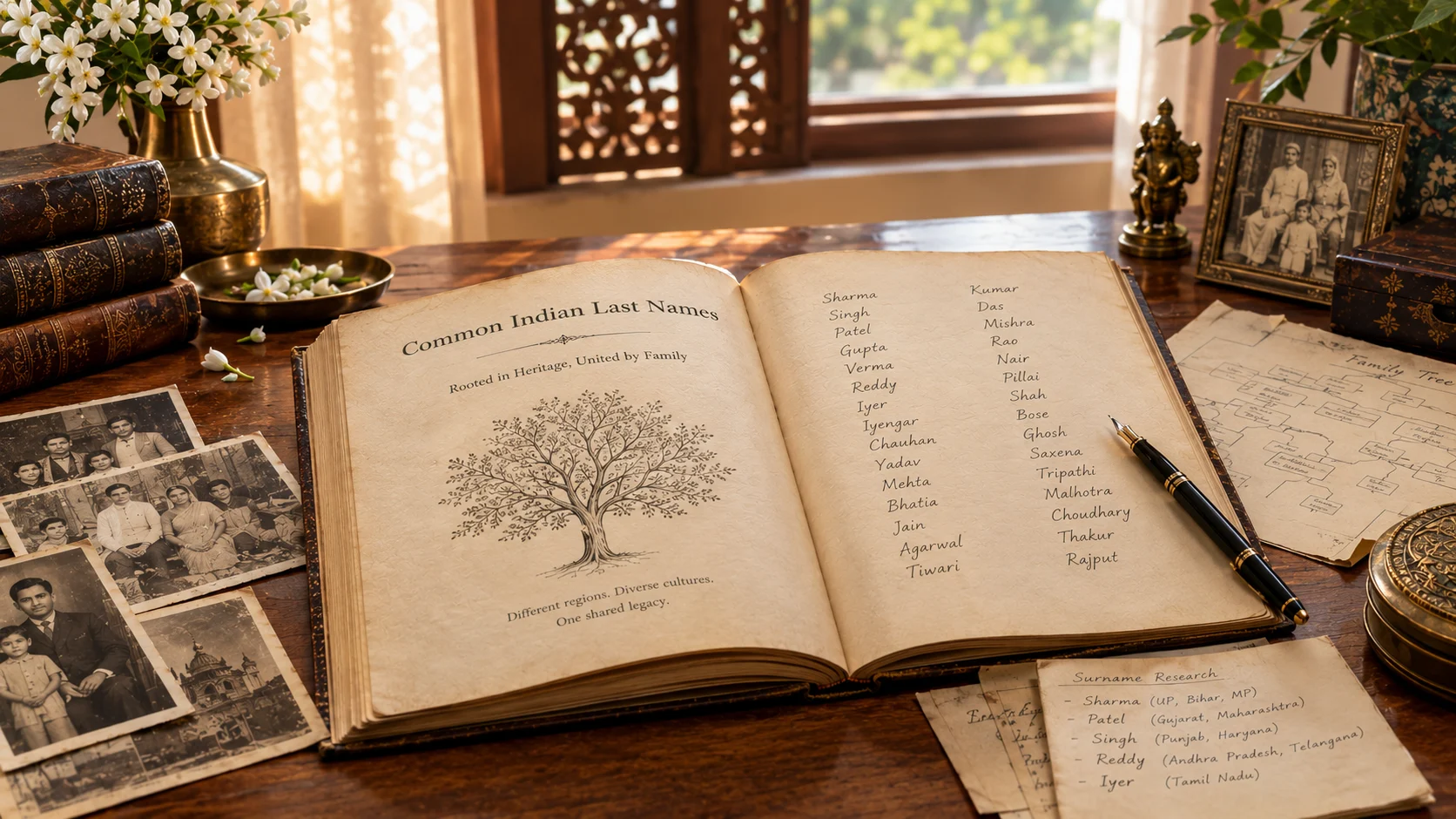
Common Indian last names include Sharma, Singh, Patel, Gupta, Kumar, Yadav, Reddy, Nair, Iyer, and Mehta. Their origins can relate to occupations, places, titles, communities, languages, ancestry, or historical traditions.
A last name can carry a surprising amount of history. Sometimes it points toward a region. Sometimes it reflects an old occupation, family tradition, title, place of origin, or linguistic heritage. That is especially true when exploring common Indian last names, because India has an enormous variety of naming traditions.
A surname that feels familiar in Gujarat may be less common in Kerala. A family name used across North India may have a completely different naming story from one traditionally used in Tamil Nadu or Bengal.
Names such as Sharma, Singh, Patel, Gupta, Reddy, Nair, and Iyer are widely recognized, but their backgrounds are not identical. Some have occupational roots, while others are connected with titles, communities, languages, or historical traditions.
The list below explores ten well-known Indian surnames while keeping one important point in mind: a surname does not always tell the complete story of a person’s identity.
Sharma: A Classic Indian Surname Linked With Learning
Meaning
Sharma is associated with joy, shelter, comfort, or protection in Sanskrit.
Origin
Sharma has Sanskrit roots and is particularly associated historically with Brahmin communities in several parts of India. It is now widely recognized beyond any single region.
Personality
Sharma has a traditional, intellectual, and respectable feel. It often gives the impression of someone connected with education, knowledge, or established family traditions.
Style
Classic, scholarly, traditional, dignified
Best For
Sharma works naturally as a realistic surname for characters, family-history research, naming projects, and people exploring traditional Indian family names.
Popularity
It remains one of the most recognizable Indian surnames and appears across multiple Indian-language communities.
Emotional Appeal
The name feels familiar without sounding overly modern. Its long association with learning and traditional culture gives it a strong heritage quality.
Pop Culture Reference
Sharma appears frequently among Indian public figures, fictional characters, athletes, entertainers, and professionals.
Similar Surnames
- Mishra
- Pandey
- Shukla
- Joshi
- Bhatt
Why It Still Works Today
Sharma combines familiarity with cultural depth. It sounds equally natural in traditional family settings and modern professional environments.
Singh: A Powerful Surname Meaning Lion
Meaning
Singh comes from the Sanskrit word siṃha, meaning lion.
Origin
The surname has deep historical roots in South Asia. It became especially significant within Sikh identity when Mentor Gobind Singh established the Khalsa in 1699 and prescribed Singh for Sikh men. It is also used by many other communities.
Personality
Singh has a bold and confident personality. The lion association naturally gives it an impression of courage, strength, leadership, and determination.
Style
Powerful, bold, heroic, timeless
Best For
It works well when researching family names, writing characters, exploring Sikh naming traditions, or looking for a surname with a strong historical association.
Popularity
Singh is among the most recognizable Indian surnames and is used across India and the Indian diaspora.
Emotional Appeal
The lion meaning gives Singh an instantly memorable quality. It feels strong without requiring an elaborate explanation.
Pop Culture Reference
Singh appears widely among athletes, actors, musicians, politicians, writers, and other public figures.
Similar Surnames
- Kaur
- Rai
- Rao
- Thakur
- Chauhan
Why It Still Works Today
Singh carries both historical depth and modern recognition. It is short, distinctive, and easy to recognize internationally.
Patel: A Gujarati Surname With Leadership Roots
Meaning
Patel is traditionally connected with a village headman or village leadership role.
Origin
The surname has strong Gujarati roots. Historical linguistic evidence connects Patel with the Prakrit term for a village headman, ultimately linked to Sanskrit terminology associated with landholding.
Personality
Patel often feels grounded, practical, established, and confident. Its historical connection with village leadership gives it an administrative quality.
Style
Traditional, confident, established, professional
Best For
Patel is useful for family-history research, Indian character naming, genealogy, cultural studies, and exploring Gujarati surnames.
Popularity
Patel is especially prominent in Gujarat and is now widely found across India and among the global Indian diaspora.
Emotional Appeal
Its connection with leadership and community responsibility gives the name a grounded historical character.
Pop Culture Reference
The surname Patel is widely represented in Indian and international media, business, sports, and entertainment.
Similar Surnames
- Patil
- Desai
- Mehta
- Shah
- Joshi
Why It Still Works Today
Patel sounds familiar, professional, and distinctly South Asian. Its strong connection with Gujarat also makes it useful when exploring regional heritage.
Gupta: A Surname Associated With Protection
Meaning
Gupta is derived from Sanskrit and is associated with the idea of being protected or a protector.
Origin
Gupta has a long history across northern and eastern India. Historical sources show that the surname was adopted by different communities at different times rather than belonging exclusively to one group.
Personality
Gupta feels refined, established, intelligent, and professional.
Style
Classic, polished, professional, traditional
Best For
It is suitable for genealogy research, character development, historical writing, and people interested in Indian family names.
Popularity
Gupta is widely recognized in India and among Indian communities around the world.
Emotional Appeal
The protective meaning gives the surname a subtle sense of security and strength.
Pop Culture Reference
Gupta is frequently seen among Indian professionals, academics, business leaders, entertainers, and fictional characters.
Similar Surnames
- Agarwal
- Mehta
- Shah
- Bansal
- Jain
Why It Still Works Today
Gupta has an established sound that works comfortably in both traditional and modern contexts.
Kumar: One of India’s Most Recognizable Name Elements
Meaning
Kumar comes from Sanskrit and means boy, youth, or prince.
Origin
Kumar is used across many Indian languages and communities. Unlike some surnames that strongly point toward one region, Kumar has broad pan-Indian usage.
Personality
Kumar feels youthful, simple, familiar, and versatile.
Style
Classic, simple, youthful, widely recognized
Best For
It can appear as a surname, middle name, or part of a longer personal name depending on regional and family naming traditions.
Popularity
Kumar is exceptionally widespread in India and is used across multiple linguistic communities.
Emotional Appeal
Its meaning connects with youth and royalty while its everyday use makes it feel approachable.
Pop Culture Reference
Numerous Indian actors, athletes, writers, and public figures use Kumar as part of their names.
Similar Names
- Raj
- Rao
- Singh
- Verma
- Prasad
Why It Still Works Today
Its simplicity is its greatest strength. Kumar is easy to pronounce, familiar across India, and recognizable internationally.
Yadav: A Surname With Ancient Lineage Associations
Meaning
Yadav is associated with the Yadav community, which traditionally claims descent from the legendary Yadu.
Origin
The surname is found across several Indian regions and languages, including Hindi, Marathi, Gujarati, Bengali, Punjabi, Telugu, and Kannada contexts.
Personality
Yadav can feel traditional, confident, community-oriented, and deeply rooted in heritage.
Style
Traditional, regional, strong, heritage-focused
Best For
It is especially relevant for genealogy, cultural research, historical writing, and understanding North and central Indian surname traditions.
Popularity
Yadav remains widely recognized and is particularly common in parts of northern and central India.
Emotional Appeal
Its historical connection to Yadu and Krishna traditions gives it significance for many families.
Pop Culture Reference
Yadav appears frequently among Indian politicians, athletes, actors, writers, and other public figures.
Similar Surnames
- Jadhav
- Ahir
- Rao
- Singh
- Chauhan
Why It Still Works Today
Yadav has a recognizable sound and strong heritage associations, making it an enduring Indian family name.
Reddy: A Well-Known Telugu Surname
Meaning
Reddy is a prominent surname associated particularly with Telugu-speaking regions.
Origin
Reddy is strongly associated with Andhra Pradesh and Telangana and has historical connections with landholding and local administration.
Personality
Reddy feels confident, established, regional, and authoritative.
Style
Strong, traditional, regional, distinguished
Best For
Reddy is useful when exploring Telugu surnames, South Indian family traditions, genealogy, and culturally grounded character names.
Popularity
The surname remains widely recognized in Andhra Pradesh and Telangana and is also found elsewhere through migration.
Emotional Appeal
Its strong regional connection gives it a clear sense of place and heritage.
Pop Culture Reference
Reddy is common among Indian politicians, business leaders, actors, athletes, and other public personalities.
Similar Surnames
- Rao
- Naidu
- Raju
- Varma
- Gowda
Why It Still Works Today
Reddy remains instantly recognizable as a major South Indian surname and carries a strong regional identity.
Nair: A Distinctive Kerala Surname
Meaning
Nair is primarily a community-associated surname from Kerala rather than a simple English-style surname meaning.
Origin
Nair is strongly associated with Kerala and has historical connections with a major social group traditionally linked with warrior and landholding roles.
Personality
Nair feels refined, regional, traditional, and distinctive.
Style
Elegant, traditional, South Indian, established
Best For
It is particularly useful when exploring Kerala ancestry, Malayalam naming traditions, genealogy, and South Indian cultural history.
Popularity
Nair remains one of the best-known surnames associated with Kerala.
Emotional Appeal
Its strong connection to Kerala gives the name a clear geographic and cultural identity.
Pop Culture Reference
Nair appears among Indian and international professionals, academics, actors, writers, and public figures of Indian heritage.
Similar Surnames
- Menon
- Pillai
- Namboodiri
- Kurup
- Varma
Why It Still Works Today
Nair remains recognizable while retaining a strong connection to Kerala’s cultural heritage.
Iyer: A Traditional Tamil Surname
Meaning
Iyer is a surname associated with the Iyer Brahmin community of Tamil Nadu.
Origin
Iyer is a Tamil surname and community designation. Its linguistic history has associations with ideas such as priest, teacher, sage, elder, and respected person.
Personality
Iyer feels scholarly, traditional, cultured, and distinctive.
Style
Classic, scholarly, South Indian, traditional
Best For
Iyer is relevant for genealogy, Tamil cultural research, historical writing, and understanding South Indian naming traditions.
Popularity
It remains one of the most recognizable Tamil-associated surnames.
Emotional Appeal
Its connections with learning, teaching, and religious tradition give it a strong intellectual character.
Pop Culture Reference
Iyer is found among Indian academics, scientists, artists, professionals, and public figures.
Similar Surnames
- Iyengar
- Bhatt
- Sastry
- Menon
- Nair
Why It Still Works Today
Iyer combines a distinctive sound with a strong Tamil cultural identity.
Mehta: A Historic Administrative Surname
Meaning
Mehta has historically been associated with roles such as an accountant, administrator, or official, although meanings and usage vary by region and community.
Origin
Mehta is particularly associated with western India, including Gujarat and Rajasthan, and is connected with historical administrative occupations.
Personality
Mehta feels polished, professional, intelligent, and established.
Style
Elegant, professional, classic, refined
Best For
It works well for genealogy, historical research, fictional characters, business-oriented naming, and Indian family-name exploration.
Popularity
Mehta remains a familiar surname, particularly in western and northern Indian communities.
Emotional Appeal
Its association with administration and scholarship gives it an educated and professional feel.
Pop Culture Reference
The surname appears among Indian entrepreneurs, academics, entertainers, authors, and other public figures.
Similar Surnames
- Shah
- Desai
- Patel
- Joshi
- Kapadia
Why It Still Works Today
Mehta sounds equally comfortable in traditional family settings and modern professional environments.
Quick Comparison Table
| Last Name | Meaning or Association | Style | Common Regional Connection |
|---|---|---|---|
| Sharma | Joy, shelter, comfort | Classic | North and several other regions |
| Singh | Lion | Powerful | Pan-Indian |
| Patel | Village headman | Established | Gujarat |
| Gupta | Protected, protector | Professional | North and East India |
| Kumar | Boy, youth, prince | Simple | Pan-Indian |
| Yadav | Yadu lineage association | Traditional | North and Central India |
| Reddy | Historical regional association | Strong | Andhra Pradesh, Telangana |
| Nair | Kerala community surname | Elegant | Kerala |
| Iyer | Tamil community surname | Scholarly | Tamil Nadu |
| Mehta | Administrator, accountant | Refined | Gujarat, Rajasthan and elsewhere |
How Indian Last Names Are Formed
Indian surnames do not follow one universal naming system.
They may be connected with occupation, geography, ancestry, community, clan, title, language, religion, or historical office. Some surnames also originated as names of places or descriptions of a person’s traditional role.
This diversity is one reason it is difficult to create a single list that represents every Indian naming tradition.
Common Indian Last Names by Region
North India
Commonly recognized surnames include:
- Sharma
- Singh
- Gupta
- Yadav
- Verma
- Mishra
- Pandey
- Chauhan
South India
Well-known surnames and family-name traditions include:
- Reddy
- Nair
- Iyer
- Rao
- Naidu
- Menon
- Pillai
- Gowda
Western India
Frequently encountered names include:
- Patel
- Patil
- Mehta
- Shah
- Desai
- Joshi
- Deshmukh
Eastern India
Commonly recognized surnames include:
- Das
- Ghosh
- Bose
- Sen
- Banerjee
- Chatterjee
- Mukherjee
These regional groupings are broad rather than absolute because migration, intermarriage, and modern naming practices have spread surnames far beyond their historical regions.
Most Popular Indian Last Names Today
Some of the most recognizable names include:
Kumar, Singh, Sharma, Patel, Gupta, Khan, Yadav, Reddy, Joshi, Nair, Mishra, Verma, Rao, Shah, Mehta, and Iyer.
Different databases produce different rankings because surname frequency depends on methodology, spelling variants, geographic coverage, and a name is used as a surname, middle name, title, or other name element. For example, available surname databases place Kumar, Singh, Sharma, Khan, Yadav, Gupta, and Patel among highly frequent names.
Traditional Indian Last Names With Deep Heritage
Some surnames have particularly strong historical or cultural associations.
Examples include:
- Singh
- Sharma
- Yadav
- Patel
- Iyer
- Nair
- Reddy
- Mehta
- Rao
- Desai
Their histories are different, so they should not be treated as interchangeable symbols of Indian identity.
Modern Trends in Indian Last Names
Indian naming traditions continue to evolve.
Urban families may use surnames differently from previous generations. Some people retain family surnames, while others use a parent’s given name, initials, community name, place-based surname, or another family naming convention.
South Indian naming traditions can differ substantially from the surname patterns commonly seen in northern India. In some communities, initials or a father’s name may form an important part of a person’s official name.
Migration has also changed how Indian surnames are presented internationally. Families may adapt the order or spelling of names when completing documents in countries that expect a fixed first-name-and-surname structure.
How to Choose the Right Indian Last Name
If you are choosing a surname for a fictional character, family-history project, naming exercise, or creative work, consider these points:
Think About Region
Choose a surname that fits the character’s or family’s intended regional background.
Check the Meaning
Do not choose a surname simply because it sounds attractive. Learn what the name traditionally means or represents.
Consider Language
A Tamil surname may have a different linguistic history from a Gujarati, Bengali, Punjabi, or Telugu surname.
Avoid Stereotypes
A surname should not automatically be used as proof of someone’s personality, social status, religion, or caste.
Check Historical Accuracy
If your project is historical, verify the surname was used in the period and location you are writing about.
Consider Modern Usage
Some names have changed in meaning or usage over time. A surname can have historical roots while being used much more broadly today.
FAQs
What are the most common Indian last names?
Some widely recognized Indian surnames include Sharma, Singh, Patel, Gupta, Kumar, Yadav, Reddy, Nair, Iyer, and Mehta.
What do Indian last names mean?
Indian surnames can reflect occupations, places, titles, ancestry, communities, languages, or historical traditions, so meanings vary greatly.
What is the most common Indian surname?
There is no single universally accepted answer because surname rankings vary by database, region, spelling, and population data.
Are Indian surnames different by region?
Yes. Surnames often reflect regional and linguistic traditions, with names such as Patel, Reddy, Nair, and Iyer having strong regional associations.
Do Indian last names indicate caste?
Some surnames have historical community or caste associations, but a surname alone cannot reliably determine a person’s caste or background.
Are Indian surnames passed down through families?
Many Indian families pass surnames from one generation to another, while some naming traditions use parental names, initials, places, or other naming patterns.
Which Indian surnames are popular internationally?
Names such as Singh, Patel, Sharma, Gupta, Kumar, and Khan are widely recognized outside India because of migration and the global Indian diaspora.
Can the same Indian surname have different origins?
Yes. The same surname may be used by different communities or have different historical associations depending on the region and family.
Conclusion
Exploring common Indian last names is really an exploration of India’s extraordinary cultural and linguistic diversity. Names such as Sharma, Singh, Patel, Gupta, Kumar, Yadav, Reddy, Nair, Iyer, and Mehta each carry different histories and associations.
Some connect with occupations or titles. Others reflect communities, regions, languages, ancestry, or historical traditions. Just as importantly, surname meanings can change as families move, cultures interact, and naming practices evolve.
If you are researching your family history, creating a character, or simply curious about Indian names, look beyond how a surname sounds. Its origin and regional context can make the name far more meaningful.
Pick the surname that interests you most, share this guide with someone exploring Indian heritage, and let us know which Indian last name you would add to the list.
Discover More Related Articles:
- 300 Scandinavian Girl Names | Beautiful Nordic Ideas In 2026
- 200 Welsh Girl Names | Inspired by Nature, Mythology & Culture In 2026
- 200 Polish Boy Names | Strong & Charming Choices In 2026