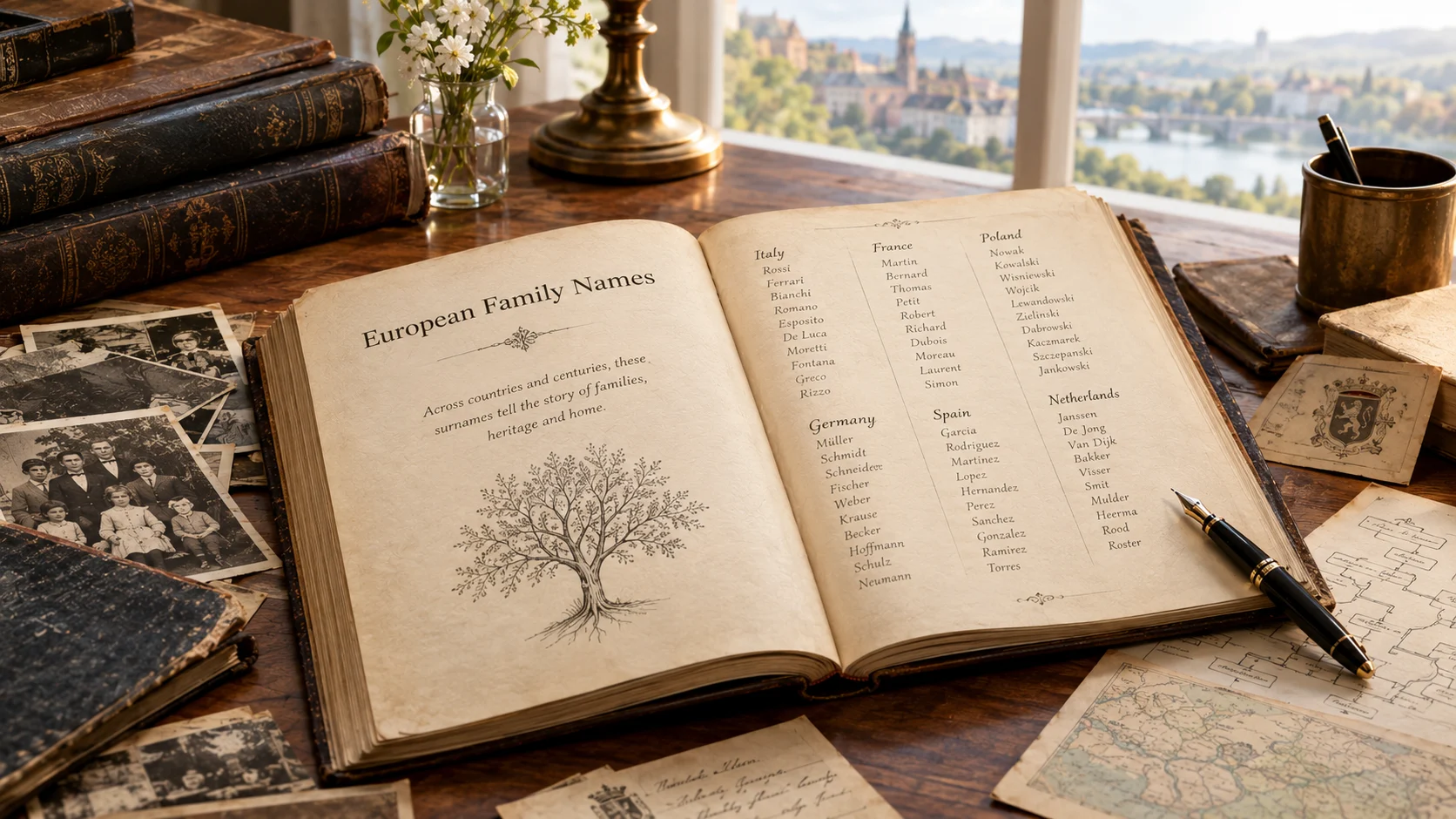
There is no single list of white people last names because “white” includes many populations and cultures. Common European-origin surnames include Smith, Brown, Taylor, Miller, Wilson, Anderson, Clark, Martin, Walker, and Thompson.
A last name can tell a tiny story.
It might point to an old occupation, describe where a family lived, identify a parent’s name, or simply carry a tradition through generations. That is why people often search for white people last names when looking for familiar European, British, American, or Western-style surnames.
The important thing to remember is that “white” is a broad racial category, not a surname system. European families have thousands of different naming traditions, from English and Scottish names to German, French, Italian, Irish, Scandinavian, and Slavic surnames.
So instead of treating these names as belonging to one racial group, this guide focuses on European-origin and Western surnames commonly encountered in white-majority countries.
You’re researching a fictional character, exploring genealogy, choosing a character name, or simply curious about surname meanings, these names offer plenty of inspiration.
Smith
Meaning: Blacksmith or metalworker
Origin: English
Personality: Practical, dependable, hardworking, and grounded.
Style: Classic, simple, timeless
Best For: Character names, family names, genealogy research, realistic fictional identities
Popularity: Extremely established
Emotional Appeal: Smith feels familiar almost everywhere. Its simplicity makes it easy to remember, while its occupational history gives it a connection to traditional working life.
Pop Culture Reference: Smith appears frequently in entertainment because it sounds natural and believable across many settings.
Similar Last Names: Miller, Taylor, Baker, Cooper, Carter
Why It Still Works Today: Smith is a classic example of an occupational surname. Blacksmiths once held important roles in local communities, and names based on occupations became family names over time. It remains recognizable because of its short spelling, easy pronunciation, and long history.
Johnson
Meaning: Son of John
Origin: English and Scandinavian-influenced naming traditions
Personality: Friendly, traditional, steady, and approachable.
Style: Classic, familiar, traditional
Best For: Fictional families, genealogy, character names, historical settings
Popularity: Long-established
Emotional Appeal: Johnson sounds familiar without being overly formal. It has the comfortable quality of a surname that could belong to almost anyone.
Pop Culture Reference: The surname is common among actors, athletes, writers, politicians, and fictional characters.
Similar Last Names: Jackson, Wilson, Thompson, Harrison, Robinson
Why It Still Works Today: Johnson is a patronymic surname. In simple terms, it originally identified someone as the son of a person named John. Similar naming patterns became widespread across Britain and other parts of Northern Europe.
Williams
Meaning: Son of William
Origin: English and Welsh
Personality: Warm, confident, traditional, and dependable.
Style: Classic, elegant, established
Best For: Family names, historical characters, baby-name combinations, fictional surnames
Popularity: Highly established
Emotional Appeal: Williams has a polished but approachable sound. It works equally well for a serious character and an everyday family.
Pop Culture Reference: The surname is strongly associated with many famous figures across sports, entertainment, literature, and history.
Similar Last Names: Williamson, Wilson, Harrison, Jackson, Thompson
Why It Still Works Today: Williams developed from the personal name William and the traditional “son of” naming pattern. Welsh and English history both contributed to its widespread use, making it one of the most recognizable surnames in the English-speaking world.
Brown
Meaning: Someone associated with brown coloring or complexion
Origin: English and Scottish
Personality: Calm, earthy, friendly, and straightforward.
Style: Simple, natural, classic
Best For: Fictional characters, family names, historical stories, genealogy
Popularity: Timeless
Emotional Appeal: Brown feels uncomplicated and familiar. It has an earthy quality that makes it sound natural rather than highly formal.
Pop Culture Reference: Brown is widely represented in literature, entertainment, sports, and public life.
Similar Last Names: White, Black, Green, Gray, Blackwell
Why It Still Works Today: Many European surnames developed from physical descriptions, clothing colors, hair colors, or other visible characteristics. Brown is one of the clearest examples of that naming tradition.
Jones
Meaning: Son of John
Origin: Welsh and English
Personality: Traditional, friendly, confident, and dependable.
Style: Classic, short, familiar
Best For: Character names, fictional families, genealogy projects, historical settings
Popularity: Very established
Emotional Appeal: Jones is short and memorable. It sounds familiar without requiring any explanation, which makes it useful for realistic character creation.
Pop Culture Reference: “Jones” appears across television, films, books, sports, and music.
Similar Last Names: James, Johns, Johnson, Evans, Williams
Why It Still Works Today: Jones became particularly common in Wales through the use of patronymic naming. Its connection to John helped it spread widely, eventually becoming one of the most familiar surnames in Britain and North America.
Miller
Meaning: Miller or grain mill worker
Origin: English, Scottish, and German
Personality: Reliable, hardworking, practical, and traditional.
Style: Rustic, classic, occupational
Best For: Historical characters, fictional families, genealogy, traditional names
Popularity: Long-established
Emotional Appeal: Miller feels connected to ordinary working life and old village communities. It has a warm, grounded quality.
Pop Culture Reference: Miller is widely used as a surname in entertainment and popular culture.
Similar Last Names: Smith, Baker, Cooper, Carter, Taylor
Why It Still Works Today: Miller is an occupational surname. A miller operated a mill, often processing grain into flour. Because milling was an important community occupation, the occupational title eventually became a hereditary family name.
Wilson
Meaning: Son of Will or William
Origin: English and Scottish
Personality: Confident, approachable, polished, and traditional.
Style: Classic, modern-classic, versatile
Best For: Baby-name combinations, fictional characters, family names, genealogy
Popularity: Established and enduring
Emotional Appeal: Wilson has a smooth sound that feels both traditional and modern. It is recognizable without sounding overly old-fashioned.
Pop Culture Reference: The surname appears frequently in films, television, literature, and sports.
Similar Last Names: Johnson, Williamson, Jackson, Harrison, Thompson
Why It Still Works Today: Wilson developed from a shortened form of William, followed by the traditional “son of” construction. Its widespread use across Britain helped it become familiar internationally.
Taylor
Meaning: Tailor or clothing maker
Origin: English and Scottish
Personality: Creative, stylish, practical, and friendly.
Style: Modern, classic, fashionable
Best For: Character names, family names, fictional identities, baby-name combinations
Popularity: Timeless
Emotional Appeal: Taylor is especially versatile because it works naturally as both a surname and a first name. It also carries an artistic association because of its connection with clothing and craftsmanship.
Pop Culture Reference: Taylor is familiar through numerous celebrities, fictional characters, and public figures.
Similar Last Names: Carter, Baker, Cooper, Miller, Walker
Why It Still Works Today: Taylor began as an occupational surname for someone who worked as a tailor. Its simple pronunciation and flexible use helped it remain popular for centuries.
Anderson
Meaning: Son of Andrew
Origin: Scottish, English, and Scandinavian
Personality: Strong, dependable, confident, and traditional.
Style: Classic, masculine, Scandinavian-inspired
Best For: Fictional families, historical characters, genealogy, realistic surnames
Popularity: Well established
Emotional Appeal: Anderson has a strong but friendly sound. It feels traditional while still fitting comfortably into a modern setting.
Pop Culture Reference: Anderson appears frequently in movies, television, sports, literature, and public life.
Similar Last Names: Johnson, Jackson, Harrison, Robertson, Williamson
Why It Still Works Today: Anderson follows the familiar patronymic pattern meaning “son of Andrew.” The surname developed independently or through related naming traditions in several Northern European regions.
Clark
Meaning: Clerk, scholar, or scribe
Origin: English and Scottish
Personality: Intelligent, composed, capable, and understated.
Style: Short, classic, sophisticated
Best For: Fictional characters, professional characters, family names, historical stories
Popularity: Timeless
Emotional Appeal: Clark has a crisp sound. It feels professional without becoming stiff, making it especially useful for character naming.
Pop Culture Reference: Clark is famously associated with Superman’s civilian identity, Clark Kent.
Similar Last Names: Clarke, Cole, Carter, Grant, Walker
Why It Still Works Today: Clark developed from an occupational title connected to clerks and scribes. Because literacy and record keeping were important specialized skills, the occupational name became established as a surname.
Quick Comparison Table
| Nickname or Surname | Meaning | Style | Best For |
|---|---|---|---|
| Smith | Metalworker | Classic | Family names |
| Johnson | Son of John | Traditional | Characters |
| Williams | Son of William | Elegant | Families |
| Brown | Brown coloring | Natural | Characters |
| Jones | Son of John | Classic | Fiction |
| Miller | Mill worker | Rustic | Historical characters |
| Wilson | Son of Will | Versatile | Modern characters |
| Taylor | Tailor | Stylish | Modern names |
| Anderson | Son of Andrew | Strong | Family names |
| Clark | Clerk or scribe | Sophisticated | Characters |
How to Choose the Perfect European-Style Last Name
Choosing a surname becomes easier when you think about the story behind it instead of simply picking the name that sounds good.
Start with geography.
If your character or family has English roots, an English surname may feel more natural than an Italian or Scandinavian one.
Think about the time period.
Smith, Miller, Taylor, and Baker can work particularly well in historical settings because they developed from occupations.
Consider pronunciation.
A surname that looks attractive but is difficult to pronounce may not work well for a character, username, or fictional family.
Match the personality.
A strong surname such as Anderson may suit a confident character, while a softer surname such as Wilson can feel more approachable.
Look beyond race.
A person’s surname cannot reliably tell you their race. Families migrate, marry across cultures, translate names, change spellings, and adopt new surnames.
Research the actual family history.
If you’re choosing a surname for genealogy, investigate records from the relevant country and region rather than assuming a surname proves ancestry.
Most Popular European and Western Surnames
Some surnames have become especially familiar throughout English-speaking countries and Europe.
- Smith
- Johnson
- Williams
- Brown
- Jones
- Miller
- Taylor
- Wilson
- Anderson
- Clark
- Martin
- Thompson
- Moore
- Walker
- White
- Harris
- Lewis
- Young
- Hall
- Allen
These names come from different naming traditions, so they should not be treated as belonging to one ethnic or racial group.
Vintage European Surnames Making a Comeback
Vintage surnames can give a character or fictional family an old-fashioned personality.
Some options include:
- Bennett
- Fletcher
- Harrison
- Spencer
- Sullivan
- Montgomery
- Graham
- Wallace
- Cooper
- Palmer
- Russell
- Grant
- Brooks
- Foster
- Marshall
These surnames can feel particularly appealing because they balance historical character with modern readability.
Common English Surnames and Their Naming Patterns
English surnames often developed from several basic categories.
Occupational surnames came from jobs. Smith, Baker, Miller, Cooper, and Taylor are familiar examples.
Patronymic surnames identified a person’s relationship to a father or male ancestor. Johnson, Williams, Anderson, and Harrison are examples of this broader pattern.
Descriptive surnames could refer to appearance or personal characteristics. Brown is a well-known example.
Locational surnames were connected to places, landscapes, settlements, or geographical features.
Understanding these categories makes surname research much more interesting because the family name becomes part of a historical naming system rather than just a label.
Modern Nickname and Surname Trends
Modern naming trends are much more flexible than older naming traditions.
People increasingly choose surnames for fictional characters based on sound, personality, cultural setting, and memorability. Short surnames such as Clark, Cole, Reed, and Grant often feel clean and contemporary.
Longer surnames can create a more formal or aristocratic impression, particularly in fiction. Names such as Montgomery, Wellington, and Harrison can give characters a traditional atmosphere.
Another trend is using surnames as first names. Taylor, Carter, Parker, Cooper, and Hunter are examples of surnames that have become popular given names in some English-speaking communities.
The key is authenticity. A name should fit the character’s background rather than simply being chosen because it sounds fashionable.
Are “White People Last Names” Actually a Thing?
Not in a strict linguistic sense.
There is no universal category of surnames that belongs to all white people. White populations include people with English, Irish, Scottish, Welsh, German, French, Italian, Spanish, Scandinavian, Slavic, Greek, Balkan, and many other backgrounds.
A surname usually tells you more about family history, geography, language, and naming tradition than someone’s racial identity.
For example, Smith is strongly associated with English-speaking naming traditions, while Anderson can reflect Scottish or Scandinavian naming traditions. Neither surname proves that a person belongs to a particular racial group.
This distinction matters when researching genealogy or writing about names accurately.
Why Surnames Have So Many Different Origins
Family names developed for practical reasons.
When communities became larger, using only a person’s first name was no longer enough to identify everyone. People began adding information about occupation, parentage, location, appearance, or other characteristics.
Someone might become known by an occupation such as a smith or baker. Another person could be identified as the son of John. Someone else might be associated with a particular village or geographical feature.
Over generations, these descriptions became hereditary surnames.
Migration then made everything even more interesting. Families moved between countries, languages changed, spellings evolved, and surnames sometimes became adapted to new cultures.
That is why one surname can have several spellings or related versions.
White American Surnames and European Heritage
Many surnames commonly encountered among white Americans have European origins because large waves of European immigration shaped the population of the United States.
English, German, Irish, Scottish, Italian, Scandinavian, Polish, French, and other European surnames can all be found in American records.
However, an American surname does not necessarily indicate recent European ancestry. Families can carry surnames for generations, change surnames through marriage or adoption, or have ancestors from many different cultural backgrounds.
For genealogy, historical records are far more reliable than assumptions based solely on a surname.
FAQs
What are common white people last names?
Common examples include Smith, Johnson, Williams, Brown, Jones, Miller, Taylor, Wilson, Anderson, and Clark. These are mainly European-origin surnames and should not be treated as proof of race.
What is the most common European last name?
Smith is one of the best-known European-origin surnames, especially in English-speaking populations. Its original meaning is connected with a skilled metalworker or blacksmith.
Do last names show someone’s race?
No. A surname cannot reliably establish someone’s race. It can sometimes provide clues about language, geography, or family history, but migration and intermarriage make racial assumptions unreliable.
What are classic English last names?
Classic English surnames include Smith, Taylor, Brown, Clark, Miller, Baker, Cooper, Carter, Walker, and Turner. Many developed from occupations or descriptive terms.
What are old European surnames?
Old European surnames include names from many different language traditions, including English, German, French, Irish, Scottish, Italian, Scandinavian, and Slavic naming systems.
Are European surnames always connected to ancestry?
Not necessarily. A surname may have been adopted, changed through marriage, translated, altered in spelling, or passed down through a family whose ancestry is now much more diverse.
What surnames sound sophisticated?
Names such as Bennett, Spencer, Montgomery, Harrison, Grant, Graham, and Marshall can create a polished or traditional impression, depending on the context.
How can I research my surname?
Start with family records, birth and marriage documents, census records, immigration documents, and reputable genealogy databases. A surname alone is not enough to establish ancestry.
Conclusion
Exploring white people last names becomes much more interesting when you look beyond race and focus on the stories behind surnames. Names such as Smith, Johnson, Williams, Brown, Taylor, Miller, Wilson, Anderson, and Clark represent different European naming traditions, occupations, family relationships, and historical influences.
A great surname can make a fictional character feel real, add personality to a story, or give genealogy research a useful starting point.
Just remember that a last name is a clue, not a complete identity. Family history can cross countries, languages, cultures, and generations.
Pick the surname that best fits your purpose, dig deeper into its history, and see where the story takes you. If you found a favorite, share this guide with someone who loves names, and leave a comment with the surname you’re researching.
Discover More Related Articles:
- 300 Scandinavian Girl Names | Beautiful Nordic Ideas In 2026
- 200 Welsh Girl Names | Inspired by Nature, Mythology & Culture In 2026
- 200 Polish Boy Names | Strong & Charming Choices In 2026