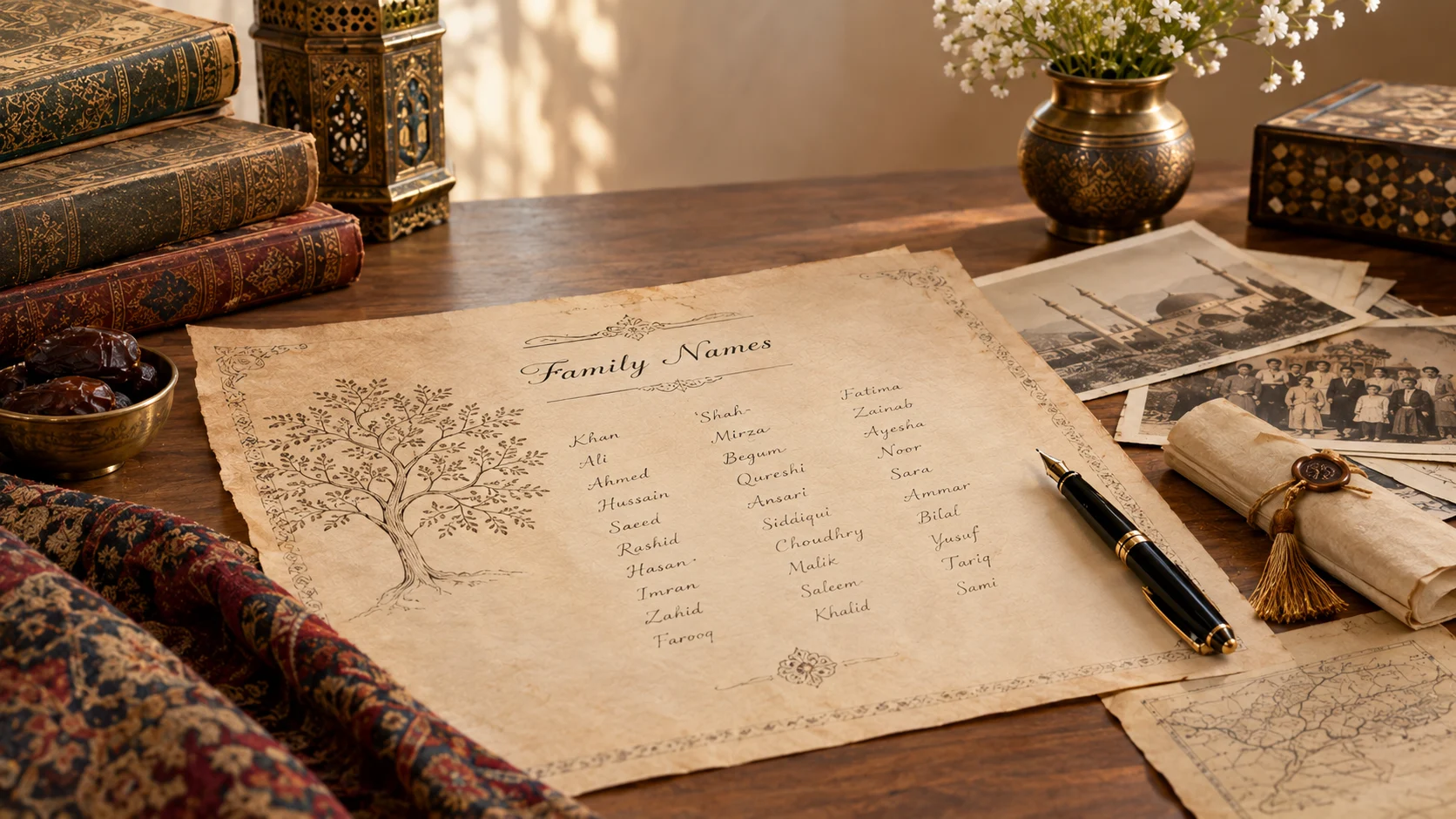
Muslim last names come from many languages and cultures, including Arabic, Persian, Turkish, Urdu, and African languages. They may describe ancestry, occupation, place, family lineage, religious heritage, or a respected ancestor.
A last name can carry more than a few letters at the end of your name. It can hint at where a family came from, what language its ancestors spoke, what profession they followed, or which respected ancestor began a family line. That is one reason Muslim last names are so fascinating.
There is no single Muslim surname system. Muslim communities live across the Middle East, South Asia, Africa, Central Asia, Southeast Asia, Europe, and many other regions. As a result, surnames can have Arabic, Persian, Turkish, Urdu, African, Berber, Malay, or other linguistic roots.
Some surnames point to ancestry or family relationships. Others are connected to places, occupations, titles, or religious traditions. A surname can also change in spelling as families move between countries and languages.
Below, you will find a carefully selected collection of Muslim last names with their commonly associated meanings, cultural backgrounds, styles, and uses.
1. Abdullah
Meaning
Servant of God.
Origin
Arabic. Abdullah is traditionally a given name, but it can also appear in family names and patronymic surnames.
Personality
The name has a respectful, humble, and deeply traditional character.
Style
Classic, spiritual, traditional, dignified.
Best For
Family research, character naming, historical settings, and understanding Arabic naming traditions.
Popularity
It is an enduring name throughout Muslim communities and is particularly familiar in Arabic-speaking regions.
Emotional Appeal
Its appeal comes from its direct religious meaning and association with devotion and humility.
Pop Culture Reference
Abdullah appears frequently as a personal name among historical and contemporary Muslim figures, making it widely recognizable.
Similar Names
Abdulrahman, Abdurrahman, Abdullahi, Abdur-Rahim, Abdulaziz.
Why It Still Works Today
Its clear meaning and long history keep Abdullah familiar across generations and regions.
2. Ahmed
Meaning
Highly praised or commendable.
Origin
Arabic. Ahmed is a form related to Ahmad, which derives from the Arabic root associated with praise.
Personality
Ahmed feels dependable, respectful, friendly, and timeless.
Style
Classic, elegant, traditional, familiar.
Best For
Family names, fictional characters, genealogy research, and exploring Arabic naming traditions.
Popularity
Ahmed is widely recognized throughout Muslim-majority and Muslim-minority communities.
Emotional Appeal
Its connection with praise gives the name a positive and uplifting quality.
Pop Culture Reference
Ahmed is a common personal name across numerous countries, so it appears regularly in literature, sports, entertainment, and public life.
Similar Names
Ahmad, Hamid, Mahmoud, Muhammad, Hameed.
Why It Still Works Today
Its short spelling, familiar pronunciation, and traditional roots make it remain relevant across generations.
3. Ali
Meaning
Exalted, noble, or elevated.
Origin
Arabic. Ali comes from an Arabic root associated with height, elevation, and nobility.
Personality
Ali has a strong, confident, and dignified personality.
Style
Short, classic, powerful, timeless.
Best For
Family histories, fictional characters, genealogy, and culturally inspired naming.
Popularity
Ali is widely used among Muslim communities across different parts of the world.
Emotional Appeal
Its association with nobility and elevation gives it a confident feel.
Pop Culture Reference
Ali is especially recognizable because of famous historical and contemporary figures who bear the name.
Similar Names
Aly, Alvi, Alawi, Alwan, Alim.
Why It Still Works Today
Its simplicity makes it easy to recognize while its historical significance gives it depth.
4. Khan
Meaning
Ruler, leader, or noble title.
Origin
Khan originated as a Central Asian and Turkic-Mongol title rather than specifically as an Islamic surname. It later became a widespread hereditary surname in many Muslim communities.
Personality
Khan feels bold, authoritative, proud, and commanding.
Style
Strong, traditional, prestigious, recognizable.
Best For
South Asian family names, historical characters, fictional leaders, and genealogy research.
Popularity
Khan is particularly common in South Asia and is also found among Muslim communities elsewhere.
Emotional Appeal
The historical association with leadership gives Khan a powerful presence.
Pop Culture Reference
The surname is globally familiar through film, literature, sports, and famous public figures.
Similar Names
Khanum, Khanzada, Khani, Malik, Mirza.
Why It Still Works Today
Khan combines a short form with a long historical legacy, making it instantly recognizable.
5. Malik
Meaning
King, ruler, or owner.
Origin
Arabic. Malik is associated with the Arabic word for king or sovereign.
Personality
Malik feels confident, mature, authoritative, and refined.
Style
Classic, strong, elegant, traditional.
Best For
Muslim families, fictional characters, historical settings, and surname research.
Popularity
Malik appears in several Muslim cultures and can function as either a personal name or surname.
Emotional Appeal
Its leadership-related meaning makes it sound confident without being complicated.
Pop Culture Reference
Malik is widely recognizable as both a given name and family name.
Similar Names
Mulk, Maliki, Malikzada, Mir, Shah.
Why It Still Works Today
Its strong meaning and simple pronunciation allow it to fit both traditional and modern contexts.
6. Hussain
Meaning
Good, handsome, or beautiful.
Origin
Arabic. Hussain is a diminutive form related to Hasan and has deep historical importance in Islamic history.
Personality
Hussain feels dignified, compassionate, traditional, and meaningful.
Style
Traditional, spiritual, classic, historical.
Best For
Genealogy, cultural research, family histories, and characters connected to Muslim traditions.
Popularity
The surname is particularly familiar in South Asian Muslim communities, although spelling varies.
Emotional Appeal
Its historical and religious associations give it strong cultural significance.
Pop Culture Reference
Hussain is found widely among contemporary public figures, writers, artists, and athletes.
Similar Names
Hussein, Husain, Hasan, Hassan, Hussaini.
Why It Still Works Today
Its cultural depth and recognizable sound help it remain an enduring family name.
7. Syed
Meaning
A title traditionally associated with descendants of the Prophet Muhammad.
Origin
Arabic. Syed is a title and family designation used in several Muslim communities, particularly in South Asia.
Personality
Syed carries a formal, dignified, and heritage-focused feeling.
Style
Traditional, prestigious, cultural, formal.
Best For
Genealogy, South Asian naming traditions, historical research, and family heritage.
Popularity
It is particularly widespread in Pakistan, India, Bangladesh, and other South Asian communities.
Emotional Appeal
For families who use it, Syed can represent ancestry and inherited family identity.
Pop Culture Reference
The spelling and pronunciation can vary across regions, including Syed, Sayyid, and Seyyed.
Similar Names
Sayyid, Seyyed, Sadat, Hashmi, Qureshi.
Why It Still Works Today
It remains meaningful because family lineage and heritage continue to influence naming traditions.
8. Qureshi
Meaning
Associated with the Quraysh team .
Origin
Arabic. Qureshi refers historically to the Quraysh, the team associated with Mecca during the lifetime of Prophet Muhammad.
Personality
Qureshi feels historical, established, and heritage-rich.
Style
Traditional, ancestral, cultural, distinctive.
Best For
Family history research, genealogy, cultural writing, and characters with South Asian Muslim backgrounds.
Popularity
Qureshi is especially familiar as a surname in South Asia.
Emotional Appeal
Its appeal comes from its connection to an important historical tribal identity.
Pop Culture Reference
Qureshi is a common surname among South Asian writers, politicians, academics, and public figures.
Similar Names
Quraishi, Qurashi, Hashmi, Ansari, Farooqi.
Why It Still Works Today
Its historical connection gives the surname a strong sense of identity and heritage.
9. Ansari
Meaning
Associated with the Ansar, or helpers and supporters.
Origin
Arabic. The Ansar were the supporters of Prophet Muhammad in Medina.
Personality
Ansari has a warm, community-minded, and historical character.
Style
Traditional, meaningful, cultural, distinctive.
Best For
Genealogy, historical research, Muslim family histories, and South Asian naming contexts.
Popularity
Ansari is particularly common in parts of South Asia.
Emotional Appeal
The idea of helping and supporting others gives the surname a positive emotional association.
Pop Culture Reference
Ansari is internationally recognizable as a surname and appears among various contemporary public figures.
Similar Names
Anصاري, Ansar, Madani, Hashmi, Qureshi.
Why It Still Works Today
Its historical meaning connects family identity with ideas of support, community, and belonging.
10. Farooqi
Meaning
Associated with Al-Faruq, a title meaning one who distinguishes truth from falsehood.
Origin
Arabic. Farooqi is a surname associated with Umar ibn al-Khattab through the title Al-Faruq and is particularly found in South Asian Muslim communities.
Personality
Farooqi feels scholarly, traditional, confident, and heritage-focused.
Style
Classic, historical, distinctive, formal.
Best For
Genealogy, cultural research, historical fiction, and South Asian Muslim family contexts.
Popularity
It is a recognized surname in Pakistan, India, and other South Asian communities.
Emotional Appeal
Its connection with justice, discernment, and historical heritage gives it a strong identity.
Pop Culture Reference
The surname appears among writers, academics, professionals, and public figures.
Similar Names
Farooque, Faruqi, Faruqi, Umar, Siddiqui.
Why It Still Works Today
Its distinctive sound and historical associations make it recognizable while retaining a traditional character.
Quick Comparison Table
| Last Name | Meaning | Style | Best For |
|---|---|---|---|
| Abdullah | Servant of God | Spiritual, classic | Family heritage |
| Ahmed | Highly praised | Timeless, elegant | Traditional families |
| Ali | Exalted, noble | Strong, classic | Modern or traditional use |
| Khan | Ruler or leader | Powerful, prestigious | South Asian heritage |
| Malik | King or ruler | Bold, refined | Strong family identity |
| Hussain | Good or beautiful | Traditional, historical | Cultural heritage |
| Syed | Lineage-associated title | Formal, prestigious | Genealogy |
| Qureshi | Connected to Quraysh | Historical, distinctive | Family history |
| Ansari | Helper or supporter | Warm, traditional | Cultural heritage |
| Farooqi | Associated with Al-Faruq | Historical, formal | South Asian families |
How to Choose the Perfect Muslim Last Name
Choosing a surname becomes easier when you understand what you want it to represent.
Consider the origin.
Look at the surname is Arabic, Persian, Turkish, South Asian, African, or from another linguistic tradition.
Check the actual meaning.
Some surnames describe ancestry, while others come from occupations, places, titles, or personal names.
Think about family history.
A surname connected to your family’s region or heritage can have more meaning than one chosen simply because it sounds attractive.
Check regional spelling.
Names can have several spellings after being transliterated from Arabic, Persian, Urdu, or other languages.
Consider pronunciation.
A beautiful surname should also be reasonably easy for the intended audience to pronounce.
Understand cultural context.
Some names are ordinary family names, while others may historically function as titles or lineage markers.
Avoid assumptions.
Having a particular Muslim surname does not automatically prove someone’s religious practice, ancestry, or exact family lineage.
Most Popular Muslim Last Names Today
Some surnames are especially recognizable across Muslim communities:
- Khan
- Malik
- Ahmed
- Ali
- Hussain
- Abdullah
- Qureshi
- Ansari
- Farooqi
- Siddiqui
- Hashmi
- Sheikh
- Mirza
- Syed
- Chaudhry
Popularity varies considerably by country, region, language, and family history.
Vintage Muslim Last Names Making a Comeback
Traditional surnames can feel surprisingly modern when paired with contemporary first names.
Some heritage-rich examples include:
- Mirza
- Malik
- Hashmi
- Qureshi
- Ansari
- Farooqi
- Siddiqui
- Sheikh
- Hussain
- Abbasi
These names often appeal to families who want a stronger connection with ancestry and cultural heritage.
Modern Muslim Nickname and Naming Trends
Modern Muslim naming is increasingly diverse. Families may combine traditional Arabic names with surnames influenced by Persian, Turkish, South Asian, African, or Western naming systems.
Short names are also attractive because they are easy to pronounce internationally. At the same time, families often preserve traditional surnames even when first names become more contemporary.
Another important trend is greater interest in name meanings and family history. People are not simply asking a surname sounds good. They want to know what it represents.
FAQs
What are common Muslim last names?
Common Muslim last names include Khan, Malik, Ahmed, Ali, Hussain, Qureshi, Ansari, Syed, Sheikh, and Siddiqui. Popularity varies by country and cultural background.
Are all Muslim last names Arabic?
No. Muslim last names can come from Arabic, Persian, Turkish, Urdu, African, Central Asian, and other languages and cultures.
What does the last name Khan mean?
Khan historically began as a title associated with leadership in Central and Inner Asia. It later became a widely used surname among many Muslim communities, especially in South Asia.
What does the surname Qureshi mean?
Qureshi refers to the Quraysh, a historic team associated with Mecca. The surname is especially common among Muslim families in South Asia.
Can a last name show Muslim ancestry?
A surname can sometimes provide clues about family history, region, or cultural heritage, but it cannot by itself prove someone’s exact ancestry or religious identity.
Conclusion
The best Muslim last names are not simply the ones that sound beautiful. Their real appeal often comes from the history, language, family connection, or cultural meaning behind them. Names such as Khan, Malik, Qureshi, Ansari, Syed, and Farooqi show how diverse Muslim naming traditions can be.
Remember that a surname can have different meanings, spellings, and uses depending on the country and family. If you are researching your own heritage, treat online surname lists as a starting point and confirm important details through family records and reliable historical sources.
Pick the surname that feels most meaningful to you, save your favorite ideas, and share this guide with someone exploring their family name.
Discover More Related Articles:
- 300 Common American Last Names | Their Meanings, Origins & History In 2026
- 200 Common Indian Last Names | With Meanings, Origins & Cultural Significance In 2026
- 250 Canadian Last Names | Meanings, Origins & Unique Surname Ideas In 2026