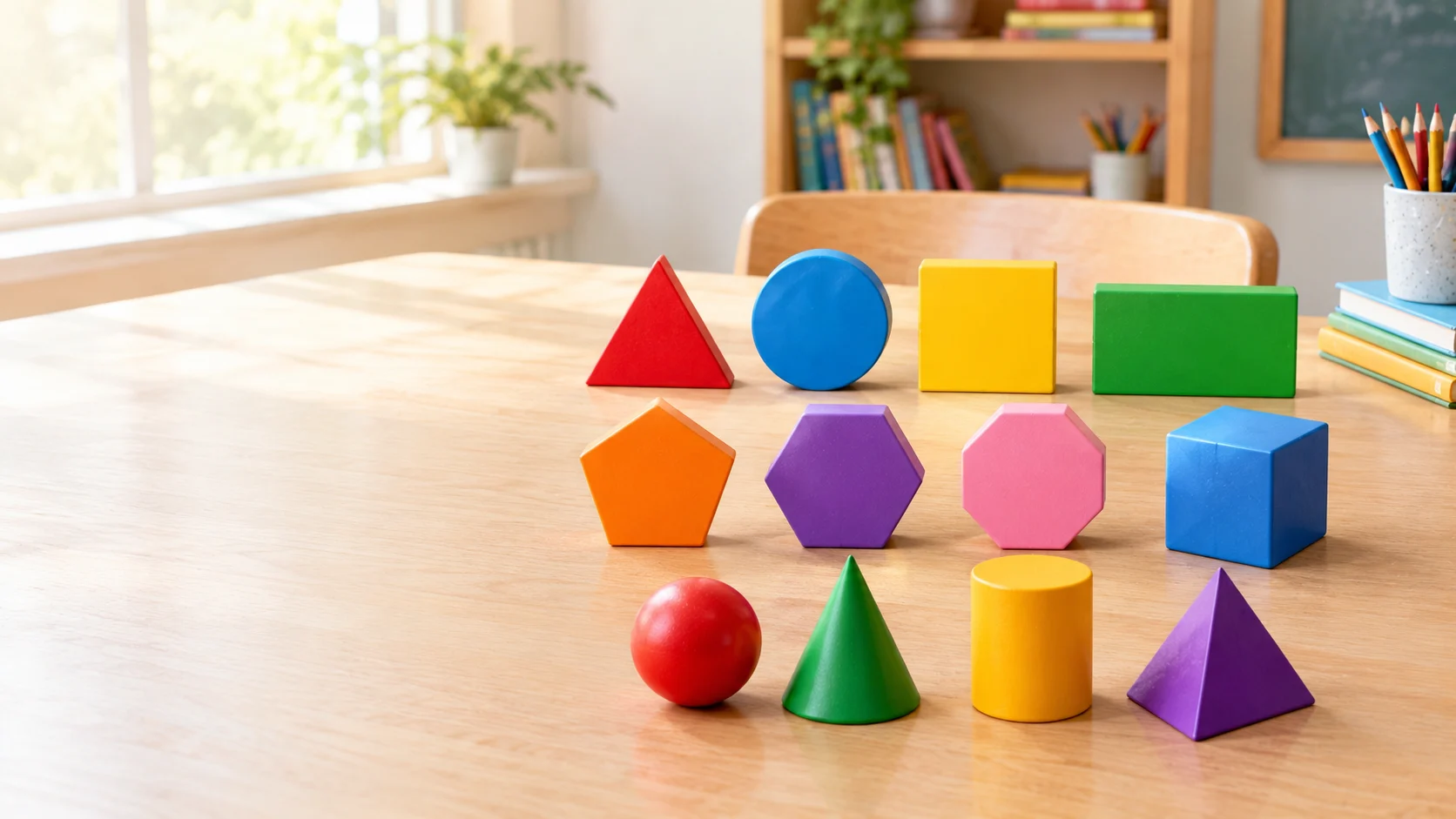
The names of common shapes include circle, triangle, square, rectangle, oval, pentagon, hexagon, octagon, cube, sphere, cone, and cylinder. Shapes are classified as 2D or 3D based on they have two dimensions or three dimensions.
Look around your home, classroom, or neighborhood. You will find shapes everywhere. A clock may look like a circle, a window may look like a rectangle, and a traffic sign may have the shape of an octagon. Even a football, a birthday hat, and a dice can help you explore the exciting world of geometry.
Learning the names of shapes is one of the first steps toward understanding mathematics. It helps children recognize patterns, compare objects, solve simple problems, and describe the world around them. Adults and beginners can also benefit from learning geometric shapes, especially when studying art, architecture, construction, or design.
But how many different shapes are there? What makes a square different from a rectangle? And what is the difference between a flat shape and a solid shape?
This guide answers these questions in simple English. You will discover common two-dimensional (2D) shapes, three-dimensional (3D) shapes, their basic properties, and examples from everyday life. You will also explore less common geometric figures and learn easy ways to remember their names.
You are helping a child with homework or refreshing your own knowledge, this collection makes learning shapes simple, practical, and enjoyable.
What Are Shapes?
A shape is the form or outline of an object. In geometry, shapes are studied by looking at their boundaries, dimensions, angles, surfaces, and other properties.
Some shapes are flat, like a triangle drawn on paper. Others are solid, like a cube or a ball. Shapes can have straight sides, curved boundaries, flat faces, or curved surfaces.
We see shapes in nature, buildings, toys, furniture, signs, artwork, and many other places.
For example:
- A wall clock may have a circular face.
- A book cover often resembles a rectangle.
- A slice of pizza may resemble a triangle.
- A dice has the shape of a cube.
- An orange is approximately spherical.
Understanding shapes helps us describe objects clearly and learn important mathematical ideas.
2D and 3D Shapes: What Is the Difference?
The two main categories beginners learn are two-dimensional shapes and three-dimensional shapes.
<box gap={3}>
<row align=start gap={3}>
<AsyncImage query=”simple colorful geometric 2D shapes circle square triangle rectangle oval flat educational illustration white background” aspectRatio=”4:3″ width=”42%”/>
<box flex=”1″ gap={1}>
**2D shapes (two-dimensional)**
  <text>These shapes have length and width. They are flat and can be drawn on a sheet of paper. Examples include circles, squares, triangles, and rectangles.</text>
</box>
</row>
<divider color=”subtle”/>
<row align=start gap={3}>
<AsyncImage query=”simple colorful 3D geometric solids cube sphere cone cylinder pyramid educational illustration white background” aspectRatio=”4:3″ width=”42%”/>
<box flex=”1″ gap={1}>
**3D shapes (three-dimensional)**
  <text>These shapes have length, width, and height or depth. They occupy space and have volume. Examples include cubes, spheres, cones, and cylinders.</text>
</box>
</row>
</box>
A useful way to remember the difference is to think of a drawing and a real object. A circle drawn on paper is two-dimensional, while a ball is three-dimensional.
A drawing can represent a 3D object, but the drawing itself is usually a flat image.
10 Common Names of Shapes and Their Properties
These ten shapes are excellent starting points for students, parents, teachers, and anyone learning geometry.
1. Circle
<AsyncImage query=”simple blue circle geometric shape isolated white background educational shape illustration” aspectRatio=”16:9″ width=”100%”/>
Definition: A circle is a round, flat shape whose boundary points are all the same distance from its center.
Properties: A circle has no straight sides and no corners or vertices. Its boundary is called the circumference.
Origin of the name: The English word comes through Old French from Latin circulus, meaning a small ring or circle.
Style and appearance: Round, smooth, and symmetrical.
Real-life examples: Coins, round plates, clock faces, wheels, and circular buttons.
Popularity and usefulness: The circle is one of the first shapes children learn because it is easy to recognize in everyday objects.
Why it matters today: Circles appear in engineering, design, sports, road signs, and mathematical diagrams. They are also useful for learning about radius, diameter, and circumference.
Similar shapes: Oval, ellipse, semicircle, and ring.
Easy memory tip: A circle is round and has no corners.
2. Triangle
<AsyncImage query=”simple green equilateral triangle geometric shape isolated white background educational illustration” aspectRatio=”16:9″ width=”100%”/>
Definition: A triangle is a closed, flat shape with three straight sides.
Properties: Every triangle has three sides, three vertices, and three interior angles. Its interior angles add up to 180 degrees in ordinary Euclidean geometry.
Origin of the name: Triangle comes from Latin roots associated with three angles.
Style and appearance: Pointed, angular, and available in many proportions.
Real-life examples: Some road signs, triangular flags, roof shapes, and pizza slices.
Popularity and usefulness: Triangles are basic shapes in early mathematics and are widely used in construction and design.
Types of triangles: Equilateral, isosceles, scalene, acute, right, and obtuse triangles. These names describe different side lengths or angle measurements.
Why it matters today: Triangles can form strong structural frameworks and help students learn angles, measurement, and geometric reasoning.
Similar shapes: Other polygons, including squares and pentagons.
Easy memory tip: The word tri means three, so remember three sides.
3. Square
<AsyncImage query=”simple orange square geometric shape isolated white background educational illustration” aspectRatio=”16:9″ width=”100%”/>
Definition: A square is a quadrilateral with four equal sides and four right angles.
Properties: It has four sides, four vertices, four 90-degree angles, and equal diagonals that bisect each other at right angles.
Origin of the name: The English word square developed through French from Latin quadratus, meaning squared or made square, though the word history is more complex.
Style and appearance: Balanced, regular, and symmetrical.
Real-life examples: Some floor tiles, chessboard squares, sticky notes, and square picture frames.
Popularity and usefulness: The square is a fundamental shape in classrooms, puzzles, design, and architecture.
Why it matters today: Squares help learners understand area, perimeter, symmetry, and measurement. They are also a special type of rectangle because they have four right angles.
Similar shapes: Rectangle, rhombus, and parallelogram.
Easy memory tip: A square has four equal sides and four square corners.
4. Rectangle
<AsyncImage query=”simple purple rectangle geometric shape isolated white background educational illustration” aspectRatio=”16:9″ width=”100%”/>
Definition: A rectangle is a quadrilateral with four right angles.
Properties: Opposite sides are equal and parallel. It has four vertices, four right angles, and two equal diagonals.
Origin of the name: Rectangle comes from Latin roots meaning “right-angled.”
Style and appearance: Long or short, with straight sides and a balanced outline.
Real-life examples: Books, doors, phone screens, computer monitors, and many windows.
Popularity and usefulness: Rectangles are common in homes, schools, packaging, digital screens, and printed materials.
Why it matters today: This shape is useful for calculating area and perimeter. Its simple outline also helps designers arrange text, images, and objects.
Similar shapes: Square, parallelogram, and oblong.
Easy memory tip: A rectangle has four right angles, but its sides do not all need to be equal.
5. Oval
<AsyncImage query=”simple pink oval ellipse geometric shape isolated white background educational illustration” aspectRatio=”16:9″ width=”100%”/>
Definition: An oval is a rounded, elongated shape that resembles an egg or an ellipse.
Properties: In everyday language, an oval has a smooth curved boundary without corners. In mathematics, an ellipse is a precise curve with a defined geometric structure.
Origin of the name: Oval comes from Latin ovum, meaning egg.
Style and appearance: Smooth, elongated, and rounded.
Real-life examples: Eggs, oval mirrors, some tabletops, and the outline of a running track.
Popularity and usefulness: Ovals are common in decorative design, illustration, and everyday descriptions.
Why it matters today: Learning about ovals helps children compare round shapes and notice how a circle differs from an elongated curve.
Similar shapes: Circle, ellipse, and oblong.
Easy memory tip: An oval looks like a stretched circle or an egg.
6. Pentagon
<AsyncImage query=”simple yellow regular pentagon geometric shape five equal sides isolated white background educational illustration” aspectRatio=”16:9″ width=”100%”/>
Definition: A pentagon is a polygon with five sides.
Properties: A regular pentagon has five equal sides and five equal interior angles. Each interior angle measures 108 degrees.
Origin of the name: Pentagon comes from Greek roots meaning “five angles.”
Style and appearance: Five-sided, angular, and symmetrical when regular.
Real-life examples: The outline of some decorative tiles, five-sided badges, and the shape associated with the U.S. Pentagon building when viewed from above.
Popularity and usefulness: Pentagons appear in geometry lessons, tiling designs, logos, and architectural forms.
Why it matters today: This shape introduces learners to polygons beyond the familiar triangle and rectangle.
Similar shapes: Hexagon, heptagon, and decagon.
Easy memory tip: Penta means five, so a pentagon has five sides.
7. Hexagon
<AsyncImage query=”simple turquoise regular hexagon geometric shape six equal sides isolated white background educational illustration” aspectRatio=”16:9″ width=”100%”/>
Definition: A hexagon is a polygon with six sides.
Properties: A regular hexagon has six equal sides and six equal interior angles. Each interior angle measures 120 degrees.
Origin of the name: Hexagon comes from Greek roots meaning “six angles.”
Style and appearance: Six-sided, structured, and often symmetrical.
Real-life examples: Honeycomb cells, some nuts and bolts, hexagonal tiles, and certain board-game pieces.
Popularity and usefulness: Hexagons are especially familiar in nature-inspired design and engineering.
Why it matters today: Honeycomb patterns show how hexagons can fit together without gaps. This makes them useful for studying tessellations, patterns, and efficient arrangements.
Similar shapes: Pentagon, heptagon, and octagon.
Easy memory tip: A hexagon has six sides. Think of the repeating cells in a honeycomb.
8. Octagon
<AsyncImage query=”simple red regular octagon geometric shape eight equal sides isolated white background educational illustration” aspectRatio=”16:9″ width=”100%”/>
Definition: An octagon is a polygon with eight sides.
Properties: A regular octagon has eight equal sides and eight equal interior angles. Each interior angle measures 135 degrees.
Origin of the name: Octagon comes from Greek roots meaning “eight angles.”
Style and appearance: Eight-sided and angular, with a balanced appearance when regular.
Real-life examples: Stop signs in countries that use octagonal stop signs, decorative floor tiles, and some architectural designs.
Popularity and usefulness: The octagon is easy to recognize because of its strong association with road safety signs.
Why it matters today: Octagons help learners count sides, compare polygons, and recognize how shape can communicate information in public spaces.
Similar shapes: Hexagon, heptagon, and decagon.
Easy memory tip: The prefix octa means eight, so an octagon has eight sides.
9. Rhombus
<AsyncImage query=”simple blue diamond shaped rhombus geometric shape isolated white background educational illustration” aspectRatio=”16:9″ width=”100%”/>
Definition: A rhombus is a quadrilateral with four equal sides.
Properties: Opposite sides are parallel, opposite angles are equal, and the diagonals bisect each other at right angles. Its angles do not all need to be 90 degrees.
Origin of the name: Rhombus comes from Greek rhombos, a word historically associated with a spinning object or a rhombus-like form.
Style and appearance: Diamond-like, angular, and often tilted.
Real-life examples: Diamond-shaped road signs in some countries, decorative patterns, and certain playing-card symbols.
Popularity and usefulness: Rhombuses are common in geometry diagrams, textile patterns, and decorative designs.
Why it matters today: This shape helps explain the difference between equal sides and equal angles.
Similar shapes: Square, parallelogram, and kite.
Easy memory tip: A rhombus has four equal sides, but its corners do not have to be right angles.
10. Trapezoid
<AsyncImage query=”simple green trapezoid geometric shape one pair of parallel sides isolated white background educational illustration” aspectRatio=”16:9″ width=”100%”/>
Definition: In common American mathematical usage, a trapezoid is a quadrilateral with at least one pair of parallel sides. Some school systems use the definition “exactly one pair,” so check your textbook’s convention.
Properties: It has four sides and four vertices. Its angles and side lengths can vary.
Origin of the name: Trapezoid comes through Latin from Greek terminology associated with a small table.
Style and appearance: Four-sided, broad or narrow, and often wider at one end.
Real-life examples: Some lampshades, table supports, architectural shapes, and craft designs.
Popularity and usefulness: Trapezoids are common in school geometry and in designs that combine sloping and horizontal edges.
Why it matters today: This shape helps students identify parallel lines and calculate the area of quadrilaterals.
Similar shapes: Parallelogram, rectangle, and isosceles trapezoid.
Easy memory tip: Look for a four-sided shape with a pair of parallel sides under the definition your class uses.
Names of 3D Shapes and Their Real-Life Examples
Three-dimensional shapes are solid objects with length, width, and height. Unlike flat shapes, they occupy space and have volume.
<box gap={3}>
<row align=start gap={3}>
<AsyncImage query=”simple colorful 3D cube geometric solid isolated white background educational illustration” aspectRatio=”4:3″ width=”36%”/>
<box flex=”1″ gap={1}>
**Cube**
  A cube has six square faces, twelve edges, and eight vertices. Examples include a standard dice and many toy building blocks.
</box>
</row>
<divider color=”subtle”/>
<row align=start gap={3}>
<AsyncImage query=”simple colorful 3D sphere ball geometric solid isolated white background educational illustration” aspectRatio=”4:3″ width=”36%”/>
<box flex=”1″ gap={1}>
**Sphere**
  A sphere is a perfectly round three-dimensional shape whose surface points are equally distant from its center. Examples include an ideal geometric ball and a model globe.
</box>
</row>
<divider color=”subtle”/>
<row align=start gap={3}>
<AsyncImage query=”simple colorful 3D cylinder geometric solid isolated white background educational illustration” aspectRatio=”4:3″ width=”36%”/>
<box flex=”1″ gap={1}>
**Cylinder**
  A cylinder has two parallel, equal circular bases and a curved surface in the usual right-circular form. Examples include cans, pipes, and many drinking glasses.
</box>
</row>
<divider color=”subtle”/>
<row align=start gap={3}>
<AsyncImage query=”simple colorful 3D cone geometric solid isolated white background educational illustration” aspectRatio=”4:3″ width=”36%”/>
<box flex=”1″ gap={1}>
**Cone**
  A cone has a base and a curved surface that narrows toward a single point called the apex. Examples include party hats and many traffic cones.
</box>
</row>
<divider color=”subtle”/>
<row align=start gap={3}>
<AsyncImage query=”simple colorful 3D rectangular prism cuboid geometric solid isolated white background educational illustration” aspectRatio=”4:3″ width=”36%”/>
<box flex=”1″ gap={1}>
**Cuboid (Rectangular Prism)**
  A cuboid has six rectangular faces in its standard form. Examples include shoe boxes, bricks, and many packages.
</box>
</row>
<divider color=”subtle”/>
<row align=start gap={3}>
<AsyncImage query=”simple colorful 3D square pyramid geometric solid isolated white background educational illustration” aspectRatio=”4:3″ width=”36%”/>
<box flex=”1″ gap={1}>
**Pyramid**
  A square pyramid has a square base and four triangular side faces meeting at an apex. Pyramids with other polygonal bases also exist.
</box>
</row>
<divider color=”subtle”/>
<row align=start gap={3}>
<AsyncImage query=”simple colorful triangular prism geometric solid isolated white background educational illustration” aspectRatio=”4:3″ width=”36%”/>
<box flex=”1″ gap={1}>
**Triangular Prism**
  This solid has two triangular bases connected by three side faces. A triangular prism can resemble certain tent structures or triangular chocolate-bar forms.
</box>
</row>
</box>
These solids help learners connect geometry with objects they can touch and observe. A useful activity is to collect safe household objects and identify the shapes they resemble.
Remember that real objects may combine several shapes. For example, a pencil can have a long prism-like body and a pointed tip.
More Names of Shapes to Learn
Beyond the ten common flat shapes and the basic 3D solids, geometry includes many other forms.
| Shape name | Basic description | Example or association |
|---|---|---|
| Semicircle | Half of a circle | Half-round window |
| Quarter circle | One-fourth of a circular disk | Pie-chart section |
| Ellipse | An oval-shaped mathematical curve | Planetary orbit model |
| Parallelogram | A quadrilateral with two pairs of parallel sides | Slanted tile |
| Kite | A quadrilateral with two pairs of adjacent equal sides | Traditional kite outline |
| Heptagon | A polygon with seven sides | Seven-sided geometric design |
| Nonagon | A polygon with nine sides | Nine-sided polygon diagram |
| Decagon | A polygon with ten sides | Ten-sided tile design |
| Dodecagon | A polygon with twelve sides | Twelve-sided decorative pattern |
| Star polygon | A star-shaped polygonal figure | Star motif in artwork |
| Crescent | A curved shape resembling a thin moon | Crescent Moon symbol |
| Heart | A familiar heart-shaped outline | Greeting cards |
| Torus | A ring-shaped 3D surface | Doughnut-like form |
| Hemisphere | Half of a sphere | Dome-like object |
| Tetrahedron | A solid with four triangular faces | Four-faced geometric model |
Some entries, such as the crescent and heart, are common everyday shapes rather than standard polygons. A torus and hemisphere are three-dimensional forms, while a star outline may be represented in different geometric ways.
How to Identify Shapes by Their Sides and Corners
One of the easiest ways to recognize a shape is to count its sides and corners. In geometry, corners of polygons are called vertices.
| Shape | Number of sides | Number of vertices |
|---|---|---|
| Triangle | 3 | 3 |
| Square | 4 | 4 |
| Rectangle | 4 | 4 |
| Pentagon | 5 | 5 |
| Hexagon | 6 | 6 |
| Heptagon | 7 | 7 |
| Octagon | 8 | 8 |
| Nonagon | 9 | 9 |
| Decagon | 10 | 10 |
These counts apply to the listed polygons. A circle has no straight sides or vertices, so it does not fit the polygon-counting pattern.
Also remember that the number of sides alone does not always identify a polygon uniquely. For example, a square and a rectangle both have four sides, but a square has four equal sides while a rectangle only requires opposite sides to be equal.
How to Choose the Right Shape for a Drawing or Design
Shapes can change how a design looks and works. Choosing the right one depends on the purpose.
For simple icons: Circles and rounded shapes can create a friendly appearance, while squares and rectangles often provide a stable layout.
For signs: Distinctive outlines help people recognize information quickly. An octagonal stop sign is a familiar example.
For patterns: Triangles, squares, and hexagons can form repeating arrangements. Some regular polygons tile a flat surface without gaps.
For buildings: Architects use many geometric forms, including rectangles, triangles, cylinders, and complex combinations of solids.
For school projects: Choose simple shapes that are easy to draw, label, cut out, or compare.
For digital graphics: Circles, rectangles, and polygons are useful building blocks for icons, charts, buttons, diagrams, and illustrations.
There is no single best shape for every task. The most useful shape is the one that fits the design, communicates the intended idea, and meets any practical requirements.
Fun Ways to Teach Names of Shapes to Kids
Learning shapes can be enjoyable when children connect words with real objects.
1. Go on a shape hunt. Ask children to find a circle on a clock, a rectangle in a book, or a sphere-shaped object such as a ball.
2. Use building blocks. Let children sort blocks by shape and compare their sides, corners, and faces.
3. Draw shapes in different colors. Ask children to draw a red triangle, a blue circle, and a green square. This combines shape recognition with color learning.
4. Make shapes from craft materials. Use safe sticks, paper strips, clay, or pipe cleaners to create simple geometric figures with adult supervision.
5. Play a guessing game. Describe a shape without naming it. For example, “I have six straight sides.” The answer is a hexagon.
6. Compare flat and solid objects. Show a drawing of a circle beside a ball. Explain that the drawing is flat while the ball occupies three-dimensional space.
7. Practice through everyday conversation. Ask questions such as “What shape is this plate?” or “How many corners does this window have?”
These activities make abstract mathematical ideas easier to remember. For young learners, begin with circles, triangles, squares, and rectangles before introducing more complex polygons and solids.
FAQs
What are the five basic shapes?
Five common beginner shapes are circle, triangle, square, rectangle, and oval. These shapes are easy to identify in everyday objects and provide a useful foundation for early geometry lessons.
What are the names of 2D shapes?
Common 2D shapes include circles, triangles, squares, rectangles, ovals, pentagons, hexagons, octagons, rhombuses, and trapezoids. They are flat shapes with length and width.
What are the names of 3D shapes?
Common 3D shapes include cubes, spheres, cones, cylinders, cuboids, pyramids, and triangular prisms. These shapes have length, width, and height and occupy space.
Which shape has three sides?
A triangle has three straight sides and three vertices. Triangles can be classified by their sides, such as equilateral, isosceles, and scalene, or by their angles.
What is the difference between a square and a rectangle?
Both have four right angles and four sides. A square has four equal sides, while a rectangle has equal opposite sides; therefore, every square is a rectangle, but not every rectangle is a square.
Which shape has no corners?
A circle has no corners or vertices and has a continuously curved boundary. An oval also has a smooth boundary without corners in its usual geometric or everyday meaning.
What shape has six sides?
A hexagon has six straight sides and six vertices. A regular hexagon has equal sides and equal angles and is often seen in honeycomb patterns and geometric tiling.
Why is learning shapes important for children?
Learning shapes helps children develop visual recognition, spatial awareness, early mathematical reasoning, and vocabulary. It also helps them recognize patterns and describe objects in their environment.
Conclusion
Learning the names of shapes is a simple way to build a strong foundation in geometry. From familiar circles and triangles to more advanced polygons and solid forms, each shape has properties that make it useful and interesting.
The easiest way to remember shapes is to connect their names with real objects. Count the corners of a triangle, compare the sides of a square and rectangle, or identify a sphere in a ball. These small activities make mathematics easier to understand.
You are a student, parent, teacher, or beginner, keep exploring shapes through drawing, building, and observation. You can start with the basic figures and gradually learn more complex geometric forms.
Choose your favorite shape, share this guide with someone who is learning geometry, and leave a comment telling us which shape you find most interesting.
Discover More Related Articles:
- 345 Sesame Street Characters Names | A Colorful Journey Through Childhood Favorites In 2026
- 345 Sanderson Sisters Names | Meet the Three Bewitching Witches of Hocus Pocus In 2026
- 378 Hocus Pocus Witches Names | For Magical Souls In 2026