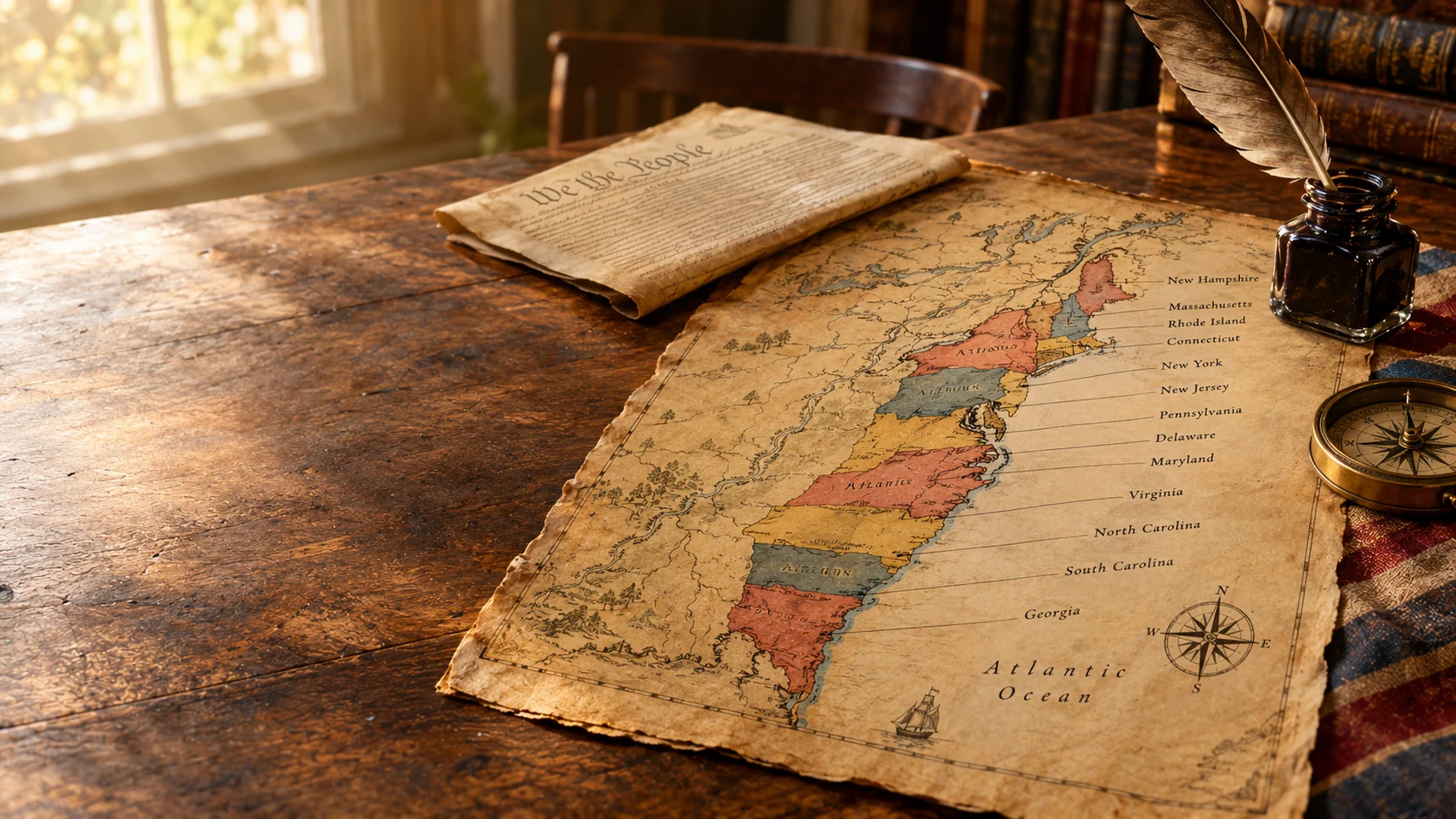
The 13 original American colonies were Virginia, Massachusetts, New Hampshire, Maryland, Connecticut, Rhode Island, Delaware, North Carolina, South Carolina, New Jersey, New York, Pennsylvania, and Georgia. They declared independence from Great Britain in 1776 and became the foundation of the United States.
Imagine looking at the eastern coast of North America before the United States existed. Instead of one independent country, you would find thirteen British colonies, each with its own communities, economy, traditions, and local government. These settlements helped shape the nation that would later become the United States.
Learning the 13 colonies names is an important first step in understanding American history. But the story becomes much more interesting when you discover why each colony was established, how its name originated, and what made its people and economy different.
Some colonies grew around tobacco farming and trade. Others became known for fishing, shipbuilding, farming, or religious communities. Their populations included European settlers, Indigenous peoples who had lived on the land for generations, and enslaved Africans forced into colonial labor systems. These experiences were not equal, and the colonies’ growth came with serious human costs.
In this guide, you will find all thirteen colonies, their founding dates, the regions they belonged to, and the stories behind their names. You will also learn how colonial disagreements with Britain led to the American Revolution and the birth of a new nation.
What Were the 13 Original American Colonies?
The thirteen colonies were British-controlled settlements along the Atlantic coast of North America. During the seventeenth and early eighteenth centuries, they developed into distinct colonies with different economies, religious traditions, and systems of local government.
In 1776, representatives of the colonies declared independence from Great Britain. Over time, these former colonies became the first thirteen states of the United States. The National Museum of American History and the U.S. National Archives document their connection to the country’s founding.
The thirteen colonies were:
- Virginia
- Massachusetts
- New Hampshire
- Maryland
- Connecticut
- Rhode Island
- Delaware
- North Carolina
- South Carolina
- New Jersey
- New York
- Pennsylvania
- Georgia
Important: This is a convenient list, not a chronological order of founding. Colonial founding dates can vary slightly depending on a source counts an initial settlement, a charter, or the formal establishment of a separate colony.
The 13 Colonies Names and Their Founding Dates
| Colony | Commonly cited founding year | Region |
|---|---|---|
| Virginia | 1607 | Southern |
| Massachusetts | 1620 | New England |
| New Hampshire | 1623 | New England |
| Maryland | 1634 | Southern |
| Connecticut | 1630s | New England |
| Rhode Island | 1636 | New England |
| Delaware | 1638 | Middle |
| North Carolina | 1653 | Southern |
| South Carolina | 1663 | Southern |
| New Jersey | 1664 | Middle |
| New York | 1664 | Middle |
| Pennsylvania | 1681–1682 | Middle |
| Georgia | 1732–1733 | Southern |
Dates are commonly used historical reference points. Some colonies developed over several years, so settlement dates, charter dates, and administrative dates may differ.
1. Virginia | The First Permanent English Colony
Virginia holds a central place in early English colonial history. In 1607, English settlers established Jamestown, the first permanent English settlement in what became the United States. The colony was named in honor of Queen Elizabeth I, traditionally known as the “Virgin Queen.”
Founding: 1607
Region: Southern Colonies
Name origin: Named in honor of Queen Elizabeth I.
Economy: Tobacco farming became a major source of wealth, alongside trade and other agricultural activity.
Jamestown struggled with disease, hunger, conflict, and difficult living conditions in its early years. Tobacco later helped the colony grow, but plantation agriculture increasingly relied on enslaved labor. Virginia’s colonial history also involved Indigenous nations whose lands and political independence were challenged by English expansion.
Virginia became important during the American Revolution and was home to influential figures such as George Washington and Thomas Jefferson. Its history illustrates both the economic growth of colonial America and the deep inequalities that shaped it.
Why it matters: Virginia was the site of the earliest permanent English settlement among the thirteen colonies and later played a major role in American independence.
2. Massachusetts | A Colony Shaped by Religious Communities
Massachusetts developed through several English settlements, including Plymouth Colony in 1620 and Massachusetts Bay Colony in 1630. These settlements had different beginnings but became part of the larger colonial history of Massachusetts.
Founding: Plymouth in 1620; Massachusetts Bay in 1630
Region: New England Colonies
Name origin: The name derives from the Massachusett people, an Indigenous nation of the region.
Economy: Fishing, shipbuilding, maritime trade, and commerce became important activities.
The Pilgrims who founded Plymouth sought to establish a community where they could practice their religious beliefs. Puritan settlers in Massachusetts Bay also aimed to build a society shaped by their religious convictions. However, their communities did not offer equal religious freedom to everyone, and Indigenous peoples faced displacement and conflict.
Boston later became a major center of colonial resistance to British policies. Events such as the Boston Massacre and Boston Tea Party helped build opposition to British rule.
Why it matters: Massachusetts became a key center of revolutionary activity and political debate before American independence.
3. New Hampshire | A Colony of Northern Forests and Trade
New Hampshire began with English settlements in the 1620s. The colony’s development was closely linked to fishing, timber, farming, and trade along the northern Atlantic coast.
Founding: Commonly dated to 1623
Region: New England Colonies
Name origin: Named after Hampshire, an English county.
Economy: Fishing, timber, farming, and coastal trade.
New Hampshire’s forests provided valuable timber, while its rivers and coastline supported trade and settlement. Like neighboring colonies, it developed local communities under British authority, although its population and economy differed from those of the larger Massachusetts settlements.
The region was also home to Indigenous peoples long before English colonization. European settlement brought major changes to their lands, livelihoods, and political relationships.
During the American Revolution, New Hampshire supported the movement toward independence. It later became the first state to ratify the U.S. Constitution in 1788.
Why it matters: New Hampshire shows how natural resources and coastal trade helped shape colonial New England.
4. Maryland | Founded as a Haven for English Catholics
Maryland was established in 1634 under the leadership of Cecil Calvert, the second Lord Baltimore. The colony was named in honor of Queen Henrietta Maria, the wife of King Charles I of England.
Founding: 1634
Region: Southern Colonies
Name origin: Named in honor of Queen Henrietta Maria.
Economy: Tobacco cultivation, farming, and trade.
Lord Baltimore hoped Maryland would provide an opportunity for English Catholics to practice their faith with greater security. Yet religious tolerance remained limited and changed over time. Maryland’s history included disputes over religion, political power, land, and labor.
Tobacco became a major cash crop, and plantation agriculture increasingly depended on enslaved Africans. The colony’s development also affected Indigenous communities that had lived in the region for generations.
Maryland joined the other colonies in declaring independence in 1776. Its location between the northern and southern colonies made it an important part of the broader Atlantic colonial world.
Why it matters: Maryland’s founding reveals the role of religion, royal charters, agriculture, and slavery in colonial development.
5. Connecticut | A Colony Built Around Towns and Local Government
Connecticut developed during the 1630s as English settlers established communities in the Connecticut River Valley. Thomas Hooker and other settlers helped shape its early political and religious life.
Founding: 1630s; the Fundamental Orders were adopted in 1639.
Region: New England Colonies
Name origin: Derived from an Indigenous place-name associated with the Connecticut River, commonly traced to an Algonquian-language form.
Economy: Farming, trade, and small-scale manufacturing.
Connecticut’s early settlements grew around farming communities and local institutions. The Fundamental Orders of Connecticut, adopted in 1639, are often discussed as an important early example of written colonial government, although their significance should be understood in the context of the period.
Indigenous communities had lived along the river long before English settlement. Colonial expansion brought land disputes and conflict, changing the region’s political and social landscape.
Connecticut later supported the Patriot cause during the Revolution and became one of the original states.
Why it matters: Connecticut’s history helps explain the development of local government and community-based political institutions in colonial New England.
6. Rhode Island | A Colony Associated With Religious Dissent
Rhode Island emerged in the 1630s after Roger Williams left Massachusetts Bay Colony. Williams opposed the colony’s religious policies and argued for a stronger separation between civil government and religious authority.
Founding: 1636 is commonly cited for Providence.
Region: New England Colonies
Name origin: The precise origin of the name is debated; it was historically associated with Rhode Island and nearby islands.
Economy: Maritime trade, fishing, farming, and shipbuilding.
Williams founded Providence in 1636. Other settlements developed in the region, including communities associated with Anne Hutchinson and other religious dissenters. These settlements eventually formed the colony of Rhode Island and Providence Plantations.
Rhode Island became known for a comparatively strong tradition of religious liberty, although its history also included slavery and participation in the Atlantic slave trade.
During the Revolution, the colony opposed British control. It was the last of the original thirteen states to ratify the U.S. Constitution, doing so in 1790.
Why it matters: Rhode Island’s history highlights religious dissent, debates over individual liberty, and the complicated realities of colonial society.
7. Delaware | A Small Colony With a Distinct Identity
Delaware’s colonial history began under Swedish and Dutch influence before English control expanded into the region. In 1638, Swedish settlers established New Sweden along the Delaware River.
Founding: 1638 is commonly cited for the early European settlement of New Sweden.
Region: Middle Colonies
Name origin: Named after Thomas West, Lord De La Warr, an early English colonial leader associated with the region.
Economy: Farming, trade, and river-based commerce.
The area passed through several periods of European rule before becoming part of England’s colonial possessions in 1664. Delaware later shared a governor with Pennsylvania for many years while maintaining its own assembly.
Its location along the Delaware River helped connect inland farms and settlements to regional trade. As in other colonies, Indigenous peoples faced the effects of European settlement, while slavery became part of Delaware’s history.
Delaware supported independence in 1776 and became the first state to ratify the Constitution in 1787.
Why it matters: Delaware’s history demonstrates how European colonial rivalries and regional trade shaped the Mid-Atlantic.
8. North Carolina | A Colony of Farms and Coastal Settlements
North Carolina developed from English settlements in the Carolina region during the seventeenth century. It became a separate colony from South Carolina in the early eighteenth century.
Founding: English settlement expanded during the 1650s; separation from South Carolina was completed in 1712.
Region: Southern Colonies
Name origin: The name Carolina honored King Charles I of England; North Carolina later distinguished the northern part of the former Carolina territory.
Economy: Farming, timber, livestock, and trade.
North Carolina’s population included small farmers, merchants, enslaved people, and communities with varied backgrounds. Its geography ranged from coastal plains to inland areas, shaping settlement patterns and economic activity.
The colony’s political and economic life was not identical to that of South Carolina. Many communities relied on smaller farms, although slavery and plantation agriculture were also important in its development.
North Carolina eventually joined the movement for independence from Great Britain. It became the twelfth state to ratify the Constitution, in 1789.
Why it matters: North Carolina illustrates the diversity of colonial Southern economies and the gradual separation of the two Carolina colonies.
9. South Carolina | A Major Plantation and Port Colony
South Carolina developed from the English Carolina colony and became a separate colony from North Carolina in the early eighteenth century. Charleston, founded in 1670, became an important port and trading center.
Founding: 1663 charter; settlement at Charleston began in 1670.
Region: Southern Colonies
Name origin: Named in honor of King Charles I; “South” distinguished it from North Carolina.
Economy: Rice, indigo, plantation agriculture, and Atlantic trade.
South Carolina’s fertile lowlands supported the cultivation of rice and indigo. Wealthy plantation owners built large estates, and the economy relied heavily on the forced labor of enslaved Africans. Enslaved people contributed vital agricultural knowledge and labor under brutal conditions.
Charleston connected the colony to Atlantic markets and international trade. Its prosperity was deeply linked to slavery and the slave trade, making this a central part of the region’s history rather than a side note.
South Carolina participated in the independence movement and later became a major theater of the American Revolutionary War.
Why it matters: South Carolina reveals the close connection between colonial wealth, international commerce, plantation agriculture, and slavery.
10. New Jersey | Between New York and Pennsylvania
New Jersey became an English colony in 1664 after the English took control of New Netherland from the Dutch. The territory was granted to Lord John Berkeley and Sir George Carteret.
Founding: 1664
Region: Middle Colonies
Name origin: Named after the Channel Island of Jersey, associated with Sir George Carteret.
Economy: Farming, trade, and small-scale industry.
New Jersey’s position between New York and Pennsylvania encouraged settlement, trade, and cultural exchange. Its communities included English settlers and people from several European backgrounds, alongside Indigenous populations whose lands were increasingly taken over by colonial expansion.
The colony was divided for a time into East Jersey and West Jersey before coming under a unified royal government in 1702.
During the Revolution, New Jersey’s location made it strategically important. Major military movements crossed the colony, and the battles of Trenton and Princeton helped shape the early course of the war.
Why it matters: New Jersey’s geography made it a vital link between neighboring colonies and a significant setting for the Revolutionary War.
11. New York | From New Amsterdam to an English Colony
New York was originally part of New Netherland, a Dutch colonial territory. In 1624, Dutch settlers established a permanent settlement in the region, and New Amsterdam developed on Manhattan Island.
Founding: Dutch settlement began in the 1620s; English control followed in 1664.
Region: Middle Colonies
Name origin: Named for the Duke of York, the brother of King Charles II.
Economy: Trade, shipping, farming, and commerce.
In 1664, the English took control of New Amsterdam and renamed it New York. Dutch influence remained visible in place-names, settlement patterns, and cultural traditions.
New York’s harbor and river connections made it a major center for trade. Its population included people from varied European backgrounds, Indigenous communities, and enslaved Africans. Economic opportunity existed alongside inequality and colonial restrictions.
New York became an important center during the Revolution, although political loyalties were divided. The city remained under British occupation for much of the war.
Why it matters: New York’s history shows how European imperial competition shaped the colonies and how trade helped create a diverse colonial society.
12. Pennsylvania | A Colony Founded by William Penn
Pennsylvania was established under a royal charter granted to William Penn in 1681. Penn intended to create a colony where Quakers and others could find greater religious freedom.
Founding: 1681 charter; settlement and administration developed in the following years.
Region: Middle Colonies
Name origin: Penn named the colony after his family name and the Latin word sylvania, meaning woodland. The name was intended to mean “Penn’s woods.”
Economy: Farming, trade, crafts, and growing urban commerce.
Philadelphia became an important colonial city and a center of printing, trade, and political discussion. Pennsylvania attracted settlers from several European communities, including Quakers, Germans, and Scots-Irish.
Penn promoted peaceful relations with Indigenous peoples, particularly in the early period, but colonial expansion eventually brought serious land disputes and conflict. Slavery also existed in Pennsylvania, despite its Quaker connections and later antislavery activism.
Philadelphia hosted the Continental Congress and became the setting for the adoption of the Declaration of Independence in 1776.
Why it matters: Pennsylvania played a major role in colonial religious life, commerce, and the political events leading to independence.
13. Georgia | The Last of the Thirteen Colonies
Georgia was the last of the original thirteen colonies to be established. Its founding is associated with James Oglethorpe and a charter granted in 1732, with the first English settlers arriving in 1733.
Founding: 1732 charter; settlement began in 1733.
Region: Southern Colonies
Name origin: Named in honor of King George II of Great Britain.
Economy: Farming, trade, and later plantation agriculture.
Oglethorpe and the colony’s trustees initially promoted Georgia as a place where poor British people could make a new start. Georgia also served as a strategic buffer between British South Carolina and Spanish Florida.
Early rules restricted slavery, but those restrictions were later removed. Plantation agriculture expanded, and enslaved Africans were forced to labor in the colony’s developing economy.
Georgia eventually supported independence from Britain and became the fourth state to ratify the U.S. Constitution, in 1788.
Why it matters: Georgia’s founding reflects British imperial strategy, settlement planning, and the changing role of slavery in the Southern colonies.
Quick Comparison Table: All 13 Colonies Names
| Colony | Region | Common founding date | Key historical feature |
|---|---|---|---|
| Virginia | Southern | 1607 | Jamestown and tobacco |
| Massachusetts | New England | 1620 / 1630 | Plymouth and Massachusetts Bay |
| New Hampshire | New England | 1623 | Timber and coastal trade |
| Maryland | Southern | 1634 | Founded under Lord Baltimore |
| Connecticut | New England | 1630s | Early colonial government |
| Rhode Island | New England | 1636 | Religious dissent |
| Delaware | Middle | 1638 | Swedish and Dutch colonial roots |
| North Carolina | Southern | 1650s | Farms and coastal settlements |
| South Carolina | Southern | 1663 / 1670 | Rice, indigo, and Charleston |
| New Jersey | Middle | 1664 | Between New York and Pennsylvania |
| New York | Middle | 1664 English rule | Former Dutch New Amsterdam |
| Pennsylvania | Middle | 1681 | William Penn and Philadelphia |
| Georgia | Southern | 1732 / 1733 | Last original colony |
The dates above refer to commonly cited milestones, not one uniform definition of “founding.”
The 13 Colonies by Region
Historians and teachers commonly group the thirteen colonies into three regions: New England, the Middle Colonies, and the Southern Colonies. These groups help explain differences in geography, climate, settlement, and economic activity. The categories are useful, but they do not capture every difference within each region.
New England Colonies
The four New England colonies were:
- New Hampshire
- Massachusetts
- Rhode Island
- Connecticut
New England had rocky soil in many areas, extensive forests, and a long Atlantic coastline. Fishing, shipbuilding, timber, trade, and small farms played important roles in its economy.
Religious communities influenced settlement in Massachusetts and Rhode Island, although the colonies differed in their approaches to religious practice and government.
Middle Colonies
The four Middle Colonies were:
- New York
- New Jersey
- Pennsylvania
- Delaware
The Middle Colonies had fertile farmland, navigable rivers, and busy ports. Farming, grain production, trade, and crafts supported their economies.
The region also attracted settlers from varied European backgrounds. Cities such as New York and Philadelphia became important commercial and political centers.
Southern Colonies
The five Southern Colonies were:
- Maryland
- Virginia
- North Carolina
- South Carolina
- Georgia
The Southern Colonies generally had longer growing seasons and extensive agricultural land. Tobacco, rice, and indigo were important cash crops in different parts of the region.
Plantation agriculture and slavery shaped much of the Southern colonial economy, although smaller farms, trade, and other activities also mattered. Enslaved Africans were forced to perform labor that generated wealth for plantation owners, while Indigenous communities faced dispossession and colonial expansion.
Why Were the 13 Colonies Established?
There was no single reason for founding all thirteen colonies. Different settlements emerged because of commercial goals, religious disagreements, royal ambitions, and strategic interests.
Economic opportunity: Some colonists and investors hoped to profit from farming, trade, natural resources, and access to Atlantic markets. Virginia’s tobacco economy is one prominent example.
Religious beliefs: Some settlers wanted to build communities shaped by their religious convictions. Massachusetts, Maryland, Pennsylvania, and Rhode Island each had distinct religious histories.
Political ambitions: English monarchs and colonial proprietors used charters and land grants to expand English influence in North America.
Strategic interests: Georgia was partly intended to strengthen Britain’s position near Spanish Florida, while ports and rivers throughout the colonies supported trade and imperial competition.
Land and settlement: European settlement expanded across Indigenous territories, often through unequal agreements, coercion, warfare, and dispossession. Any complete account of colonial development must include these experiences.
The colonies did not begin as a unified nation. They developed separately, with different laws, institutions, economies, and relationships with Britain.
How Did the 13 Colonies Become the United States?
The road to independence developed over many years. Although the colonies had different local interests, disputes with Britain encouraged greater cooperation.
After the French and Indian War ended in 1763, Britain sought additional revenue and tighter control over its North American empire. Measures such as the Stamp Act of 1765 and the Tea Act of 1773 intensified disagreements over taxation, representation, and imperial authority.
Resistance grew through protests, boycotts, and political meetings. The Boston Tea Party in 1773 became a well-known act of opposition to British tea policy. Britain responded with punitive measures, further increasing tensions.
Fighting began at Lexington and Concord in April 1775. Representatives of the colonies then continued debating whether reconciliation with Britain was possible.
On July 4, 1776, the Second Continental Congress adopted the Declaration of Independence. It announced that the colonies considered themselves independent states rather than possessions of the British Crown. The Declaration expressed political principles while also emerging from the conflicts and contradictions of colonial society.
The Revolutionary War continued until 1783, when the Treaty of Paris formally recognized American independence. The former colonies then faced another challenge: how to cooperate as a nation.
The Constitution was drafted in 1787 and took effect after ratification by the required states. The original colonies became the first thirteen states, although they ratified the Constitution at different times. Delaware was first, in 1787, and Rhode Island was last, in 1790.
Easy Ways to Memorize the 13 Colonies Names
Remembering thirteen names can feel difficult at first. Grouping them by region makes the task easier.
Step 1: Learn the regional groups. Start with four New England colonies, four Middle Colonies, and five Southern Colonies.
Step 2: Memorize one region at a time. Practice New England first, then the Middle Colonies, and finally the Southern Colonies.
Step 3: Use a map. Locate each colony along the Atlantic coast. Visual placement can help you remember neighboring colonies.
Step 4: Write the names from memory. Close your notes and list all thirteen colonies. Check your answers and repeat the exercise.
Step 5: Connect each name to one historical clue. For example, Virginia is associated with Jamestown, Massachusetts with Plymouth, New York with New Amsterdam, Pennsylvania with William Penn, and Georgia with James Oglethorpe.
A Simple Regional Memory Trick
Use these short lists as a study guide:
- New England: New Hampshire, Massachusetts, Rhode Island, Connecticut.
- Middle: New York, New Jersey, Pennsylvania, Delaware.
- Southern: Maryland, Virginia, North Carolina, South Carolina, Georgia.
There are four colonies in New England, four in the Middle Colonies, and five in the Southern Colonies. The total is thirteen.
Common Mistakes About the Original 13 Colonies
A few common misunderstandings can make colonial history confusing.
Mistake 1: Treating the list as a founding timeline. The list of thirteen names does not always appear in chronological order. Founding dates can refer to settlements, charters, or separate colonial governments.
Mistake 2: Confusing colonies with modern states. The colonies became the first thirteen states, but their historical boundaries and political arrangements were not always identical to those of the modern states.
Mistake 3: Assuming every colony had the same economy. Fishing and shipbuilding mattered in New England, while plantation crops such as tobacco, rice, and indigo played major roles in parts of the South.
Mistake 4: Assuming all colonists wanted independence from the beginning. Colonial residents held different political views. Some supported independence, some remained loyal to Britain, and others changed their positions as the conflict developed.
Mistake 5: Ignoring Indigenous and African American history. Colonial growth depended on land taken from Indigenous peoples and, in many regions, on enslaved African labor. These histories are essential to understanding colonial America.
FAQs
Q1. What are the names of the 13 colonies?
The colonies were Virginia, Massachusetts, New Hampshire, Maryland, Connecticut, Rhode Island, Delaware, North Carolina, South Carolina, New Jersey, New York, Pennsylvania, and Georgia.
Q2. Which was the first of the 13 colonies?
Virginia is commonly identified as the first, because Jamestown was founded in 1607 as the first permanent English settlement in what became the United States.
Q3. Which was the last of the 13 colonies?
Georgia was the last original colony to be established. Its charter dates to 1732, and the first English settlers arrived in 1733.
Q4. How many colonies were in New England?
There were four New England colonies: New Hampshire, Massachusetts, Rhode Island, and Connecticut. They shared regional characteristics but had distinct histories and institutions.
Q5. What were the four Middle Colonies?
The Middle Colonies were New York, New Jersey, Pennsylvania, and Delaware. Their farms, rivers, ports, and growing towns supported agriculture and trade.
Q6. What were the five Southern Colonies?
The Southern Colonies were Maryland, Virginia, North Carolina, South Carolina, and Georgia. Agriculture was important throughout the region, and slavery shaped much of its economy.
Q7. Why were the colonies called the 13 original colonies?
They were the thirteen British colonies that declared independence in 1776 and formed the foundation of the United States. They became the nation’s original thirteen states.
Q8. Did all thirteen colonies declare independence in 1776?
All thirteen ultimately supported the Declaration of Independence, although their representatives’ votes and approvals occurred through different proceedings. The Declaration was adopted on July 4, 1776.
Conclusion
Learning the 13 colonies names opens a window into the early history of the United States. Virginia, Massachusetts, New Hampshire, Maryland, Connecticut, Rhode Island, Delaware, North Carolina, South Carolina, New Jersey, New York, Pennsylvania, and Georgia each developed under different conditions and contributed to the nation’s formation.
Their stories include settlement, commerce, religious differences, political debate, and the struggle for independence. They also include the displacement of Indigenous peoples and the exploitation of enslaved Africans, which remain essential parts of understanding colonial America.
For students, the easiest way to remember the thirteen colonies is to divide them into New England, Middle, and Southern groups. Then connect each name with a founding date or historical event.
Choose your favorite study method, share this guide with a classmate or history enthusiast, and leave a comment with the colony or historical fact you found most interesting.
Discover More Related Articles:
- 345 Sesame Street Characters Names | A Colorful Journey Through Childhood Favorites In 2026
- 345 Sanderson Sisters Names | Meet the Three Bewitching Witches of Hocus Pocus In 2026
- 378 Hocus Pocus Witches Names | For Magical Souls In 2026