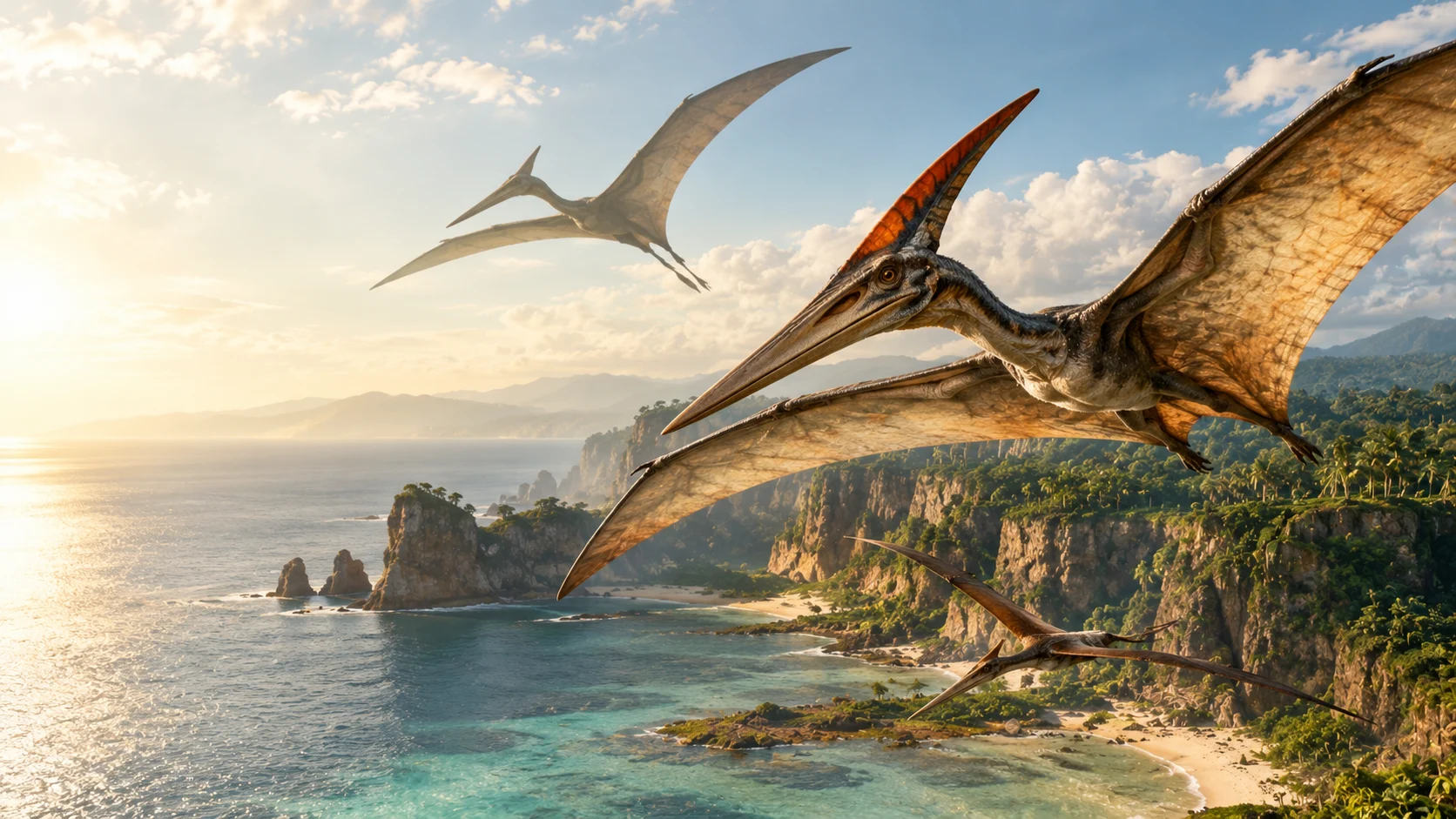
Flying dinosaurs are commonly known as pterosaurs, but they were actually flying reptiles, not true dinosaurs. Famous examples include Pteranodon, Pterodactylus, Quetzalcoatlus, Dimorphodon, and Rhamphorhynchus.
Imagine looking up at the sky millions of years ago and seeing enormous wings moving above ancient forests, coastlines, and open seas. Some of these creatures were small enough to look delicate, while others grew so large that their wingspans rivaled those of small aircraft. Their strange crests, long beaks, and unusual wings make them some of the most fascinating animals in prehistoric history.
If you are searching for flying dinosaur names, you are probably thinking of famous creatures such as Pteranodon and Pterodactylus. These animals often appear in dinosaur books, museum displays, films, and children’s toys. Yet there is one surprising fact: they were not actually dinosaurs.
They belonged to a separate group of flying reptiles called pterosaurs. They lived during the Mesozoic Era, sharing the ancient world with dinosaurs while evolving their own remarkable ways of moving through the air. The Natural History Museum explains that pterosaurs were a distinct group rather than flying members of the dinosaur family.
In this guide, you will discover prehistoric flying reptile names, explore ten famous examples in detail, learn what their names mean, and find out which species were among the largest and most unusual flyers ever known.
What Were Flying Dinosaurs Really Called?
The scientific name for the group commonly mistaken for flying dinosaurs is Pterosauria, or pterosaurs. These extinct reptiles developed wings and powered flight long before modern birds appeared.
Pterosaurs were related to dinosaurs through a broader group of reptiles called archosaurs, but they were not dinosaurs themselves. Birds, by contrast, evolved from theropod dinosaurs. These differences matter when identifying prehistoric animals accurately. Source: Natural History Museum.
Pterosaurs lived from the Late Triassic until the end of the Cretaceous, approximately 66 million years ago. Their bodies varied greatly. Some had short tails and large head crests, while others had long tails, narrow jaws, or unusual feeding adaptations.
Their wings were also different from bird wings. A greatly elongated fourth finger supported a membrane that extended along the body and toward the hind limbs. This design helped pterosaurs achieve powered flight.
Flying Reptiles vs. Flying Dinosaurs
| Feature | Pterosaurs | True dinosaurs |
|---|---|---|
| Examples | Pteranodon, Quetzalcoatlus | Tyrannosaurus, Triceratops |
| Main movement | Many flew using wing membranes | Most lived on land; some later evolved into birds |
| Wing structure | Membrane supported by an elongated finger | Birds have feathered wings |
| Classification | Flying reptiles, not dinosaurs | A distinct reptile group |
| Time period | Late Triassic to Late Cretaceous | Dinosaur lineages began in the Triassic; non-avian dinosaurs vanished 66 million years ago |
Not every prehistoric reptile could fly. Marine reptiles such as plesiosaurs and mosasaurs also lived during the age of dinosaurs, but they swam rather than flew.
1. Pteranodon | The Famous Crest-Headed Flyer
Meaning: Commonly interpreted as “wing without teeth.”
Origin: The scientific name comes from Greek roots referring to wings and teeth.
Appearance: Pteranodon had long, narrow wings, a toothless beak, and a striking crest extending backward from its head.
Personality and style: As a fictional character or mascot, Pteranodon suggests freedom, speed, intelligence, and a bold appearance.
Best for: Dinosaur projects, educational posters, prehistoric-themed games, and anyone looking for a recognizable flying reptile.
Popularity: Pteranodon is one of the best-known pterosaurs in museums and popular media.
Emotional appeal: Its dramatic crest and wide wings make it easy to recognize. It is an excellent starting point for children learning about ancient flying animals.
Similar names: Nyctosaurus, Quetzalcoatlus, Pterodactylus, Tapejara.
Why it still matters: Pteranodon helps explain how some pterosaurs became highly specialized flyers. Despite its familiar appearance, it was a flying reptile, not a dinosaur.
2. Pterodactylus | The Classic Pterodactyl
Meaning: “Wing finger,” referring to the distinctive wing structure.
Origin: The name combines Greek roots associated with a wing and a finger.
Appearance: Pterodactylus was a relatively small pterosaur compared with giant forms such as Quetzalcoatlus. It had a long skull, teeth, and wings adapted for flight.
Personality and style: In stories and toys, it often represents curiosity, agility, and a classic prehistoric look.
Best for: Beginner science projects, museum-inspired drawings, children’s stories, and pterosaur identification guides.
Popularity: The word “pterodactyl” is widely used in everyday speech, although Pterodactylus is the scientific name of a particular genus rather than a label for every pterosaur.
Emotional appeal: Its name is familiar and relatively easy to associate with prehistoric flight.
Similar names: Dimorphodon, Rhamphorhynchus, Pteranodon, Anhanguera.
Why it still matters: Pterodactylus is central to the history of pterosaur research. The Oxford University Museum of Natural History explains that the name refers to its long wing finger.
3. Quetzalcoatlus | The Giant of the Ancient Sky
Meaning: Named after Quetzalcoatl, the feathered serpent deity associated with Mesoamerican traditions.
Origin: The genus name references the feathered serpent; it is not simply a Greek or Latin description of the animal’s body.
Appearance: Quetzalcoatlus had an extremely long neck, a long beak, and enormous wings. Estimates for its wingspan are commonly around 10–11 metres for the largest known forms, although estimates depend on the specimen and reconstruction.
Personality and style: It evokes grandeur, mystery, and power.
Best for: Giant-creature illustrations, advanced school reports, fantasy-inspired artwork, and comparisons of prehistoric animals.
Popularity: It is one of the most widely recognized giant pterosaurs.
Emotional appeal: Its size makes it an unforgettable example of how large a flying animal can become.
Similar names: Hatzegopteryx, Arambourgiania, Pteranodon, Tropeognathus.
Why it still matters: Quetzalcoatlus shows the extraordinary range of pterosaur body sizes. Despite its huge wingspan, it was a flying reptile, not a dinosaur.
4. Dimorphodon | The Two-Form-Toothed Pterosaur
Meaning: “Two-form tooth,” referring to its different tooth shapes.
Origin: The name comes from Greek roots meaning “two,” “form,” and “tooth.”
Appearance: Dimorphodon had a large head, a relatively short wingspan compared with giant pterosaurs, and a long tail. Its jaws contained differently shaped teeth.
Personality and style: It feels distinctive and slightly fierce, making it a memorable name for prehistoric characters.
Best for: School presentations, fossil illustrations, prehistoric timelines, and comparisons of pterosaur skulls.
Popularity: It is less famous than Pteranodon but is an important example of early pterosaur diversity.
Emotional appeal: Its unusual name gives learners a useful clue about its anatomy.
Similar names: Rhamphorhynchus, Pterodactylus, Scaphognathus, Dorygnathus.
Why it still matters: Dimorphodon helps scientists and students understand how pterosaurs varied in shape and feeding adaptations. The Natural History Museum notes its distinctive two types of teeth and its discovery in England by Mary Anning.
5. Rhamphorhynchus | The Long-Tailed Flyer
Meaning: Commonly interpreted as “beak snout” or “beak-shaped snout.”
Origin: The scientific name uses Greek elements associated with a beak and a snout.
Appearance: Rhamphorhynchus had long, narrow jaws with teeth, elongated wings, and a long tail that ended in a distinctive diamond-shaped vane.
Personality and style: It suggests agility, a streamlined body, and a striking silhouette.
Best for: Fossil identification, scientific drawings, prehistoric animal collections, and learning about early pterosaurs.
Popularity: It is a familiar name in pterosaur fossil collections, though it is less widely recognized by casual audiences than Pteranodon.
Emotional appeal: Its unusual tail makes it stand out from many better-known flying reptiles.
Similar names: Dimorphodon, Scaphognathus, Dorygnathus, Pterodactylus.
Why it still matters: Rhamphorhynchus offers a useful contrast with later pterosaurs that had short tails. Its fossils help show the variety of wing and tail designs that evolved among these animals.
6. Nyctosaurus | The Night-Lizard Name
Meaning: Commonly translated as “night lizard.”
Origin: The name draws on Greek roots associated with night and lizard.
Appearance: Nyctosaurus was a toothless pterosaur known for its unusual head crest. Some specimens show a dramatic branching crest, although the exact appearance and function of these structures have been studied through fossil evidence and reconstruction.
Personality and style: It feels mysterious, elegant, and unusual.
Best for: Creative writing, prehistoric character names, science displays, and learners who want a less familiar pterosaur.
Popularity: Nyctosaurus is less common in everyday conversation than Pteranodon but is notable among fossil enthusiasts.
Emotional appeal: Its striking crest makes it visually memorable.
Similar names: Pteranodon, Tapejara, Quetzalcoatlus, Anhanguera.
Why it still matters: Nyctosaurus reminds us that pterosaurs were not all built alike. Their head shapes and crests varied, giving scientists important clues about their diversity.
7. Anhanguera | The Long-Beaked Pterosaur
Meaning: The name is associated with the Tupi language of Brazil; translations vary in sources, so a precise meaning should be verified before publication.
Origin: Named from a Brazilian linguistic and geographic context, this genus is known from fossils found in Brazil.
Appearance: Anhanguera had an elongated skull, a prominent beak, and teeth adapted for catching prey. It lived around the edges of ancient bodies of water.
Personality and style: Its name feels alluring and adventurous, while its long jaws give it a distinctive appearance.
Best for: Learning about Brazilian fossils, prehistoric coastal ecosystems, and the diversity of pterosaur skulls.
Popularity: It is well known in specialist pterosaur discussions but less familiar to general readers.
Emotional appeal: Its unusual name and long beak make it a memorable discovery for young science fans.
Similar names: Tropeognathus, Pteranodon, Ornithocheirus, Pterodaustro.
Why it still matters: Anhanguera illustrates how pterosaurs adapted to different environments and feeding styles. The Natural History Museum describes it as a flying reptile associated with ancient coastal settings.
8. Tapejara | The Crested Pterosaur
Meaning: Often explained as a name derived from a Tupi-language word, but translations and interpretations should be checked against specialist sources.
Origin: The name reflects the Brazilian context in which the animal’s fossils were discovered and studied.
Appearance: Tapejara had a short, deep skull and a prominent head crest. Its unusual profile makes it easy to distinguish in many reconstructions.
Personality and style: It suggests creativity, boldness, and a dramatic look.
Best for: Prehistoric art, pterosaur comparison charts, imaginative character design, and science activities.
Popularity: Tapejara is recognizable among pterosaur enthusiasts but less widely known than Pteranodon.
Emotional appeal: Its distinctive crest gives it a striking appearance without requiring an enormous body size.
Similar names: Tupandactylus, Nyctosaurus, Pteranodon, Quetzalcoatlus.
Why it still matters: Tapejara helps demonstrate the range of head shapes found among pterosaurs. Its fossils contribute to research on how these flying reptiles looked and varied.
9. Pterodaustro | The Filter-Feeding Specialist
Meaning: The name is generally associated with a “southern wing” interpretation, reflecting its scientific word roots and geographic context.
Origin: The genus name combines a Greek element for wing with a Latin-derived word associated with the south.
Appearance: Pterodaustro had a long, curved jaw containing numerous fine, bristle-like teeth. These structures are linked to a specialized feeding method that likely involved filtering small organisms from water.
Personality and style: It feels unusual, gentle, and highly specialized.
Best for: Science projects about animal diets, fossil anatomy, and how different species adapt to food sources.
Popularity: It is less famous than Pteranodon but stands out for its unusual jaws.
Emotional appeal: Its feeding adaptations show that prehistoric flying reptiles were more diverse than the giant, sharp-beaked hunters often shown in films.
Similar names: Ctenochasma, Gnathosaurus, Pterodactylus, Anhanguera.
Why it still matters: Pterodaustro shows how a flying reptile could develop a feeding strategy unlike that of many other pterosaurs.
10. Dsungaripterus | The Powerful-Jawed Pterosaur
Meaning: Its name refers to the Junggar region, also written as Dzungaria, together with a pterosaur-related word element meaning wing.
Origin: Named in connection with the region where its fossils were discovered.
Appearance: Dsungaripterus had a robust skull, distinctive bony ridges, and strong jaws. Its teeth and jaw shape suggest adaptations for dealing with hard-shelled prey.
Personality and style: It sounds powerful and unusual, making it an appealing choice for a prehistoric creature name.
Best for: Advanced fossil studies, science presentations, and comparisons of pterosaur feeding adaptations.
Popularity: It is less familiar to casual audiences but notable for its unusual skull and jaws.
Emotional appeal: Dsungaripterus shows that not every flying reptile relied on the same hunting method.
Similar names: Pterodaustro, Anhanguera, Pteranodon, Quetzalcoatlus.
Why it still matters: Its anatomy highlights the ecological diversity of pterosaurs, from long-beaked fish eaters to forms adapted to different food sources.
Quick Comparison Table of Flying Dinosaur Names
| Name | Meaning or naming clue | Distinctive feature | Best known for |
|---|---|---|---|
| Pteranodon | Wing without teeth | Toothless beak and crest | Famous flying reptile |
| Pterodactylus | Wing finger | Long wing finger and toothed jaws | Classic pterodactyl |
| Quetzalcoatlus | Named for Quetzalcoatl | Enormous wingspan | Giant pterosaur |
| Dimorphodon | Two-form tooth | Different tooth shapes | Distinctive jaws |
| Rhamphorhynchus | Beak snout | Long tail with a vane | Early pterosaur form |
| Nyctosaurus | Night lizard | Unusual head crest | Dramatic crest |
| Anhanguera | Name with Brazilian linguistic roots | Long, toothed beak | Coastal pterosaur |
| Tapejara | Name with Tupi-language associations | Prominent head crest | Unusual skull |
| Pterodaustro | Southern-wing interpretation | Fine bristle-like teeth | Specialized feeding |
| Dsungaripterus | Named for a geographic region | Robust jaws | Hard-shelled prey adaptations |
15 More Prehistoric Flying Reptile Names
Beyond the ten famous examples, the pterosaur family includes many other genera. Each had its own body shape, wings, skull, and ecological role.
- Hatzegopteryx — A giant azhdarchid pterosaur known from fossils found in what is now Romania.
- Arambourgiania — A large pterosaur recognized from fragmentary remains.
- Tropeognathus — A large pterosaur with a distinctive crest on its snout.
- Ornithocheirus — A well-known name in the history of pterosaur research.
- Ctenochasma — A pterosaur with numerous fine teeth adapted for specialized feeding.
- Gnathosaurus — A pterosaur known for its elongated jaw and teeth.
- Scaphognathus — A small pterosaur with a relatively short skull and long tail.
- Dorygnathus — An early pterosaur with long, pointed teeth.
- Sordes — A small pterosaur known from remarkably preserved fossils.
- Brasileodactylus — A Brazilian pterosaur known from skull material.
- Tupandactylus — A crested pterosaur with an especially striking head profile.
- Pterodaustro — A specialized filter-feeding pterosaur, included here again as a notable example.
- Jeholopterus — A small pterosaur known from exceptionally preserved fossils.
- Eudimorphodon — An early pterosaur with a complex arrangement of teeth.
- Boreopterus — A pterosaur known from fossils found in China.
These names represent a small selection of pterosaur diversity. Scientific classifications can change as researchers discover new fossils or revise earlier interpretations. For further reading, the Natural History Museum’s pterosaur collection guide lists additional genera and fossil specimens.
Which Flying Reptile Was the Biggest?
Quetzalcoatlus is one of the leading candidates for the largest known flying animals of all time. Its wingspan is often estimated at roughly 10–11 metres for the largest species, although estimates depend on incomplete fossils and scientific reconstructions.
Hatzegopteryx is another giant pterosaur often discussed in comparisons of the largest flyers. Its remains suggest a powerful animal, but its exact size is difficult to establish because the fossil record is incomplete.
Size comparisons require care. Scientists often estimate wingspan from fossil bones, compare them with better-preserved relatives, and use biomechanical models to test an animal could launch and fly.
A large wingspan alone does not tell us everything about flight. Body mass, wing shape, muscle strength, and how the animal took off also matter.
How Did Pterosaurs Fly?
Pterosaurs developed a wing structure unlike that of modern birds. Their wings were formed by a membrane supported largely by an elongated fourth finger and connected to the body and hind limbs.
Their flight depended on strong muscles, suitable wing shapes, and body structures that supported movement through the air. Fossils preserve bones rather than the full appearance of most soft tissues, so scientists combine fossil evidence with comparisons and biomechanical studies to understand how they flew.
Pterosaurs likely used different flight strategies depending on their size and environment. Some may have relied on flapping flight, while larger forms could have benefited from rising air currents under suitable conditions.
They were not all fish eaters, either. Different species had different jaw shapes and teeth, suggesting a range of diets and feeding methods.
How to Choose the Right Flying Dinosaur Name
If you are selecting a name for a school project, a fictional creature, a toy, a game character, or an educational poster, think about what you want the name to express.
Choose Pteranodon for a recognizable flying reptile with a long crest and toothless beak.
Choose Quetzalcoatlus when you want a name associated with enormous size and prehistoric grandeur.
Choose Dimorphodon for a creature with an unusual skull and distinctive teeth.
Choose Rhamphorhynchus if you like long-tailed pterosaurs.
Choose Tapejara for a dramatic crest and a memorable silhouette.
Choose Pterodaustro for a character inspired by unusual feeding adaptations.
You can also create fictional names inspired by scientific naming patterns. Names such as Skyclaw, Windcrest, Cloudwing, and Stormbeak can work for fantasy creatures, but they should be clearly labeled as invented names rather than real prehistoric species.
For a science assignment, use the accepted scientific name and check the spelling. Scientific names are typically written in italics, with the genus capitalized and the species epithet lowercase when a full species name is used. The American Museum of Natural History provides a useful.
Most Recognizable Flying Reptiles
For readers who want a short list to remember, these are good starting points:
- Pteranodon: A famous toothless pterosaur with a prominent crest.
- Pterodactylus: The genus behind the familiar word “pterodactyl.”
- Quetzalcoatlus: A giant pterosaur with an enormous wingspan.
- Dimorphodon: Known for its differently shaped teeth.
- Rhamphorhynchus: Recognizable for its long tail.
- Nyctosaurus: Notable for its unusual crest.
- Tapejara: A crested pterosaur with a distinctive head shape.
- Pterodaustro: Known for its specialized filter-feeding jaws.
These are useful names to learn first because they represent different pterosaur body shapes and adaptations.
Modern Naming Trends Inspired by Prehistoric Flyers
Pterosaur names also provide inspiration for creative projects. Their scientific names sound dramatic because many combine roots that describe anatomy, appearance, geography, or other naming details.
For a fictional flying creature, you might borrow the general style of prehistoric names without presenting the result as a real species.
Nature-inspired names: Skywing, Cloudcrest, Stormglider, Windtail.
Powerful names: Thunderwing, Shadowbeak, Ironcrest, Stormclaw.
Cute names: Tinywing, Pebblebeak, Flufftail, Little Glider.
Fantasy-inspired names: Mooncrest, Emberwing, Starbeak, Nightglider.
These invented names work for games, stories, toys, usernames, and classroom activities. If accuracy matters, keep them separate from genuine scientific names such as Pteranodon or Quetzalcoatlus.
FAQs
What are flying dinosaurs called?
They are commonly called pterosaurs, but they were flying reptiles rather than true dinosaurs.
Was a pterodactyl a real dinosaur?
Pterodactylus was a real prehistoric animal, but it belonged to the pterosaur group, not the dinosaur group.
What is the biggest flying reptile?
Quetzalcoatlus is among the largest known pterosaurs, with the largest forms estimated to have wingspans of roughly 10–11 metres.
Did all pterosaurs eat fish?
No. Pterosaurs had varied diets, and their teeth, jaws, and skull shapes suggest different feeding strategies.
Could pterosaurs fly like modern birds?
Pterosaurs used powered flight, but their wings were supported by a long fourth finger and a membrane rather than feathers.
When did flying reptiles go extinct?
Pterosaurs disappeared around 66 million years ago, at the end of the Cretaceous, during the mass extinction that also wiped out non-avian dinosaurs.
What is the difference between Pteranodon and Pterodactylus?
Pteranodon had a toothless beak and a prominent crest, while Pterodactylus was generally smaller and had teeth.
Are Quetzalcoatlus and Pteranodon dinosaurs?
No. Both are pterosaurs, a distinct group of flying reptiles that lived alongside dinosaurs.
Conclusion
The world of prehistoric flight was far more varied than many people imagine. From the famous Pteranodon to the enormous Quetzalcoatlus and the unusual, long-tailed Rhamphorhynchus, each pterosaur offers a different glimpse into life during the age of dinosaurs.
Although people often search for flying dinosaur names, the scientifically accurate term is flying reptiles or pterosaurs. Learning that distinction makes it easier to understand the amazing range of prehistoric animals that once filled the skies.
You are researching a school assignment, creating an educational poster, naming a fantasy character, or simply exploring ancient life, these names offer a great place to start. Choose your favorite, look more closely at its fossils, and discover what made it unique.
If you enjoyed this guide, share it with a fellow prehistoric-animal fan and leave a comment telling us which flying reptile you find most fascinating.
Discover More Related Articles:
- 345 Sesame Street Characters Names | A Colorful Journey Through Childhood Favorites In 2026
- 345 Sanderson Sisters Names | Meet the Three Bewitching Witches of Hocus Pocus In 2026
- 378 Hocus Pocus Witches Names | For Magical Souls In 2026