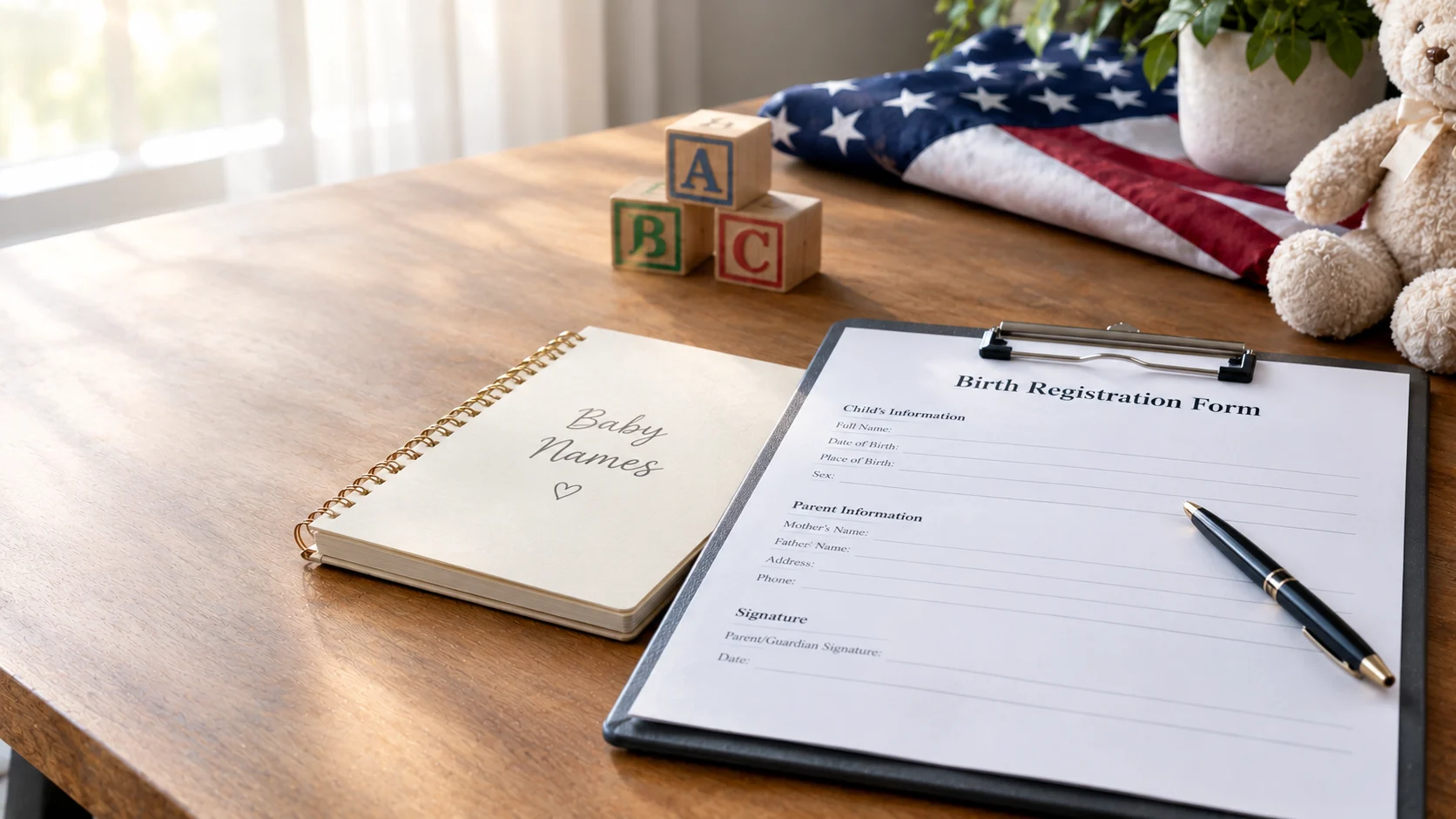
The United States has no single nationwide list of illegal baby names. State rules may restrict numbers, symbols, certain characters, excessive name length, or obscene wording, so parents should check their state’s birth registration requirements
Choosing a name for your baby is one of the most exciting decisions a parent can make. You might love a traditional name like William, a powerful choice like King, or something completely different that reflects your family’s culture and creativity. But before putting that name on a birth certificate, you may wonder: what names are illegal in the US?
The answer is more complicated than many online lists suggest. The United States does not have one federal list of forbidden baby names. Instead, birth registration rules vary by state, and some restrictions concern the characters a government record can accept rather than the meaning of the name itself. Alabama, for example, expressly limits birth certificate names to English alphabetic characters, hyphens, and apostrophes.
That means a name rejected in one situation might be accepted in another state or with a different spelling. Claims that names such as King, Queen, or Messiah are universally illegal in America can therefore be misleading.
In this guide, you’ll learn about the main naming restrictions, examples of names that could cause problems, common myths, and the official resources that help parents make an informed choice. Rules can change, so always confirm the latest requirements with the relevant state office before registering a name.
1. Names With Numbers May Be Rejected
One of the most common restrictions concerns numbers in a baby’s legal name. Some state registration systems do not accept digits in the name fields, even when parents use them creatively.
For example, parents might want to write a name as “J4ck,” “A1,” or “K8.” These spellings may look modern, but the relevant state may reject them when the birth certificate is registered.
Alabama’s administrative rule specifically excludes numbers from a child’s registered name. Georgia and Minnesota also have published restrictions on numbers in birth names.
Examples that could cause registration problems:
- J4ck instead of Jack
- A1 instead of Ace
- K8 instead of Kate
- M4x instead of Max
Does that mean every name containing a number is illegal nationwide?
No. There is no universal federal ban covering every naming situation. The state’s specific rules and registration system matter.
Best advice: Choose a spelling that uses permitted characters, and ask the state vital records office about unusual alternatives before submitting the paperwork.
2. Names Containing Symbols and Emojis
Digital culture has inspired many creative naming ideas. Some parents may like a name containing a heart, star, smiley face, or other symbol because it looks distinctive on social media.
However, a birth certificate is an official government record, not a social media profile. Many state systems limit the characters that can appear in a legal name.
Alabama’s rule, for instance, does not allow symbols or periods in the child’s name field. Georgia’s published regulation also restricts symbols.
Examples that could be rejected include:
- Star★
- Love♥
- Alex😊
- Sky*
- Baby!
These examples illustrate potentially problematic characters, not a nationwide faillist of names.
Can you use a symbol as a nickname?
A family can use an informal nickname, online handle, or decorative spelling socially, even if that format is unsuitable for an official birth certificate. A legal name and a social media display name serve different purposes.
If your chosen name includes a symbol, ask the registration office whether it can be recorded exactly as intended.
3. Offensive or Obscene Baby Names
Some naming rules address the content of a proposed name, not just its spelling. A name containing an obscene expression or a clearly offensive term may face additional scrutiny in a state that expressly prohibits such entries.
New Mexico’s naming regulation, for example, identifies obscenity and offensive or bizarre names among the concerns relevant to birth registration. Georgia also has a rule against obscenities.
This does not mean that every unusual, humorous, or unfamiliar name is prohibited. A name that sounds strange to one person may have an important cultural, religious, or family meaning to someone else.
Potentially problematic examples include:
- A name made up entirely of a recognized vulgar insult
- A name containing an explicit obscene expression
- A deliberately degrading phrase used as a child’s legal name
These are general illustrations rather than names officially ruled illegal in every state.
What should parents know?
There is no universal federal list of offensive baby names. Whether a particular name is refused depends on the applicable state rule and the circumstances.
If a name has an unusual meaning in another language, explain its background when asking the state office for guidance.
4. Names That Are Too Long
Some parents love long, elaborate names. Others want to combine several family names or create a unique string of words.
But a state’s registration system may limit how many characters fit into a name field. In that situation, a name may be rejected or require a different format even if its words are not offensive.
Minnesota’s published guidance, for example, sets a limit of 50 characters for each first, middle, and last name. New Mexico’s regulation refers to names that are unduly lengthy without setting the same specific numerical limit.
Examples that may create problems include:
- A first name containing hundreds of characters
- A long chain of several given names entered into one field
- A name exceeding the state’s permitted character limit
There is no single maximum length that applies to all American states.
Before choosing an unusually long name, check the rules for the first-name, middle-name, and surname fields separately. Ask whether spaces and punctuation count toward the limit.
A shorter legal name with a longer ceremonial or family name used informally may be worth considering if the proposed name exceeds the state’s limit.
5. Names Using Accents or Non-English Letters
Names reflect the world’s many languages and cultures. Parents may want to preserve the correct spelling of a family name using accents, tildes, umlauts, or other marks.
Whether those characters can appear on a US birth certificate depends on the relevant state’s rules and current registration system.
Alabama’s published rule restricts names to English alphabetic characters, hyphens, and apostrophes. California, however, enacted legislation allowing diacritical marks on vital records beginning in 2026. Its Department of Public Health issued guidance explaining the change.
Consider these examples:
- José compared with Jose
- Zoë compared with Zoe
- Renée compared with Renee
- André compared with Andre
The unaccented version is not inherently more correct. It may simply be the version a particular system can accept.
Are foreign names illegal in America?
No. A name does not become illegal simply because it comes from Spanish, French, Arabic, Chinese, or another language. The issue may be how the name’s characters are handled by the relevant registration process.
Parents should ask the state office how it records the exact spelling, especially if preserving cultural or linguistic accuracy is important to their family.
6. Names That Include Unusual Punctuation
Punctuation can be an important part of a name. Hyphens and apostrophes, for example, appear in many familiar names and surnames.
However, not every state accepts every punctuation mark in every name field. Some systems permit a limited set of characters, while others may have specific formatting requirements.
Alabama explicitly permits hyphens and apostrophes but excludes periods and other symbols in the child’s name.
Examples worth checking before registration include:
- Anne-Marie
- O’Connor
- J.R.
- Alex,James
- Mary–Jane
These examples do not all have the same legal status. A hyphenated name or a surname with an apostrophe may be acceptable, while repeated punctuation or commas may conflict with a state’s formatting rules.
What if your family already uses a hyphenated name?
Do not assume it will be rejected. Check whether the state accepts the particular punctuation and whether it must appear in the first, middle, or last name field.
If a name uses punctuation to preserve a cultural spelling, explain that preference to the registrar. The goal is to have the name recorded accurately within the state’s requirements.
7. Names That Resemble Titles or Official Ranks
Parents sometimes choose powerful words as names. King, Queen, Prince, Princess, Major, and Duke can sound distinctive, meaningful, or aspirational.
But are these names illegal in the United States?
Not automatically. There is no general federal rule that makes every title-like word illegal as a baby’s name. The relevant state’s regulations and the details of registration still matter.
For example, Minnesota’s guidance discusses titles such as King in the context of its naming instructions. The exact wording and application of state rules should be checked before making a legal decision.
Here are some title-inspired names parents may want to investigate:
- King
- Queen
- Prince
- Princess
- Duke
- Major
These are examples of words used as names, not a confirmed list of banned names.
It is also important to distinguish between giving a child a title-inspired name and falsely claiming an official rank or legal status. Those are separate issues.
If you love a name such as King or Major, contact the state’s vital records office rather than relying on a viral list claiming the name is forbidden across America.
8. Names That Do Not Fit the State’s Registration System
Sometimes, a name is not rejected because of its meaning. The problem is that the official birth registration system cannot record it in the requested format.
This can happen when a name contains unsupported characters, exceeds a field limit, or uses punctuation that the system does not accept.
For example, a state might allow letters and hyphens but not emoji. Another state might accept a wider range of characters but limit the length of each name field.
The US Records guide summarizes published rules that differ between states, illustrating why parents should verify their own state’s requirements.
Examples of potential formatting issues:
- A name longer than the available field
- A name with unsupported symbols
- A name containing prohibited digits
- A name entered with punctuation that the system cannot process
A formatting restriction is not the same as a judgment that a name is culturally or personally unacceptable.
If the name is rejected, ask the registrar which exact rule applies and whether a corrected spelling, amended entry, or other permitted process could solve the problem.
9. Names That Cause Problems With Other Official Records
A baby’s name appears on more than a birth certificate. It may also be used in Social Security records, passports, school records, medical documents, and other official systems.
Those systems have their own data requirements, so an unusual name can sometimes create practical complications even if the birth registration itself is accepted.
For example, Arizona’s practical guidance, as summarized in a recent naming-law overview, notes that abbreviations entered on a birth record may become the child’s legal name. The same overview discusses how certain punctuation combinations can complicate automatic Social Security enrollment.
Possible issues include:
- Different spellings appearing on different documents
- Unexpected punctuation or spacing differences
- Delays while an agency verifies a name
- Extra steps to correct a record
These problems do not automatically make a name illegal. They show why accurate registration matters.
How can parents reduce the risk?
Confirm the spelling before signing the birth registration paperwork. Review every field carefully and ask the registrar how the name will be transmitted to other agencies.
If the name is accepted but unusual, check the relevant Social Security Administration guidance as well. This can help you avoid unnecessary delays and inconsistent records.
10. Names Rejected Under a Specific State Rule
The most important lesson is that baby naming rules vary by state. A name may be acceptable in one place but run into a restriction elsewhere, particularly when the issue concerns characters, obscenity, or length.
Here are examples of published rules identified in state regulations and guidance. This is a selective overview, not a complete legal survey of all 50 states.
| State | Example of a published restriction |
|---|---|
| Alabama | Birth certificate name fields are limited to English alphabetic characters, hyphens, and apostrophes. |
| Georgia | Published rules prohibit obscenities, numbers, and symbols. |
| Minnesota | Guidance limits name fields to specified characters and sets a 50-character limit for each first, middle, and last name. |
| New Mexico | Rules address obscenity, offensive or bizarre names, undue length, and required name components. |
| California | Legislation effective in 2026 permits specified diacritical marks on vital records. |
Sources: Alabama Administrative Code, state guidance summarized in US Records, and the California Department of Public Health.
These examples demonstrate why broad statements such as “America bans all unusual baby names” are inaccurate.
A state may restrict how a name is entered without prohibiting the underlying word. Another state may have a different rule, a different system, or a process for correcting a record.
For the most reliable answer, check the law or official vital records instructions for the state where the birth will be registered.
Quick Comparison Table: Baby Name Restrictions
| Name feature | Possible issue | What to check |
|---|---|---|
| Numbers | May be prohibited | Whether digits are allowed |
| Symbols and emojis | Often unsupported | Accepted character list |
| Obscene wording | May violate content rules | State restrictions on offensive names |
| Excessive length | May exceed field limits | Maximum characters per field |
| Accents and diacritics | Rules vary | Current spelling and accent policy |
| Hyphens and apostrophes | May be allowed | Permitted punctuation |
| Title-like words | Not universally banned | Specific state guidance |
| Unusual formatting | May cause rejection | Birth record system requirements |
| Inconsistent spelling | May cause document problems | Exact spelling across records |
This table is a practical checklist, not a declaration that every example is prohibited in every state.
How to Check Whether a Baby Name Is Legal in Your State
Before choosing a name, follow these practical steps.
1. Identify the state where the birth will be registered. Naming rules are generally handled through state vital records systems, so begin with the appropriate state agency.
2. Visit the official health department or vital records website. Look for birth registration instructions, a birth certificate handbook, or rules about the name field.
3. Check the characters. If the name includes digits, accents, unusual punctuation, or symbols, confirm whether each character is accepted.
4. Check the length. If you have chosen a long first name or several middle names, ask whether the form has character limits.
5. Ask about unusual or disputed names. If the name might raise a question under a state rule, request clarification directly from the registrar.
6. Confirm the final spelling. Review the registration form carefully. Correcting a record later may require additional documents, time, or fees.
7. Check related records. If you expect to use an unusual spelling, review the relevant Social Security Administration and passport guidance.
Do not rely solely on an online list of banned names. Some lists mix US rules with naming laws from other countries, while others repeat outdated or unverified claims.
Most Common Myths About Illegal Baby Names
Myth 1: The US has a nationwide list of banned names
Fact: There is no single federal list of forbidden baby names. State rules and registration requirements determine what can be recorded.
Myth 2: King and Queen are always illegal
Fact: Title-inspired words are not automatically banned nationwide. Check the applicable state rules before assuming a particular name is prohibited.
Myth 3: Every foreign name is illegal
Fact: A name from another language is not automatically illegal. The spelling and characters may be subject to state-specific requirements.
Myth 4: Every state follows the same alphabet rule
Fact: Rules for accents, punctuation, and other characters differ. California’s 2026 change regarding diacritical marks is one example of why older information may be outdated.
Myth 5: A rejected name means the parents have broken the law
Fact: A registration office may reject a name format because it conflicts with an administrative rule. That does not necessarily mean the parents committed an offense.
FAQs
Q1. What names are illegal in the US?
There is no single nationwide list of illegal names. Some states restrict numbers, symbols, obscene wording, or excessive name length, so legality depends on the applicable state rules.
Q2. Can I name my baby anything I want in America?
Parents have broad naming freedom, but it is not unlimited in every state. Check the local rules on characters, length, punctuation, and prohibited wording before registering the birth.
Q3. Is the name King illegal in the United States?
King is not automatically illegal nationwide. Since state requirements differ, consult the vital records office where the child will be registered before relying on general online claims.
Q4. Are numbers allowed in American baby names?
Some states explicitly prohibit numbers in registered names. Alabama and Georgia are examples with published restrictions, so ask your state’s vital records office about your proposed spelling.
Q5. Can I use accents in my baby’s name?
That depends on the state’s current rules. California permits specified diacritical marks under legislation effective in 2026, while other jurisdictions may have different requirements.
Q6. Can a state reject an offensive baby name?
Some state regulations prohibit obscene or offensive names. Whether a particular name violates a rule depends on the wording of the regulation and how the registration authority applies it.
Q7. What happens if a birth name is rejected?
Ask the registrar which rule applies and what alternatives are available. You may need to change the proposed spelling or follow the state’s permitted correction or review procedure.
Q8. Where can I check baby naming laws?
Start with the official state health department or vital records office. Read its current birth registration instructions and contact the office directly if your proposed name includes unusual characters or wording.
Conclusion
Understanding what names are illegal in the US starts with one important fact: American baby naming rules are not identical in every state. Some jurisdictions limit numbers, symbols, punctuation, or accents, while others also address obscene wording or unusually long names.
That does not mean parents must choose a common name. Many distinctive names can be registered, provided they meet the requirements that apply to the birth record.
Before settling on a favorite, check your state’s official guidance, confirm the exact spelling, and ask the registrar about anything unusual. A few minutes of research can prevent avoidable paperwork problems later.
If this guide helped you understand American naming rules, share it with other expecting parents. Have you come across a surprising baby-name restriction? Leave a comment and share what you learned.
Discover More Related Articles:
- 345 Sesame Street Characters Names | A Colorful Journey Through Childhood Favorites In 2026
- 345 Sanderson Sisters Names | Meet the Three Bewitching Witches of Hocus Pocus In 2026
- 378 Hocus Pocus Witches Names | For Magical Souls In 2026