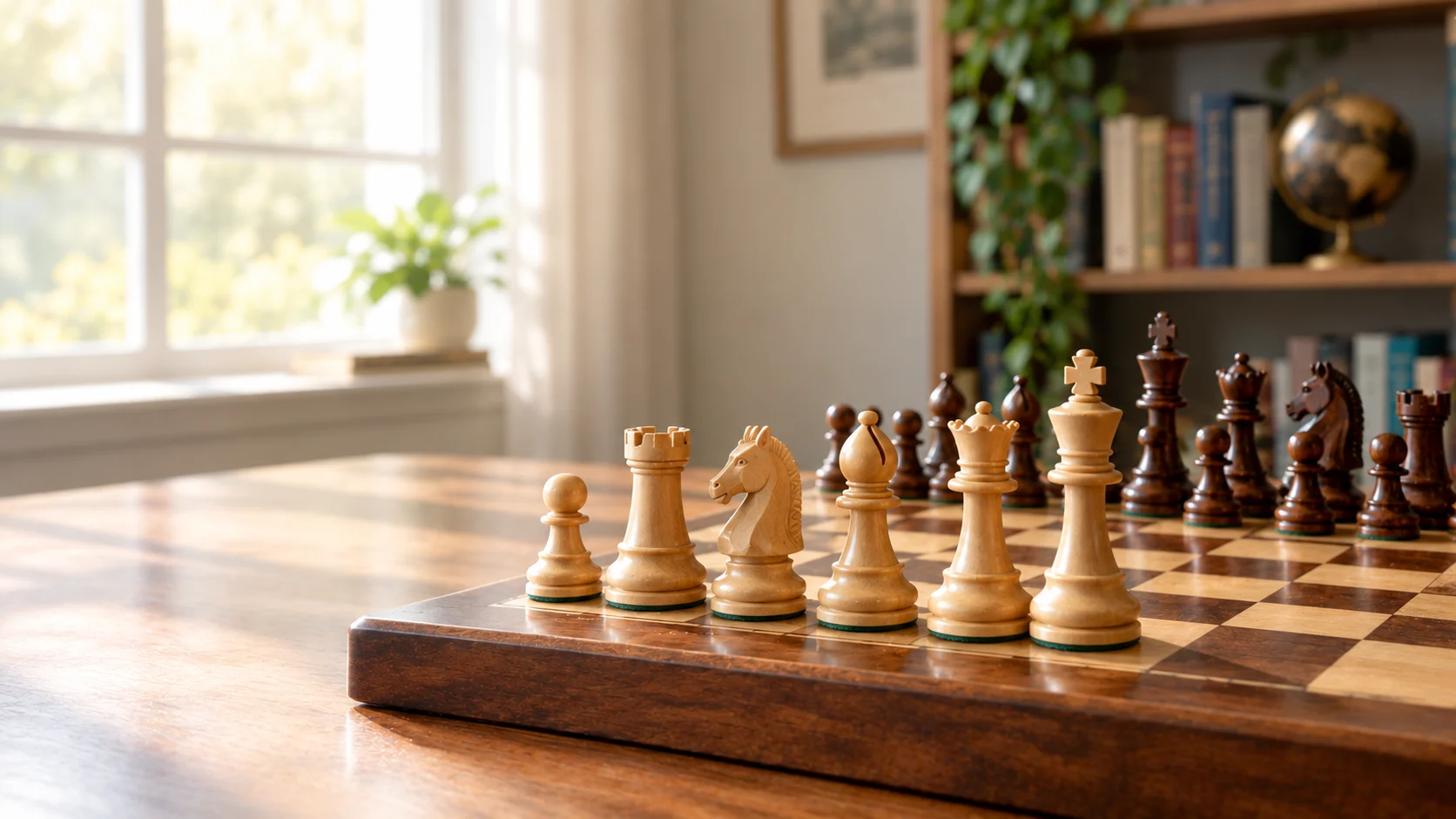
The six types of chess pieces are the king, queen, rook, bishop, knight, and pawn. Each has its own movement rules and strategic role. A standard chess set contains 32 pieces: 16 for each player.
Chess is more than a game of black and white squares. Every piece has a special role, every move creates new possibilities, and even the smallest pawn can change the outcome of a match.
If you are learning the game for the first time, understanding the names of chess pieces is the perfect place to begin. You have probably seen the tall king, the crowned queen, the horse-shaped knight, and the little pawns lined up across a chessboard. But do you know what each piece can do?
There are six types of chess pieces, and learning to recognize them makes the game much easier. Some pieces travel across the board in straight lines. Others move diagonally or jump over obstacles. The king must stay safe, while the queen can attack in almost every direction.
This guide explains all six chess piece names, their basic meanings, historical background, movements, traditional values, and strategic uses. You will also learn how to arrange the pieces, understand their symbols, and remember their roles without feeling overwhelmed.
you are a curious beginner, a parent teaching a child, or someone returning to chess after years away, this guide will help you approach the board with confidence.
1. King | The Most Important Chess Piece
Meaning: The central royal figure whose safety determines the result of the game.
Origin: The king’s name reflects the royal ruler in medieval European society. Chess developed from earlier games in India and spread through Persia and the Islamic world before evolving into its modern form.
Personality and role: The king represents leadership, survival, and careful decision-making. It is not the most mobile piece, but it is the most important one.
Movement: The king can move one square in any direction: horizontally, vertically, or diagonally. It cannot move onto a square attacked by an enemy piece. It can also take part in a special move called castling when the conditions are met.
Value: The king has no ordinary numerical value because losing it to checkmate ends the game.
Strategic importance: Protecting your king is essential. Players often castle early to move the king toward safety.
Why it matters today: The king teaches beginners that importance is not the same as attacking power. Your main goal is not to capture the enemy king but to checkmate it.
2. Queen | The Most Powerful Chess Piece
Meaning: The royal partner of the king and the most mobile standard chess piece.
Origin: The queen became part of European chess as the game developed from older traditions. Earlier versions used a counselor or vizier-like piece instead of today’s queen. Its modern movement became much stronger during the evolution of European chess rules.
Personality and role: The queen represents flexibility, reach, and attacking strength. It can support an attack, defend the king, or control several parts of the board.
Movement: The queen can move any number of unobstructed squares horizontally, vertically, or diagonally. It combines the movement of a rook and a bishop.
Value: A queen is commonly estimated at about nine points, although its actual value depends on the position.
Strategic importance: The queen is excellent for creating threats, delivering attacks, and supporting checkmate. However, bringing it out too early can expose it to attacks from weaker pieces.
Why it matters today: The queen is often the favorite piece of beginners because of its freedom. Learning when to use its power—and when to keep it safe—is a major step toward stronger chess.
3. Rook | The Straight-Line Powerhouse
Meaning: A major chess piece known for controlling ranks and files.
Origin: The English word rook ultimately traces through Persian and Arabic forms associated with the older chess piece called rukh. Historical accounts connect it with a chariot, although its form and interpretation changed as chess traveled across cultures.
Personality and role: The rook represents strength, structure, and control. It is particularly effective on open lines.
Movement: A rook moves any number of unobstructed squares horizontally or vertically. It cannot move diagonally or jump over another piece.
Value: A rook is commonly valued at about five points.
Strategic importance: Rooks are powerful on open files and ranks. Two connected rooks can work together to pressure an opponent’s position. A rook also participates in castling with the king.
Why it matters today: Rooks often become more active when pawns move or disappear, opening paths across the board. Learning to place them on open files helps beginners understand long-term planning.
4. Bishop | The Diagonal Specialist
Meaning: A chess piece that travels along diagonal lines.
Origin: The English name reflects the bishop’s traditional appearance in European chess sets. Earlier versions of chess used pieces with different names and representations, so the modern bishop’s name is part of the game’s cultural evolution.
Personality and role: The bishop represents precision, patience, and long-range influence. Each player starts with two bishops, one on a light square and one on a dark square.
Movement: A bishop can move any number of unobstructed squares diagonally. It stays on the same color of square throughout the game.
Value: A bishop is commonly valued at about three points.
Strategic importance: Bishops can control long diagonals and become especially powerful when the center is open. A bishop may be more useful than a knight in positions with fewer blocked lines.
Why it matters today: Bishops teach players to think beyond nearby squares. A well-placed bishop can influence distant areas of the board and create threats before the opponent notices them.
5. Knight | The Horse-Shaped Piece That Jumps
Meaning: A mounted warrior represented by a horse’s head in many standard chess sets.
Origin: The English name comes from the medieval knight, a mounted warrior. The piece’s role reflects chess’s older military imagery, although its exact movement and representation developed across different chess traditions.
Personality and role: The knight represents creativity, surprise, and tactical skill. Its unusual movement makes it different from every other piece.
Movement: The knight moves in an L shape: two squares in one direction and then one square at a right angle. It is the only standard chess piece that can jump over intervening pieces.
Value: A knight is commonly valued at about three points.
Strategic importance: Knights are excellent at attacking pieces that cannot easily escape and can be especially effective in crowded positions. A knight placed deep in enemy territory may become a powerful outpost.
Why it matters today: The knight rewards imaginative thinking. Beginners often need time to master its movement, but once they do, they can spot surprising forks that attack two targets at once.
6. Pawn | The Small Piece With Big Potential
Meaning: A foot soldier in the traditional military imagery of chess.
Origin: The English word pawn is connected with older European terms for a foot soldier or subordinate. Pawns have represented the front line of the army in many interpretations of the game.
Personality and role: The pawn represents progress, teamwork, and potential. Each player starts with eight pawns, more than any other type of piece.
Movement: A pawn normally moves one square forward into an empty square. On its first move, it may advance two squares if both squares are clear. It captures one square diagonally forward, not straight ahead.
Value: A pawn is commonly valued at one point.
Strategic importance: Pawns control space, protect other pieces, and shape the position. A pawn that reaches the opposite end of the board can usually promote to a queen, rook, bishop, or knight.
Why it matters today: Pawns may look weak, but they can decide a game. Their promotion rule gives them a path to become much more powerful pieces.
7. How Many Chess Pieces Are There in a Standard Set?
A standard chess set contains 32 pieces in total, with 16 belonging to each player. Each side begins with the same arrangement and types of pieces.
Here is the complete count:
| Chess piece | Each player | Both players |
|---|---|---|
| King | 1 | 2 |
| Queen | 1 | 2 |
| Rook | 2 | 4 |
| Bishop | 2 | 4 |
| Knight | 2 | 4 |
| Pawn | 8 | 16 |
| Total | 16 | 32 |
Each player begins with one king, one queen, two rooks, two bishops, two knights, and eight pawns.
The board itself has 64 squares arranged in eight rows and eight columns. The pieces occupy the first two rows on each player’s side at the start of the game.
Remember that the six names refer to six types of pieces, not the total number of individual pieces. For example, there are six types, but 32 individual pieces in a complete standard set.
8. Chess Piece Names, Symbols, and Traditional Values
Knowing the names of chess pieces is useful, but recognizing their symbols makes reading chess books and game records much easier.
In standard English algebraic notation, the king is written as K, the queen as Q, the rook as R, the bishop as B, and the knight as N. Pawns do not use a letter in standard algebraic notation. The letter N is used for the knight to avoid confusion with the king.
| Chess piece | Symbol | Common point value |
|---|---|---|
| King | K | No ordinary point value |
| Queen | Q | 9 |
| Rook | R | 5 |
| Bishop | B | 3 |
| Knight | N | 3 |
| Pawn | No letter | 1 |
These point values are common teaching estimates, not official rules. A piece’s real value depends on the position, available targets, king safety, and the stage of the game.
For example, a knight may be more useful than a bishop in a closed position with many pawns blocking diagonal lines. In an open position, a bishop may have greater reach.
The king is different because its safety decides the result. You cannot trade it away like a queen or rook.
9. How to Set Up Chess Pieces Correctly
Setting up the board correctly helps you begin every game with confidence. The standard arrangement is the same for both players, with the black pieces mirroring the white pieces.
Follow these steps:
- Place the board correctly. The square at each player’s right-hand corner must be light.
- Arrange the back row. From left to right, place rook, knight, bishop, queen, king, bishop, knight, and rook.
- Check the queen’s square. The white queen starts on a light square, and the black queen starts on a dark square. A useful reminder is “queen on her color.”
- Place the pawns. Put all eight pawns in the row directly in front of the main pieces.
- Check both sides. Each player should have 16 pieces in the starting position.
The back row is often remembered as rook, knight, bishop, queen, king, bishop, knight, rook.
Once the pieces are arranged, White makes the first move. After that, the players alternate turns, following the movement rules for each piece.
10. Special Chess Rules Every Beginner Should Know
The six types of chess pieces follow different movement rules, but a few special rules are especially important for beginners.
Check: A king is in check when an opposing piece attacks it. The player must respond by moving the king, blocking the attack, or capturing the attacking piece when legal.
Checkmate: Checkmate occurs when the king is in check and the player has no legal move to escape. The game ends immediately. The king is not physically captured.
Castling: This special move involves the king and one rook. Under the rules, neither piece may have moved previously, the squares between them must be clear, and the king cannot be in check or pass through an attacked square.
Pawn promotion: When a pawn reaches the farthest rank, it must be promoted to a queen, rook, bishop, or knight of the same color. It does not have to become a queen, although the queen is often the most useful choice.
En passant: This is a special pawn capture that may be available immediately after an opponent advances a pawn two squares from its starting position and lands beside your pawn.
These rules add depth to chess and explain why learning the names and movements is only the beginning. The more you play, the easier it becomes to recognize opportunities.
Quick Comparison Table of All Six Chess Pieces
| Piece | Main movement | Common value | Main role |
|---|---|---|---|
| King | One square in any direction | Special | Survive and avoid checkmate |
| Queen | Straight or diagonal lines | 9 | Attack and defend across the board |
| Rook | Horizontal and vertical lines | 5 | Control open files and ranks |
| Bishop | Diagonal lines | 3 | Control long diagonals |
| Knight | L-shaped jump | 3 | Create forks and surprise attacks |
| Pawn | Forward movement, diagonal capture | 1 | Control space and promote |
How to Remember the Names of Chess Pieces Easily
Learning six names is simple when you connect each piece with its appearance and movement.
King: Look for the piece that usually has a cross or distinctive crown-like top.
Queen: The queen often has a crown with points. She is usually the tallest piece after the king in a traditional Staunton-style set.
Rook: It commonly looks like a castle tower.
Bishop: It often has a rounded or split top.
Knight: Look for the horse’s head. It is the easiest piece to recognize by its animal shape.
Pawn: Pawns are usually the smallest and simplest pieces, with rounded heads.
Modern tournament sets often use the Staunton style, designed to make the pieces easy to recognize. The International Chess Federation (FIDE) specifies Staunton-style pieces for its equipment standards.
Try saying the six names aloud while pointing to each piece. Then shuffle a few pieces and identify them without looking at a list. Practicing for a few minutes each day can make recognition feel natural.
Most Important Chess Pieces for Beginners
Every piece has a purpose, but beginners often ask which one matters most.
- King: The most important piece because checkmate ends the game.
- Queen: The most powerful piece by movement and common point value.
- Rook: A strong attacker on open files and ranks.
- Bishop: A long-range piece that controls diagonal squares.
- Knight: A tactical piece that can jump over other pieces.
- Pawn: A basic unit that controls space and can promote.
There is no single piece that should always be moved first. Good chess depends on the position, the opponent’s threats, and your plan.
A useful beginner habit is to ask three questions before every move: Is my king safe? Is any of my pieces under attack? Can I create a threat without losing material?
Modern Chess Piece Designs and Their Popularity
Chess pieces come in many styles, from traditional wooden sets to colorful plastic designs and decorative themed collections. Yet the familiar six names remain the foundation of standard chess.
Classic Staunton pieces: These are widely used in tournament play because their shapes are easy to distinguish.
Wooden chess sets: Wooden pieces offer a traditional appearance and are popular for home games and gifts.
Travel chess sets: Compact boards and smaller pieces make chess easier to play on trips.
Magnetic chess sets: These are useful when playing in moving vehicles or places where pieces might slide.
Themed chess sets: Some sets use fantasy characters, historical figures, or movie-inspired designs. These can be fun to collect, though unusual shapes may be less practical for serious play.
Whatever design you choose, learn the standard names and movement rules first. A piece’s decorative appearance may change, but its role in the game remains the same.
FAQs
Q1. What are the six names of chess pieces?
The six types are king, queen, rook, bishop, knight, and pawn. Each piece has different movement rules and a different role in the game.
Q2. How many chess pieces are in a standard set?
A standard set has 32 pieces: 16 white and 16 black. Each player starts with one king, one queen, two rooks, two bishops, two knights, and eight pawns.
Q3. Which chess piece is the most powerful?
The queen is usually considered the most powerful piece because it can move any number of unobstructed squares horizontally, vertically, or diagonally. The king, however, is the most important piece.
Q4. Which chess piece moves in an L shape?
The knight moves two squares in one direction and then one square at a right angle. It is the only standard piece that can jump over other pieces.
Q5. What is the weakest chess piece?
The pawn has the lowest conventional point value, usually one point. However, pawns can control important squares and promote to a more powerful piece when they reach the opposite end of the board.
Q6. What are the letters used for chess pieces?
Standard English chess notation uses K for king, Q for queen, R for rook, B for bishop, and N for knight. Pawns have no letter in standard algebraic notation.
Q7. Can a pawn become a queen?
Yes. When a pawn reaches the last rank, it must promote to a queen, rook, bishop, or knight of its own color. It can become a queen even if the original queen is still on the board.
Q8. Why is the knight different from other chess pieces?
The knight has a special L-shaped movement and can jump over intervening pieces. This lets it attack from unusual angles and create tactical threats that other pieces cannot make in the same way.
Conclusion
Learning the names of chess pieces is the first step toward understanding the beauty and strategy of the game. The king protects the result, the queen offers unmatched mobility, the rooks control straight lines, the bishops dominate diagonals, the knights create surprising attacks, and the pawns shape the battlefield.
Once you understand how each piece moves, you can begin spotting threats, planning combinations, and enjoying the game with greater confidence. Remember that traditional point values are helpful guides, but the real strength of a piece depends on its position and purpose.
Use this guide as a quick reference whenever you need a reminder. Practice identifying the pieces, setting up the board, and learning one movement rule at a time.
If this article helped you, share it with a friend who is learning chess. Which piece do you enjoy playing with most? Leave a comment and tell us why!
Discover More Related Articles:
- 345 Sesame Street Characters Names | A Colorful Journey Through Childhood Favorites In 2026
- 345 Sanderson Sisters Names | Meet the Three Bewitching Witches of Hocus Pocus In 2026
- 378 Hocus Pocus Witches Names | For Magical Souls In 2026