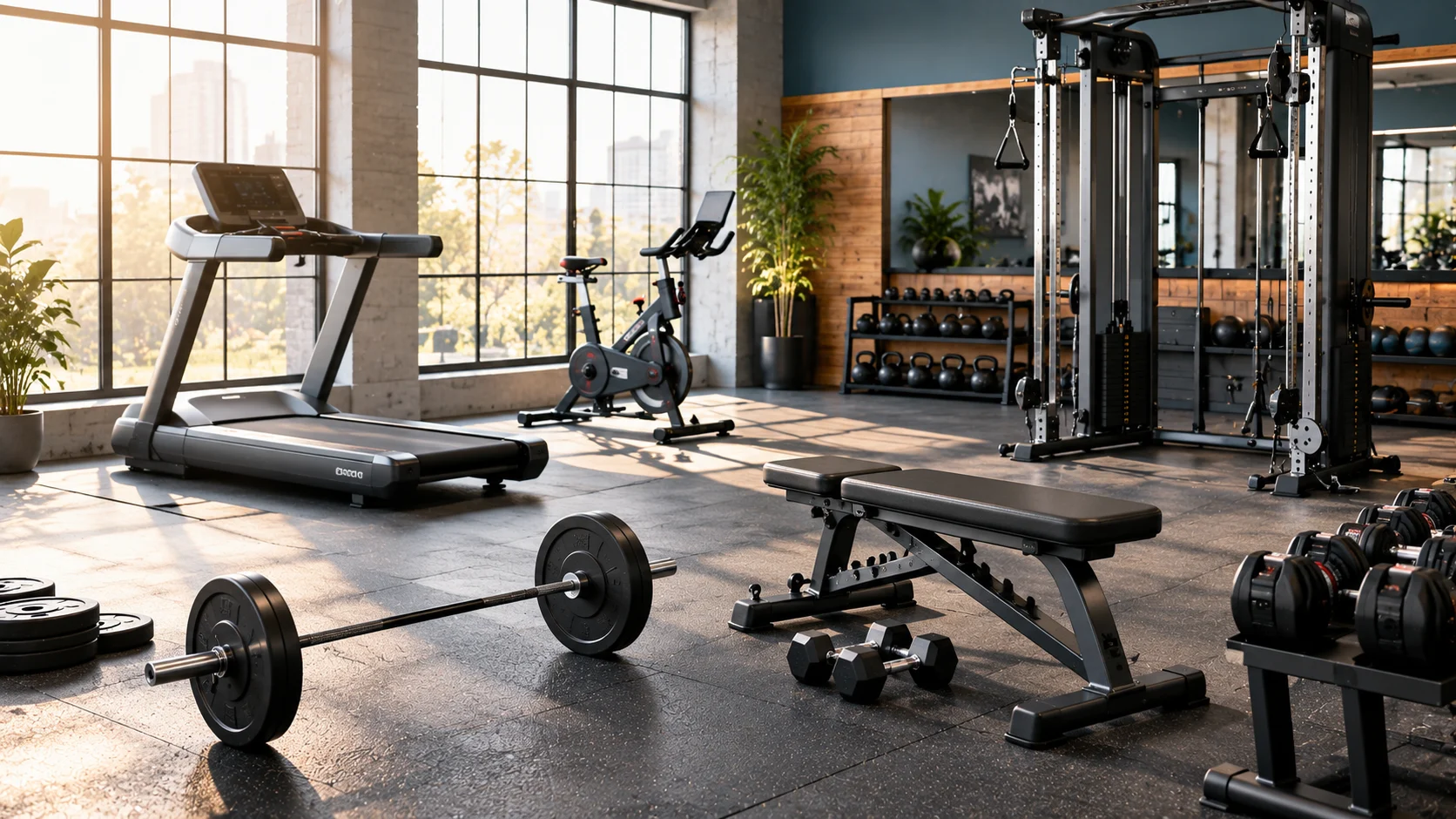
Common gym equipment names include treadmills, dumbbells, barbells, weight benches, leg press machines, cable machines, rowing machines, exercise bikes, kettlebells, and resistance bands. Each tool supports different exercises, muscle groups, and fitness goals.
Walking into a gym for the first time can feel confusing. You see rows of machines, racks of weights, cables, benches, and workout tools, but you may not know what they are called or how they work. Learning gym equipment names is a simple first step toward feeling more confident and making better use of your workout time.
You are a beginner, a fitness enthusiast, a student learning exercise terminology, or someone planning a home gym, understanding the equipment makes exercise easier to navigate. You can recognize the machines your trainer mentions, choose the right tools for your goals, and avoid wasting time trying to figure out unfamiliar equipment.
This guide covers more than common types of gym equipment, including cardio machines, strength-training machines, free weights, functional training tools, and useful accessories. You will learn their names, main uses, training styles, and the muscle groups they typically target.
You do not need to master every machine at once. Start with a few basic tools, learn proper technique, and gradually explore more options as your strength and confidence grow.
1. Cardio Gym Equipment Names and Their Uses
Cardio equipment helps improve cardiovascular fitness, stamina, and endurance. Many machines also support calorie expenditure as part of an overall fitness routine.
1. Treadmill
Main use: Walking, jogging, and running.
A treadmill features a moving belt that lets you exercise indoors. Many models offer adjustable speed and incline settings, making them useful for beginners and experienced runners. Start at a comfortable walking speed and increase the intensity gradually.
2. Stationary Exercise Bike
Main use: Indoor cycling and lower-body endurance.
An exercise bike simulates outdoor cycling without requiring you to travel. It can be a practical option for people who prefer seated cardio or want to control workout intensity.
3. Elliptical Trainer
Main use: Low-impact cardiovascular exercise.
The elliptical uses moving foot pedals and handles to create a smooth stepping motion. It can engage both the upper and lower body while reducing impact compared with running.
4. Rowing Machine
Main use: Full-body cardio and endurance.
A rowing machine imitates the movement of rowing a boat. It works the legs, back, arms, and core when used with proper technique.
5. Stair Climber
Main use: Climbing-based cardio.
This machine simulates walking up stairs and challenges the muscles of the legs and glutes. Adjust the pace to match your current fitness level.
6. Air Bike
Main use: High-intensity cardio.
An air bike uses fan resistance that increases as you pedal harder. Many models include moving handles, so both the arms and legs contribute to the effort.
7. Spin Bike
Main use: Indoor cycling workouts.
Spin bikes are designed for cycling sessions that may include changes in resistance, speed, and riding position. They are common in group cycling classes.
8. Recumbent Bike
Main use: Seated, supported cycling.
A recumbent bike has a backrest and a more reclined seating position. Some users find this position more comfortable than an upright bike.
9. Ski Ergometer
Main use: Skiing-style cardiovascular training.
A ski ergometer uses handles and resistance to imitate the pulling action of cross-country skiing. It can challenge the arms, back, core, and legs depending on technique.
10. Battle Ropes
Main use: Conditioning and upper-body endurance.
Battle ropes are thick, heavy ropes anchored at one end. Users create waves, slams, or alternating movements to challenge the arms, shoulders, trunk, and cardiovascular system.
2. Free Weights and Weightlifting Equipment Names
Free weights allow movement in different directions and can support strength, muscle development, and coordination. Good technique and suitable loads matter more than lifting the heaviest weight available.
11. Dumbbells
Main use: Strength training for the whole body.
Dumbbells are short handheld weights used in exercises such as curls, presses, rows, lunges, and raises. They are available in fixed-weight and adjustable designs.
12. Barbell
Main use: Compound strength exercises.
A barbell is a long metal bar that holds weight plates. It is commonly used for squats, deadlifts, bench presses, and rows.
13. Weight Plates
Main use: Adjusting resistance.
Weight plates fit onto compatible barbells or machines. They come in different sizes and weights, allowing users to increase or decrease the load.
14. Kettlebell
Main use: Strength, power, and conditioning.
A kettlebell is a weighted ball with a handle. It is used for movements such as goblet squats, carries, deadlifts, and swings. Dynamic exercises require proper instruction.
15. EZ Curl Bar
Main use: Arm exercises.
The EZ curl bar has a curved grip that gives the hands different holding positions. It is often used for biceps curls and triceps extensions.
16. Trap Bar
Main use: Deadlifts and loaded carries.
A trap bar has a frame that allows the user to stand inside it while lifting. Depending on the design and technique, it can be used for deadlifts, shrugs, and carries.
17. Adjustable Dumbbells
Main use: Space-saving strength training.
Adjustable dumbbells allow users to change the weight using plates or a selector mechanism. They are especially useful for home gyms with limited storage space.
18. Medicine Ball
Main use: Core training and functional exercises.
Medicine balls are weighted balls used for throws, carries, rotational exercises, and certain strength drills. Choose a weight that allows you to control the movement.
19. Slam Ball
Main use: Conditioning and explosive movements.
A slam ball is designed to withstand forceful throws against the floor. It is often used for controlled slams and conditioning circuits.
20. Weightlifting Chains
Main use: Variable resistance in selected lifts.
Heavy chains can be attached to compatible barbells for specialized strength training. Because setup and loading affect safety, they are generally more suitable for experienced lifters working with knowledgeable supervision.
3. Strength Training Machines in a Gym
Strength machines guide movement along a set path or use cables and pulleys to provide resistance. They can help beginners learn exercises, although correct adjustment and technique are still essential.
21. Leg Press Machine
Main use: Training the quadriceps, glutes, and other leg muscles.
The user pushes a weighted platform away while seated or reclined. Foot placement and machine design influence how the movement feels, so follow the machine’s instructions.
22. Lat Pulldown Machine
Main use: Training the upper back and arms.
The user pulls a bar down toward the upper chest while seated. This exercise primarily trains the latissimus dorsi and also involves the biceps and other upper-back muscles.
23. Chest Press Machine
Main use: Training the chest, shoulders, and triceps.
The user pushes handles away from the torso. Adjust the seat so the handles begin around a comfortable chest-level position.
24. Pec Deck Machine
Main use: Chest isolation exercises.
The pec deck typically uses padded arms that move inward in front of the body. It trains the chest muscles through a controlled fly-like movement.
25. Leg Extension Machine
Main use: Training the quadriceps.
The user straightens the knees against a padded resistance arm. Adjust the seat and knee position according to the machine’s instructions.
26. Seated Leg Curl Machine
Main use: Training the hamstrings.
This machine uses resistance as the user bends the knees against a padded lever. It is a common option for strengthening the back of the thighs.
27. Lying Leg Curl Machine
Main use: Hamstring training.
The user lies face down and bends the knees against resistance. The machine’s pad should sit comfortably near the lower legs without pressing directly on the ankle joint.
28. Shoulder Press Machine
Main use: Training the shoulders and triceps.
The user presses handles upward from a seated position. Start with a light resistance and avoid forcing the shoulders into an uncomfortable range.
29. Assisted Pull-Up Machine
Main use: Practicing pull-ups.
This machine provides counterweight assistance while the user performs pull-ups or chin-ups. More assistance makes the exercise easier, while less assistance increases the challenge.
30. Smith Machine
Main use: Guided barbell exercises.
A Smith machine uses a bar that moves along fixed vertical or angled rails. It can support exercises such as squats and presses, but users still need correct positioning and suitable safety stops.
31. Hack Squat Machine
Main use: Lower-body strength training.
The hack squat typically supports the torso while the user bends and straightens the knees and hips under resistance. Follow the equipment’s setup instructions and use a comfortable range of motion.
32. Cable Crossover Machine
Main use: Cable-based strength exercises.
This station has adjustable pulleys on either side. It supports chest flyes, cable rows, triceps pushdowns, curls, and many other movements.
33. Seated Row Machine
Main use: Training the back and arms.
The user pulls handles toward the torso against resistance. Keep the back controlled and avoid using excessive momentum.
34. Calf Raise Machine
Main use: Training the calf muscles.
Depending on its design, the machine may support seated or standing calf raises. The user raises and lowers the heels in a controlled manner.
35. Hip Abductor Machine
Main use: Training the muscles that move the thighs outward.
The user presses the padded supports away from the body’s midline. It primarily targets the hip abductor muscles.
36. Hip Adductor Machine
Main use: Training the inner-thigh muscles.
This machine uses resistance as the user brings the thighs toward one another. Use a controlled movement rather than forcing a wide starting position.
37. Back Extension Machine
Main use: Training the back extensors and related trunk muscles.
Some models use a padded support and resistance mechanism, while others use body weight. Adjust the machine to your size and avoid excessive arching.
38. Ab Crunch Machine
Main use: Training the abdominal muscles.
The user bends the torso against resistance. Focus on controlled abdominal movement rather than pulling with the arms or jerking the body.
39. Glute Drive Machine
Main use: Training the gluteal muscles.
This machine typically supports a hip-thrust movement with a padded load across the hips. Keep the movement controlled and avoid overextending the lower back.
40. Multi-Gym Machine
Main use: Several strength exercises in one station.
A multi-gym combines multiple stations or cable mechanisms in a single frame. Depending on its design, it may support chest presses, pulldowns, leg extensions, and other exercises.
4. Gym Benches, Racks, and Support Equipment
Not every important piece of gym equipment has a moving mechanism. Benches and racks help position weights, support lifts, and organize training spaces.
41. Flat Weight Bench
Main use: Bench presses and supported exercises.
A flat bench provides a stable horizontal surface for dumbbell presses, barbell bench presses, and various seated or lying movements.
42. Adjustable Incline Bench
Main use: Exercises at different backrest angles.
An adjustable bench allows the backrest to move between flat, incline, and sometimes decline positions. It adds variety to chest, shoulder, and dumbbell exercises.
43. Decline Bench
Main use: Decline abdominal exercises and selected pressing movements.
A decline bench places the torso at a downward angle relative to the legs. Some models include foot supports to help keep the user in position.
44. Squat Rack
Main use: Supporting barbell squats and other lifts.
A squat rack holds a barbell at a suitable starting height. Many racks include adjustable safety arms, which should be positioned correctly before lifting.
45. Power Rack
Main use: Squats, presses, and other barbell exercises.
A power rack is a sturdy frame with adjustable bar supports and safety bars. It offers a useful setup for solo training when users know how to configure the equipment properly.
46. Dip Station
Main use: Bodyweight upper-body exercises.
A dip station has parallel bars used for dips and, on some designs, knee raises. Beginners may use assisted variations to control the difficulty.
47. Preacher Curl Bench
Main use: Supported biceps curls.
This bench supports the upper arms while the user performs curls with a dumbbell, barbell, or compatible machine. The support reduces body movement during the exercise.
48. Roman Chair
Main use: Back extensions and selected trunk exercises.
A Roman chair generally supports the hips or thighs while the user performs controlled back extensions. Some designs also accommodate abdominal and oblique movements.
49. Weight Tree
Main use: Storing weight plates.
A weight tree is a stand with pegs designed to hold compatible plates. Organized storage helps keep gym floors clear and reduces tripping hazards.
50. Barbell Collars
Main use: Securing weight plates.
Barbell collars attach to the ends of a compatible bar to help prevent plates from sliding off. Always check that the collars fit securely before lifting.
5. Functional Training and Resistance Equipment Names
Functional training tools support movements such as pushing, pulling, carrying, balancing, and rotating. The equipment selected should match the exercise, the user’s ability, and the available space.
51. Resistance Bands
Main use: Adjustable resistance for strength and mobility exercises.
Resistance bands are elastic strips or tubes available in different resistance levels. They can support warm-ups, rows, presses, glute exercises, and assisted movements.
52. Suspension Trainer
Main use: Bodyweight strength training.
A suspension trainer uses adjustable straps anchored to a secure support. Exercises such as rows, squats, and chest presses rely on body position to change the difficulty.
53. TRX-Style Training Straps
Main use: Suspension-based exercise.
These straps allow users to perform bodyweight movements using handles and foot loops. Always verify the anchor point and follow the manufacturer’s installation instructions.
54. Pull-Up Bar
Main use: Pull-ups, chin-ups, and hanging exercises.
A pull-up bar may be part of a rack, wall-mounted setup, or compatible doorway system. Check the weight limit and mounting security before use.
55. Parallettes
Main use: Bodyweight strength and balance.
Parallettes are short parallel bars used for push-ups, L-sits, and other bodyweight exercises. Their stability and height depend on the model.
56. Plyometric Box
Main use: Jumping and step-up exercises.
A plyometric box provides an elevated platform for selected jumping, stepping, and strength movements. Choose a height you can use safely and land on with control.
57. Agility Ladder
Main use: Footwork and coordination drills.
An agility ladder lies flat on the floor and provides a pattern for stepping exercises. It can support coordination practice, warm-ups, and sports conditioning.
58. Cones and Training Markers
Main use: Marking exercise routes and boundaries.
Cones help organize shuttle runs, agility drills, and group exercise stations. They are simple tools for creating clear training paths.
59. Weighted Vest
Main use: Adding load to selected bodyweight exercises.
A weighted vest distributes additional weight across the torso. Begin with a light load and make sure it does not interfere with breathing or movement.
60. Sandbag
Main use: Loaded carries, squats, and lifting drills.
A training sandbag has flexible handles or grip areas, depending on its design. The shifting contents challenge control, so start with manageable resistance.
6. Core, Balance, and Mobility Equipment
Core and mobility tools can help people practice balance, trunk control, and selected flexibility exercises. They should complement—not replace—appropriate strength and cardio training.
61. Stability Ball
Main use: Balance and core exercises.
A stability ball is an inflatable exercise ball used for supported movements, crunches, and selected strength drills. Choose a size suitable for your height and exercise.
62. BOSU Balance Trainer
Main use: Balance and stability practice.
A BOSU-style trainer has a domed surface attached to a flat base. It can be used for balance drills and selected exercises under controlled conditions.
63. Ab Wheel
Main use: Challenging the abdominal and trunk muscles.
An ab wheel is a small wheel with handles on either side. Users roll it forward and back while controlling trunk position. Beginners should start with a short range.
64. Foam Roller
Main use: Self-massage and warm-up or recovery routines.
A foam roller is a cylindrical tool used to apply pressure to muscles. Some people use it to temporarily ease feelings of tightness or improve short-term range of motion.
65. Yoga Mat
Main use: Floor exercises and stretching.
A yoga mat creates a cushioned, nonslip surface for mobility drills, stretching, core exercises, and bodyweight workouts.
66. Exercise Mat
Main use: Floor-based fitness movements.
Exercise mats come in different thicknesses and materials. They can provide comfort during sit-ups, planks, stretching, and other floor exercises.
67. Balance Board
Main use: Balance and coordination training.
A balance board has an unstable surface that requires controlled weight shifts. Use it in a clear area and begin with appropriate support if needed.
68. Massage Ball
Main use: Targeted pressure for tight-feeling muscles.
A massage ball is a small, firm ball used against a wall or floor to apply pressure to selected areas. Avoid direct pressure on joints and painful or injured areas.
7. Gym Accessories and Small Workout Tools
Accessories help users grip weights, manage training sessions, and keep equipment organized. Some provide comfort, while others may improve the practicality of specific exercises.
69. Lifting Straps
Main use: Supporting grip during selected pulling exercises.
Lifting straps wrap around the wrist and bar to help hold the weight. They can be useful when grip strength limits a pulling exercise, but they do not replace proper technique.
70. Weightlifting Belt
Main use: Supporting bracing during heavy lifts.
A lifting belt provides a firm surface against which a lifter can brace the trunk. It does not automatically prevent injuries and should be used with sound lifting technique.
71. Wrist Wraps
Main use: Additional wrist support during selected lifts.
Wrist wraps provide external support around the wrist. They are often used during pressing exercises, but should not be so tight that they cause numbness or discomfort.
72. Knee Sleeves
Main use: Compression and warmth around the knee.
Knee sleeves are elastic supports commonly worn during squats and other lower-body exercises. They may improve comfort for some users but are not a substitute for medical treatment.
73. Gym Gloves
Main use: Hand comfort and grip preference.
Gym gloves cover the palms and may reduce friction during selected exercises. Their usefulness depends on the fit, material, and user’s preference.
74. Jump Rope
Main use: Cardiovascular conditioning and coordination.
A jump rope is a portable tool for rhythmic skipping. Beginners can start with short intervals and a comfortable pace before increasing duration.
75. Hand Gripper
Main use: Training hand and forearm grip.
A hand gripper uses spring or adjustable resistance as the user squeezes its handles. Select a resistance level that allows controlled repetitions.
76. Ankle Straps
Main use: Attaching the ankle to a cable machine.
Ankle straps connect to compatible cable systems for exercises such as cable kickbacks and hip abductions. Check that the strap and attachment are secure before starting.
77. Triceps Rope Attachment
Main use: Cable triceps exercises.
This rope attaches to a cable machine and is commonly used for triceps pushdowns and selected face-pull variations. Grip the rope securely and avoid swinging the torso.
78. Lat Pulldown Bar
Main use: Cable pulldowns.
A lat pulldown bar is a long attachment connected to a cable machine. Its shape and grip options influence hand placement during pulldown exercises.
79. Straight Cable Bar
Main use: Cable curls, pushdowns, and other exercises.
A straight bar attachment provides a fixed grip position on a cable machine. Use a comfortable wrist position and a manageable load.
80. Gym Timer
Main use: Tracking workout and rest intervals.
A gym timer helps users manage exercise periods, rest breaks, and circuit workouts. A simple stopwatch or interval timer can serve the same purpose.
8. Home Gym Equipment Names for Beginners
You do not need a commercial gym’s entire equipment collection to start exercising at home. A small selection of versatile tools can support a range of beginner workouts.
81. Adjustable Weight Bench
Main use: Supporting several types of strength exercises.
An adjustable bench can be used with dumbbells for presses, rows, and other movements. Check its maximum load rating and make sure it locks securely into position.
82. Compact Dumbbell Set
Main use: Basic home strength training.
A compact dumbbell set is useful for exercises that target the arms, shoulders, chest, back, and legs. Select weights that match your current ability and leave room for progression.
83. Doorway Pull-Up Bar
Main use: Upper-body bodyweight training.
A doorway pull-up bar can save space, but not every doorframe is suitable. Follow the product’s installation requirements and weight limits carefully.
84. Foldable Treadmill
Main use: Walking or running in a smaller space.
A foldable treadmill can be stored more easily than some full-size models. Check the running surface, motor specifications, and storage requirements before purchasing.
85. Compact Exercise Bike
Main use: Indoor cycling at home.
A compact exercise bike provides a convenient option for regular cardio sessions. Consider adjustability, stability, noise level, and the space available in your home.
86. Door Anchor for Resistance Bands
Main use: Creating a secure band attachment point.
A compatible door anchor allows resistance bands to be used for rows, presses, and other movements. Install it exactly as directed and inspect the band and anchor for damage.
87. Adjustable Kettlebell
Main use: Space-efficient resistance training.
An adjustable kettlebell allows users to change the load without storing several separate weights. Make sure the locking mechanism is secure before every workout.
88. Compact Cable Trainer
Main use: Cable-based strength exercises at home.
Compact cable trainers can support movements such as rows, presses, and curls. Their exercise options, mounting needs, and resistance limits vary by model.
9. Gym Equipment Names by Muscle Group
Knowing equipment names becomes more useful when you connect each tool to the muscles or movements it trains. The following examples are general guidelines; the exact muscles involved depend on exercise technique and equipment design.
Chest Equipment
- Chest press machine: Trains the chest, shoulders, and triceps.
- Flat weight bench: Supports barbell and dumbbell presses.
- Cable crossover: Allows cable fly variations.
- Pec deck: Supports controlled chest fly movements.
Back Equipment
- Lat pulldown machine: Trains the lats and upper back.
- Seated row machine: Trains the back and elbow-flexing muscles.
- Pull-up bar: Supports pull-ups and chin-ups.
- Cable trainer: Allows different pulling movements.
Leg Equipment
- Leg press: Trains the quadriceps and glutes.
- Leg extension: Focuses on the quadriceps.
- Leg curl: Focuses on the hamstrings.
- Calf raise machine: Trains the calf muscles.
- Hack squat: Supports compound lower-body training.
Shoulder Equipment
- Shoulder press machine: Trains the shoulders and triceps.
- Dumbbells: Support lateral raises and overhead presses.
- Cable machine: Allows controlled shoulder movements.
Arm Equipment
- EZ curl bar: Commonly used for biceps curls.
- Dumbbells: Support curls and triceps extensions.
- Triceps rope: Used for cable pushdowns.
- Preacher curl bench: Provides support for biceps curls.
Core Equipment
- Ab crunch machine: Adds resistance to abdominal flexion.
- Ab wheel: Challenges trunk control.
- Stability ball: Supports selected core exercises.
- Exercise mat: Provides a surface for planks and floor exercises.
10. Gym Equipment Names: Quick Comparison and Selection Guide
Use this table to compare common equipment and decide what may fit your routine.
| Equipment | Main Use | Style | Best For |
|---|---|---|---|
| Treadmill | Walking and running | Cardio | Endurance |
| Exercise bike | Cycling | Cardio | Lower-body endurance |
| Rowing machine | Full-body rowing motion | Cardio | Conditioning |
| Dumbbells | Free-weight exercises | Strength | Beginners and experienced users |
| Barbell | Compound lifting | Strength | Progressive loading |
| Kettlebell | Carries, swings, and squats | Functional | Strength and conditioning |
| Leg press | Lower-body resistance | Machine | Leg training |
| Lat pulldown | Vertical pulling | Machine | Back training |
| Cable crossover | Adjustable cable exercises | Functional strength | Exercise variety |
| Weight bench | Supported lifting | Support equipment | Presses and rows |
| Resistance bands | Elastic resistance | Portable | Home workouts |
| Stability ball | Balance and core work | Functional | Selected core exercises |
| Foam roller | Self-massage | Recovery accessory | Mobility routines |
| Jump rope | Skipping | Cardio | Conditioning |
| Power rack | Barbell support | Strength setup | Squats and presses |
How to Choose the Right Gym Equipment
The right equipment depends on your goals, budget, available space, and experience. Here are some practical steps to guide your choice.
1. Identify your main goal. If you want to improve endurance, consider cardio tools such as a treadmill, exercise bike, or rowing machine. For strength training, dumbbells, barbells, and suitable resistance machines may be more useful.
2. Start with versatile equipment. Beginners often benefit from a few basic tools rather than buying every available machine. Adjustable dumbbells, resistance bands, and a suitable bench can support several exercises.
3. Check your available space. Measure your workout area before buying large equipment. Include enough room for safe movement, access, and storage.
4. Consider comfort and adjustability. A machine should fit your body and allow you to move without pain. Adjustable seats, handles, and supports can make a significant difference.
5. Learn the correct technique. Ask a qualified trainer for help with unfamiliar equipment, especially heavy free weights and machines that require careful setup.
6. Inspect safety features. Check weight limits, locking mechanisms, cables, anchors, and safety stops. Never use equipment that appears damaged or unstable.
7. Build your collection gradually. Add tools as your routine develops. Your fitness goals may change, so buying everything immediately is rarely necessary.
Most Common Gym Equipment for Beginners
If you are new to fitness, start by learning a small group of familiar tools:
- Treadmill: For walking and introductory cardio.
- Exercise bike: For seated cardiovascular exercise.
- Dumbbells: For basic strength movements.
- Weight bench: For supported exercises.
- Resistance bands: For portable resistance training.
- Lat pulldown machine: For learning vertical pulling.
- Chest press machine: For guided pushing exercises.
- Leg press machine: For lower-body resistance training.
- Exercise mat: For floor exercises and stretching.
- Cable machine: For a wide range of pulling and pushing movements.
You do not need to use all of these in one session. Choose equipment based on a balanced plan that matches your ability, and learn how to adjust each machine before adding resistance.
Traditional and Modern Gym Equipment Trends
Traditional equipment such as barbells, dumbbells, benches, and weight plates remains useful because it supports a wide range of exercises. Many gyms combine these basics with machines that offer guided movement and convenient resistance adjustments.
Modern equipment may include digital workout displays, connected exercise bikes, smart resistance systems, and machines that track selected training data. These features can make workouts more interactive, but they do not automatically make a workout more effective.
Home fitness has also encouraged demand for compact equipment, adjustable dumbbells, folding benches, and resistance bands. These options appeal to people who need flexibility or have limited space.
The best choice is not always the newest machine. A safe, reliable tool that fits your goals and that you use consistently can be more valuable than an expensive piece of equipment with features you rarely need.
FAQs
Q1. What are the most common gym equipment names?
Common examples include treadmills, dumbbells, barbells, weight benches, exercise bikes, leg press machines, cable machines, and rowing machines. The equipment available varies by gym size and type.
Q2. What gym equipment should beginners use first?
Beginners can start with light dumbbells, resistance bands, exercise bikes, treadmills, and easy-to-adjust strength machines. Learn proper technique and choose resistance that allows controlled movement.
Q3. What are the main types of gym equipment?
The main categories are cardio machines, strength machines, free weights, benches and racks, functional training tools, mobility equipment, and workout accessories.
Q4. Which gym machines help train the legs?
Leg presses, leg extensions, leg curls, hack squat machines, and calf raise machines are common choices. Each targets different muscles and movement patterns in the lower body.
Q5. What equipment is best for a home gym?
Dumbbells, resistance bands, a stable bench, and an exercise mat provide a useful starting point. Add larger equipment based on your goals, space, and budget.
Q6. What is the difference between free weights and gym machines?
Free weights allow more freedom of movement and require users to control the load. Machines guide or constrain parts of the movement, although both types require proper technique.
Q7. What gym equipment is used for cardio?
Treadmills, stationary bikes, ellipticals, rowing machines, stair climbers, and air bikes are common cardio options. The best choice depends on your comfort and fitness goals.
Q8. How can I learn to use gym equipment safely?
Read the machine instructions, check its settings, start with light resistance, and ask a qualified trainer for guidance when needed. Stop if you experience sharp pain, dizziness, or unusual discomfort.
Conclusion
Learning gym equipment names helps you feel more prepared, you are visiting a fitness center for the first time or creating a workout space at home. From treadmills and exercise bikes to dumbbells, cable machines, benches, and resistance bands, each tool offers different ways to support strength, endurance, balance, and general fitness.
You do not need to understand every machine before starting. Focus on the equipment that matches your goals, learn proper technique, and increase the challenge gradually. If you are unsure how to adjust a machine or perform an exercise, ask a qualified trainer for help.
Use this guide as a reference whenever you encounter an unfamiliar tool or need ideas for your next workout. Save or share it with a friend who is learning about gym equipment, and leave a comment telling us which machine you use most often.
Discover More Related Articles:
- 345 Sesame Street Characters Names | A Colorful Journey Through Childhood Favorites In 2026
- 345 Sanderson Sisters Names | Meet the Three Bewitching Witches of Hocus Pocus In 2026
- 378 Hocus Pocus Witches Names | For Magical Souls In 2026