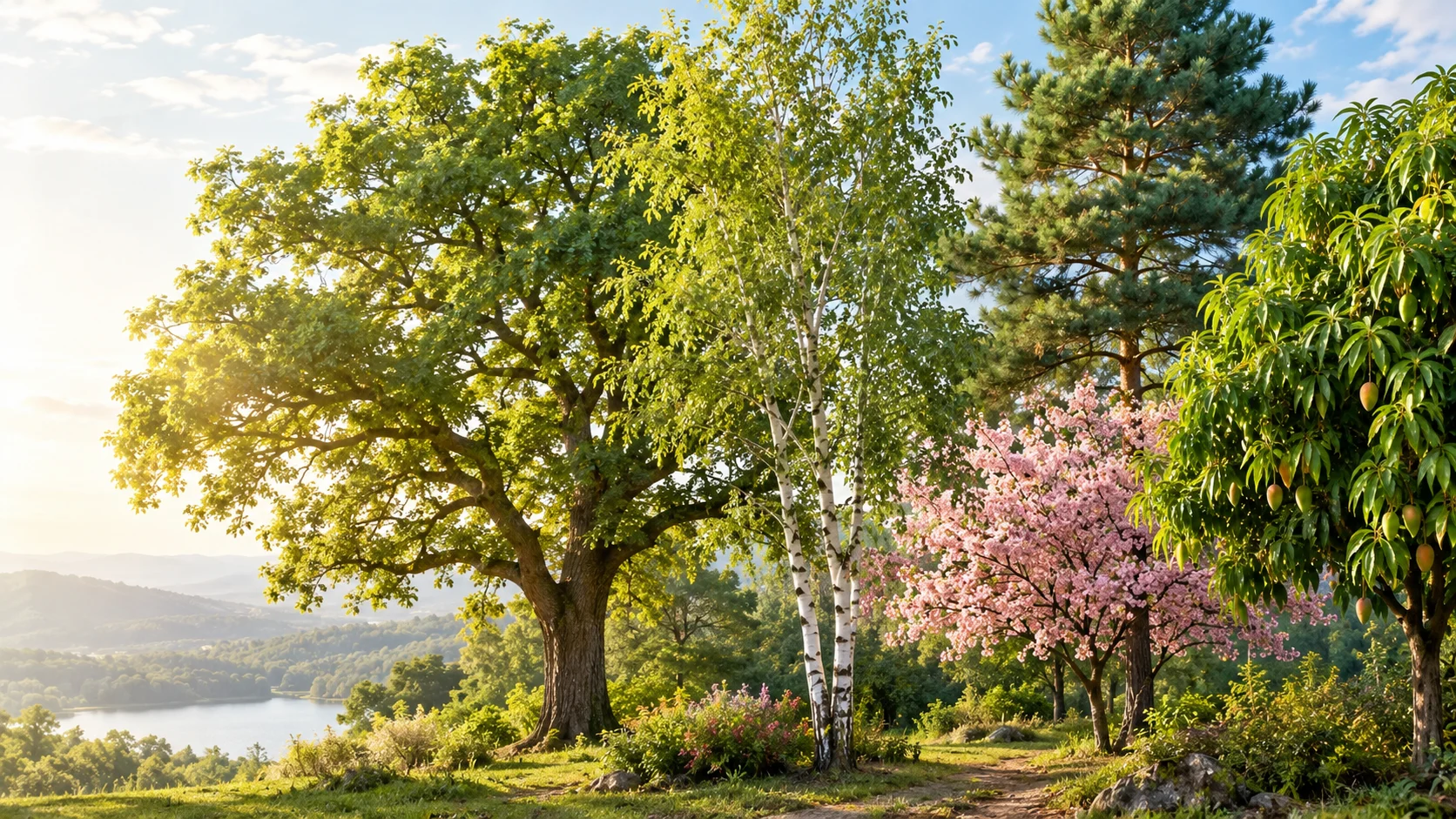
Common names of trees include oak, maple, pine, birch, willow, cedar, cherry, mango, neem, banyan, and olive. Trees vary in size, leaf type, flowers, fruit, habitat, and growing conditions.
A tree is more than a beautiful part of a landscape. It can provide shade on a hot afternoon, produce fruit for a family, shelter birds, or stand quietly in the same place for generations. From towering forest giants to small flowering trees in home gardens, every species has its own story.
Exploring the names of trees is a wonderful way to understand the natural world around us. You may recognize the familiar mango tree in a tropical garden, the graceful willow beside a stream, or the bright cherry tree covered in spring blossoms. Other trees, such as the ancient bristlecone pine, are famous for their remarkable ability to survive for thousands of years.
But how do you tell one tree from another? Its leaves, bark, flowers, fruit, shape, and growing location can offer useful clues. Learning these features makes nature walks more interesting and helps gardeners choose suitable trees for their surroundings.
In this guide, you will discover more than 100 tree names, their scientific names, distinctive features, common uses, and interesting facts. you are a student, gardener, nature lover, or simply curious, this collection will help you explore the amazing diversity of trees.
1. Oak Tree (Quercus spp.) | A Symbol of Strength
The oak is one of the best-known groups of trees in the Northern Hemisphere. Different oak species have lobed, toothed, or smooth-edged leaves, and many produce acorns.
Meaning and origin: The English word “oak” has Germanic roots. Oak trees are often used as symbols of strength, endurance, and stability.
Personality and style: Majestic, traditional, sturdy, and timeless.
Best for: Parks, large gardens, woodland restoration, and wildlife habitats, depending on the species and local climate.
Popularity: Oaks are widely recognized landscape and forest trees.
Emotional appeal: Their broad crowns and long lives make them impressive features in many landscapes.
Cultural reference: Oaks appear in folklore, heraldry, and traditional symbolism across several European cultures.
Similar trees: Beech, chestnut, elm, maple.
Why it still matters: Oak trees provide habitat and food for many animals. Their acorns support wildlife, while mature trees contribute shade and carbon storage. Different oak species vary greatly in size, so local growing conditions matter.
2. Maple Tree (Acer spp.) | Nature’s Autumn Artist
Maple trees are admired for their distinctive leaves, many of which turn bright red, orange, or yellow in autumn. The group includes species native to Asia, Europe, and North America.
Meaning and origin: Maple is the common English name for trees in the genus Acer. Maples are often associated with balance, change, and seasonal beauty.
Personality and style: Colorful, graceful, and ornamental.
Best for: Gardens, parks, streets, and larger yards, depending on the species.
Popularity: Maples are popular ornamental trees, particularly in regions with noticeable autumn seasons.
Emotional appeal: Their changing leaf colors make seasonal transitions feel special.
Cultural reference: The maple leaf is a national symbol of Canada.
Similar trees: Sweetgum, birch, oak, Japanese maple.
Why it still matters: Maples offer shade, wildlife habitat, and beautiful foliage. Some species provide sap used to produce maple syrup. Japanese maples are especially valued for their delicate shapes and colorful leaves.
3. Pine Tree (Pinus spp.) | The Evergreen Classic
Pine trees are conifers with needle-like leaves and woody cones. Many species remain green throughout the year, although needle retention and growth patterns vary.
Meaning and origin: Pine refers to trees in the genus Pinus. Evergreen pines often symbolize longevity, resilience, and renewal.
Personality and style: Hardy, natural, rustic, and evergreen.
Best for: Forests, windbreaks, large gardens, and suitable dry or cool landscapes, depending on the species.
Popularity: Pines are widely planted for forestry, landscaping, and habitat restoration.
Emotional appeal: Their evergreen foliage keeps landscapes looking alive during many winter months.
Cultural reference: Pine trees feature in winter holiday traditions in many countries.
Similar trees: Spruce, fir, cedar, larch.
Why it still matters: Pine forests support wildlife and provide timber and other useful products. However, not every pine suits a small garden; some grow very large and have extensive root systems.
4. Cherry Tree (Prunus spp.) | A Springtime Beauty
Cherry trees include ornamental flowering species and trees grown for their fruit. Their blossoms can cover branches in white or pink flowers during the right season.
Meaning and origin: Cherry comes through older European language forms related to the fruit. Cherry blossoms are widely associated with spring, renewal, and the fleeting beauty of life.
Personality and style: Romantic, delicate, colorful, and elegant.
Best for: Ornamental gardens, parks, orchards, and spring displays, depending on the variety.
Popularity: Flowering cherries are popular ornamental trees in many temperate regions.
Emotional appeal: Their brief but striking blossom displays create memorable seasonal moments.
Cultural reference: Cherry blossom viewing, known as hanami, is an important seasonal tradition in Japan.
Similar trees: Plum, peach, almond, crabapple.
Why it still matters: Cherry trees provide flowers and, in fruit-producing varieties, edible cherries. Ornamental varieties may produce little useful fruit, so choose a tree based on your main goal.
5. Willow Tree (Salix spp.) | Graceful and Peaceful
Willows are often recognized by their narrow leaves and flexible branches. Weeping willow varieties have long, hanging shoots that create a distinctive flowing shape.
Meaning and origin: Willow is an old English tree name. In literature and symbolism, willows are sometimes linked with sorrow, reflection, flexibility, or peace.
Personality and style: Graceful, soft, flowing, and natural.
Best for: Large gardens, parks, and suitable damp locations with enough room for roots and branches.
Popularity: Weeping willows remain familiar ornamental trees.
Emotional appeal: Their hanging branches and movement in the wind create a calm, gentle appearance.
Cultural reference: Willows appear in poetry, folklore, and art across different cultures.
Similar trees: Birch, alder, poplar, aspen.
Why it still matters: Willows can help stabilize some stream banks and provide habitat for insects and birds. Many species prefer moist soil, and some have vigorous roots, making careful placement essential.
6. Banyan Tree (Ficus benghalensis) | The Living Giant
The banyan is a tropical fig tree famous for aerial roots that grow from branches and may eventually form additional trunk-like supports.
Meaning and origin: The name “banyan” developed through historical trade and language contact in South Asia. Banyan trees are associated with shelter, longevity, community, and spiritual significance.
Personality and style: Monumental, protective, ancient, and spreading.
Best for: Large tropical landscapes, public gardens, and open spaces where extensive growth is possible.
Popularity: Banyans are well known across South Asia and are planted as shade trees in suitable climates.
Emotional appeal: A mature banyan can create a vast canopy that feels like a natural gathering place.
Cultural reference: The banyan has religious and cultural importance in parts of South Asia. The national tree of India is the banyan.
Similar trees: Sacred fig, rain tree, giant fig, Indian laurel.
Why it still matters: Banyans provide food and habitat for wildlife. Their enormous size and spreading roots make them unsuitable for most small residential gardens.
7. Neem Tree (Azadirachta indica) | A Useful Tropical Tree
Neem is an evergreen or semi-evergreen tree native to the Indian subcontinent and widely grown in tropical and subtropical regions.
Meaning and origin: Neem is the common name used across South Asia. The tree is associated with traditional practices, shade, and practical uses.
Personality and style: Hardy, practical, resilient, and familiar.
Best for: Suitable warm-climate gardens, farms, and open spaces with room for mature growth.
Popularity: Neem is widely recognized in South Asia and is planted in many warm regions.
Emotional appeal: Its broad canopy provides welcome shade in hot weather.
Cultural reference: Neem leaves and other parts of the tree have a long history in traditional South Asian practices.
Similar trees: Moringa, tamarind, acacia, Indian laurel.
Why it still matters: Neem has many traditional and commercial uses, including products derived from its seeds. However, traditional use does not prove that every neem preparation is safe or effective for every medical purpose.
8. Mango Tree (Mangifera indica) | A Tropical Favorite
The mango tree is a tropical evergreen known for its dense foliage, fragrant flowers, and sweet fruit.
Meaning and origin: Mango is the common English name for Mangifera indica, a species domesticated in South Asia and cultivated widely in tropical regions.
Personality and style: Generous, lush, fruitful, and summery.
Best for: Warm-climate gardens, orchards, farms, and spacious yards.
Popularity: Mango is one of the most familiar fruit trees across tropical and subtropical countries.
Emotional appeal: Its fruit is connected with summer, family meals, and local food traditions.
Cultural reference: Mangoes have a long cultural and culinary history in South Asia and beyond.
Similar trees: Guava, jackfruit, citrus, lychee.
Why it still matters: Mango trees provide edible fruit and shade. They generally need warmth and suitable growing conditions to fruit well, so cold-climate gardeners may need container-grown dwarf varieties or a different species.
9. Olive Tree (Olea europaea) | A Timeless Mediterranean Icon
The olive is an evergreen tree with narrow, gray-green leaves and small fruits used to produce olives and olive oil.
Meaning and origin: Olive comes through Latin and older Mediterranean language forms. The tree has long symbolized peace, wisdom, and abundance in several cultural traditions.
Personality and style: Elegant, understated, historic, and resilient.
Best for: Mediterranean-style gardens, warm dry regions, orchards, and containers in suitable climates.
Popularity: Olive trees are widely cultivated in Mediterranean countries and other regions with appropriate growing conditions.
Emotional appeal: Their silvery foliage and gnarled trunks give landscapes an aged, peaceful character.
Cultural reference: Olive branches have long been symbols of peace and have historical associations with ancient Greece.
Similar trees: Bay laurel, fig, pomegranate, pistachio.
Why it still matters: Olive trees produce an important food crop and can live for centuries under suitable conditions. Fruit production depends on climate, variety, pollination, and care.
10. Birch Tree (Betula spp.) | A Bright Woodland Favorite
Birch trees are known for their light-colored bark in many species and their delicate leaves. They are found across cool and temperate regions of the Northern Hemisphere.
Meaning and origin: Birch is an old English tree name with Germanic roots. The tree is often associated with renewal, lightness, and new beginnings.
Personality and style: Delicate, graceful, fresh, and natural.
Best for: Woodland gardens, parks, and cool-climate landscapes where the selected species can thrive.
Popularity: Birches are popular ornamental trees because of their bark and airy appearance.
Emotional appeal: Their pale trunks stand out beautifully against dark foliage or winter landscapes.
Cultural reference: Birch has appeared in folklore and traditional crafts in parts of Europe and Asia.
Similar trees: Aspen, alder, poplar, beech.
Why it still matters: Birch trees support insects and wildlife and can contribute to woodland diversity. Many species prefer cooler conditions and may struggle in very hot, dry locations.
Quick Comparison Table of Tree Names
| Tree Name | Scientific Name | Main Feature | Style or Use |
|---|---|---|---|
| Oak | Quercus spp. | Acorns and broad crowns | Shade and wildlife |
| Maple | Acer spp. | Colorful autumn leaves | Ornamental |
| Pine | Pinus spp. | Needles and cones | Evergreen landscapes |
| Cherry | Prunus spp. | Spring blossoms or fruit | Gardens and orchards |
| Willow | Salix spp. | Flexible branches | Moist landscapes |
| Banyan | Ficus benghalensis | Aerial roots | Large tropical spaces |
| Neem | Azadirachta indica | Hardy tropical foliage | Shade and traditional uses |
| Mango | Mangifera indica | Edible fruit | Orchards and gardens |
| Olive | Olea europaea | Silvery leaves and olives | Mediterranean landscapes |
| Birch | Betula spp. | Often pale bark | Woodland gardens |
100+ Names of Trees Around the World
The following list includes common tree names from different climates and regions. Scientific names are provided where useful. Some common names refer to several related species, so local identification guides can help distinguish them.
Deciduous Trees
Deciduous trees shed their leaves during part of the year, often in response to seasonal changes.
- Oak — Quercus spp.
- Maple — Acer spp.
- Birch — Betula spp.
- Willow — Salix spp.
- Beech — Fagus spp.
- Elm — Ulmus spp.
- Ash — Fraxinus spp.
- Aspen — Populus tremula and related species
- Poplar — Populus spp.
- Sycamore — Platanus spp. or Acer pseudoplatanus, depending on region
- Alder — Alnus spp.
- Hornbeam — Carpinus spp.
- Linden — Tilia spp.
- Sweetgum — Liquidambar styraciflua and related species
- Ginkgo — Ginkgo biloba
Evergreen Trees
Evergreen trees retain foliage throughout the year, although they still replace old leaves or needles over time.
- Scots pine — Pinus sylvestris
- Eastern white pine — Pinus strobus
- Norway spruce — Picea abies
- Blue spruce — Picea pungens
- Silver fir — Abies alba
- Douglas-fir — Pseudotsuga menziesii
- Cedar of Lebanon — Cedrus libani
- Deodar cedar — Cedrus deodara
- Cypress — Cupressus spp.
- Juniper — Juniperus spp.
- Yew — Taxus spp.
- Holly — Ilex spp.
- Southern magnolia — Magnolia grandiflora
- Eucalyptus — Eucalyptus spp.
- Coast redwood — Sequoia sempervirens
Flowering Trees
Flowering trees add color, fragrance, and seasonal interest to landscapes. Some also provide nectar, pollen, or fruit.
- Cherry — Prunus spp.
- Japanese magnolia — Magnolia spp.
- Dogwood — Cornus spp.
- Jacaranda — Jacaranda mimosifolia
- Golden shower tree — Cassia fistula
- Redbud — Cercis spp.
- Crape myrtle — Lagerstroemia spp.
- Royal poinciana — Delonix regia
- Frangipani — Plumeria spp.
- Silk floss tree — Ceiba speciosa
- Tulip tree — Liriodendron tulipifera
- Flame tree — Brachychiton acerifolius and other regionally named species
- Bottlebrush tree — Melaleuca spp. and related genera
- Flowering crabapple — Malus spp.
- Horse chestnut — Aesculus hippocastanum
Fruit-Bearing Trees
Fruit trees produce edible crops or fruits eaten by wildlife. Growing needs vary by climate, soil, and variety.
- Mango — Mangifera indica
- Apple — Malus domestica
- Pear — Pyrus communis
- Peach — Prunus persica
- Plum — Prunus spp.
- Apricot — Prunus armeniaca
- Lemon — Citrus limon
- Orange — Citrus sinensis
- Lime — Citrus aurantiifolia and related species
- Guava — Psidium guajava
- Pomegranate — Punica granatum
- Fig — Ficus carica
- Olive — Olea europaea
- Avocado — Persea americana
- Jackfruit — Artocarpus heterophyllus
- Lychee — Litchi chinensis
- Sapodilla — Manilkara zapota
- Persimmon — Diospyros spp.
- Mulberry — Morus spp.
- Jujube — Ziziphus jujuba
Tropical and Subtropical Trees
These trees grow naturally or are cultivated in warm regions. Some are evergreen, while others shed their leaves seasonally.
- Banyan — Ficus benghalensis
- Neem — Azadirachta indica
- Tamarind — Tamarindus indica
- Baobab — Adansonia spp.
- Rain tree — Samanea saman
- African mahogany — Khaya spp.
- Teak — Tectona grandis
- Sandalwood — Santalum album
- Moringa — Moringa oleifera
- Indian rosewood — Dalbergia sissoo
- Flame of the forest — Butea monosperma
- Indian laburnum — Cassia fistula
- Indian almond — Terminalia catappa
- Breadfruit — Artocarpus altilis
- Areca palm — Areca catechu
- Coconut palm — Cocos nucifera
- Royal palm — Roystonea regia
- Sago palm — Cycas revoluta
- Dragon blood tree — Dracaena cinnabari
- Indian beech — Pongamia pinnata
Botanical note: Palms and cycads are often called trees in everyday language, but they are not true woody trees in the same botanical sense as oaks and maples. Their growth structures differ.
Famous and Ancient Trees
Some trees are famous because of their age, size, cultural role, or unusual shape.
- Bristlecone pine — Pinus longaeva
- Giant sequoia — Sequoiadendron giganteum
- Coast redwood — Sequoia sempervirens
- Sacred fig — Ficus religiosa
- Banyan — Ficus benghalensis
- Olive — Olea europaea
- Dragon blood tree — Dracaena cinnabari
- Baobab — Adansonia spp.
- Monkey puzzle tree — Araucaria araucana
- Wollemi pine — Wollemia nobilis
More Trees for Gardens and Landscapes
- Japanese maple — Acer palmatum
- Weeping willow — Salix babylonica
- Persian ironwood — Parrotia persica
- Katsura tree — Cercidiphyllum japonicum
- Paperbark maple — Acer griseum
- Persian silk tree — Albizia julibrissin
- Strawberry tree — Arbutus unedo
- Smoke tree — Cotinus coggygria
- Kentucky coffeetree — Gymnocladus dioicus
- Chinese pistache — Pistacia chinensis
- American sycamore — Platanus occidentalis
- American hornbeam — Carpinus caroliniana
- Bald cypress — Taxodium distichum
- Dawn redwood — Metasequoia glyptostroboides
- Kousa dogwood — Cornus kousa
How to Choose the Right Tree for Your Garden
The best tree for your garden depends on your climate, available space, soil, and reason for planting it.
1. Check your local climate. Some trees need winter chill, while tropical species require warm temperatures. Select species suited to your region.
2. Measure the available space. Consider the tree’s mature height and width, not just the size of the young plant. Keep large trees away from buildings, overhead wires, and underground utilities.
3. Think about your goal. Choose mango or citrus for fruit in suitable climates, cherry for seasonal blossoms, maple for autumn color, or pine for evergreen foliage.
4. Understand soil and water needs. Willows often prefer moist conditions, while olives generally tolerate drier climates once established. Requirements differ among species and cultivars.
5. Consider maintenance. Some trees drop fruit, shed leaves, develop surface roots, or require regular pruning. Ask a local nursery about common problems before planting.
6. Choose native species where practical. Locally native trees can support regional wildlife and may be better adapted to local conditions. Avoid invasive species and follow local planting guidance.
7. Plan for the future. A tree planted today may grow for decades. Think about shade, roots, branches, and how the landscape may change over time.
Most Popular Tree Types for Different Purposes
Different trees are useful for different settings. These are general examples, not a universal ranking.
- For shade: Oak, plane tree, rain tree, and suitable maple species.
- For colorful flowers: Cherry, jacaranda, dogwood, and golden shower tree.
- For fruit: Mango, apple, citrus, guava, and fig, depending on climate.
- For evergreen foliage: Pine, spruce, fir, and suitable cypress species.
- For small gardens: Carefully selected Japanese maples, dwarf fruit trees, and compact ornamental cultivars.
- For dry climates: Olive and locally adapted drought-tolerant species.
- For tropical gardens: Mango, neem, frangipani, and suitable palms.
- For autumn color: Many maples, sweetgums, and selected birch species.
- For wildlife: Native oaks, willows, birches, and locally appropriate fruiting species.
- For large open spaces: Banyan, rain tree, and other broad-canopied trees where their size is manageable.
Always confirm mature dimensions and local suitability before planting.
Traditional and Culturally Significant Trees
Trees have played important roles in stories, religion, food, medicine, art, and community life. Their meanings vary by culture, so no single symbolic interpretation applies everywhere.
- Olive: Often associated with peace and historically important around the Mediterranean.
- Banyan: A culturally and spiritually significant tree in parts of South Asia.
- Sacred fig: Known for its religious significance in Hinduism, Buddhism, and other South Asian traditions.
- Oak: Associated with strength and endurance in several European traditions.
- Cherry: Cherry blossoms are celebrated in Japan as signs of spring and the temporary nature of beauty.
- Cedar: Important in the histories, traditions, and material cultures of several regions.
- Baobab: A striking African tree featured in local stories and landscapes across parts of its range.
- Neem: Long used in traditional South Asian practices.
- Coconut palm: An important source of food and materials in many tropical communities.
- Bristlecone pine: Noted for its exceptional longevity and value to scientific research.
These examples show how trees can become symbols of identity, memory, and place as well as living parts of an ecosystem.
Modern Tree-Planting Trends
Tree planting increasingly focuses on more than appearance. Gardeners, cities, and conservation groups consider heat, water, biodiversity, and long-term maintenance.
Native planting: Locally native trees can support insects, birds, and other wildlife.
Urban shade: Cities often plant trees to help shade streets and public spaces, although success depends on species selection, soil volume, irrigation, and maintenance.
Small-space gardening: Dwarf fruit trees and compact ornamental varieties help people grow trees in smaller yards and containers.
Climate-resilient landscapes: Planners increasingly consider heat tolerance, drought, pests, and expected future conditions.
Mixed-species planting: Using a variety of suitable trees can reduce reliance on a single species and improve landscape resilience.
Fruit trees at home: In suitable climates, fruit trees let families enjoy fresh produce while adding shade and seasonal interest.
A thoughtful planting plan considers the tree’s entire life, including how it will grow, what wildlife it may support, and how it will fit into its surroundings.
FAQs
Q1. What are the most common names of trees?
Oak, maple, pine, birch, willow, cedar, cherry, mango, neem, and olive are familiar tree names. Their distribution varies by region, climate, and local planting practices.
Q2. How many types of trees are there in the world?
There are tens of thousands of tree species worldwide. The exact number depends on how researchers define trees and classify species, and scientific estimates change as new research becomes available.
Q3. What is the difference between evergreen and deciduous trees?
Evergreen trees retain their foliage throughout the year, replacing old leaves gradually or in cycles. Deciduous trees shed their leaves seasonally, often in response to cold, drought, or other environmental conditions.
Q4. Which trees are best for home gardens?
The best trees depend on climate, soil, and available space. Compact Japanese maples, dwarf fruit trees, and suitable native species can work well in smaller gardens, while large oaks and banyans need much more room.
Q5. Which trees produce fruit?
Mango, apple, orange, guava, fig, olive, pear, and pomegranate are examples of fruit-bearing trees. Some produce fruit suitable for people, while others mainly provide food for wildlife.
Q6. Which trees are famous for their flowers?
Cherry, jacaranda, dogwood, magnolia, golden shower tree, and royal poinciana are known for their flowers. Bloom color and timing depend on species, variety, climate, and local growing conditions.
Q7. What are the oldest types of trees?
Bristlecone pines include some of the oldest known individual non-clonal trees. Other long-lived groups include certain olive trees and giant sequoias, although ages vary and individual claims require reliable verification.
Q8. Why are scientific tree names important?
Scientific names help identify a particular species across languages and regions. Common names can refer to several different plants, so botanical names reduce confusion when researching tree identification, care, and conservation.
Conclusion
Learning the names of trees opens the door to a richer understanding of nature. From the strong oak and colorful maple to the tropical mango and remarkable banyan, each tree has its own features, growing needs, and place in the environment.
Some trees provide food, others offer shade or beautiful flowers, and many support birds, insects, and other wildlife. Their cultural meanings also remind us that trees are deeply connected to human history and everyday life.
Use this guide as a starting point when identifying trees, planning a garden, helping children learn plant names, or exploring your local environment. Always check the scientific name and growing requirements before choosing a tree for planting.
Which tree is your favorite, and which one grows near your home? Share this guide with fellow nature lovers and leave a comment with the tree you would most like to learn about next.
Discover More Related Articles:
- 101 Country Dog Names | For a Rustic, Charming & Southern Pup In 2026
- 100 Badass Dog Names | For Tough, Cool & Fearless Dogs In 2026
- 300 French Dog Names | Elegant, Cute & Unique Ideas for Your Pup In 2026