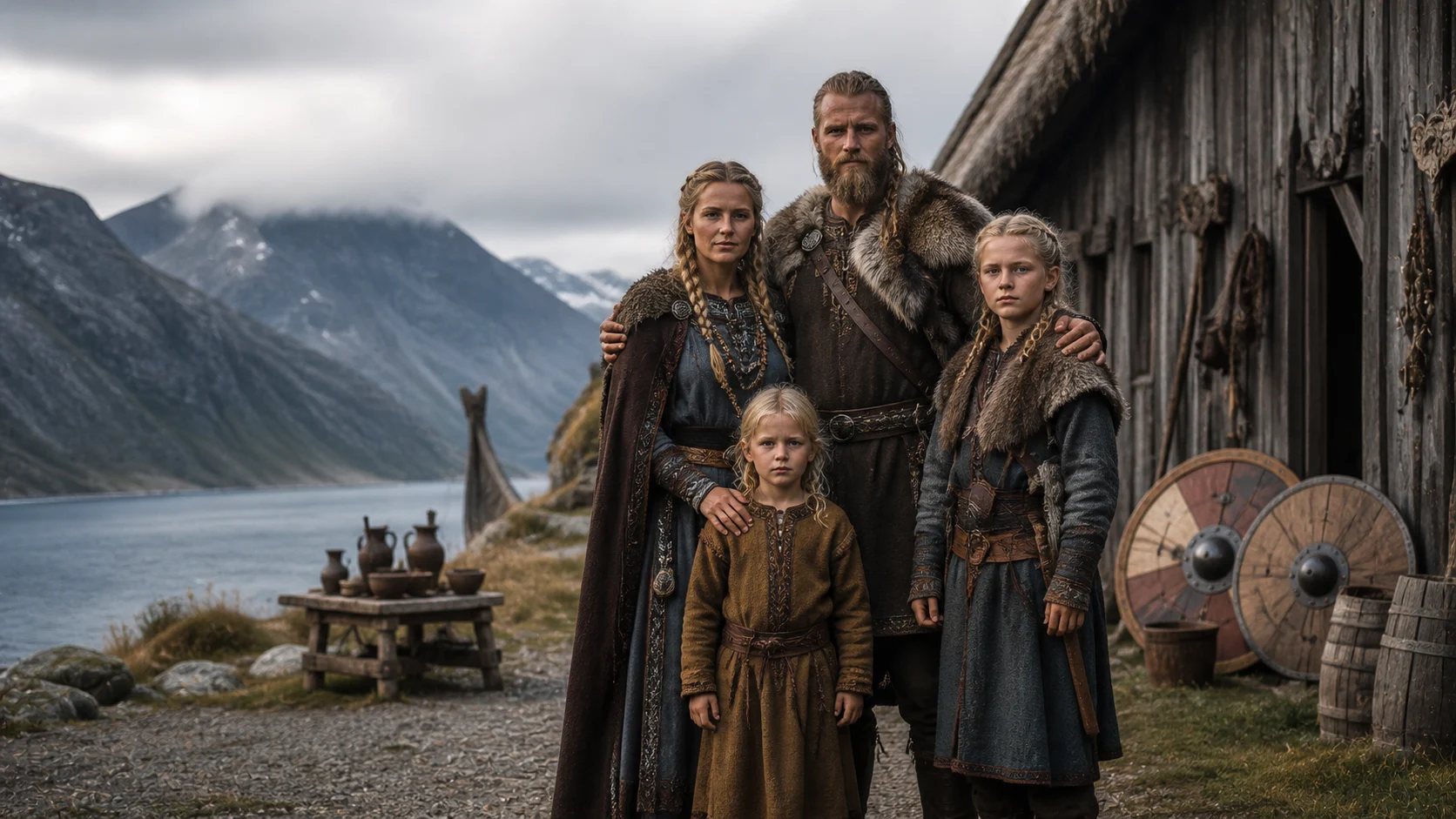
Viking last names were usually not hereditary surnames like modern family names. Norse people commonly used patronymics such as Eriksson or Eiríksdóttir, along with descriptive bynames that identified a person’s parentage, appearance, birthplace, occupation, or reputation.
A name can carry an entire story. It can tell you who someone belonged to, where they came from, or what made them memorable. That is one reason Viking last names continue to fascinate people today. Norse names sound strong and distinctive, but their history is even more interesting than their dramatic style suggests.
The important thing to know is that Vikings generally did not use hereditary surnames in the modern sense. Instead, they commonly used patronymics, occasional matronymics, and descriptive bynames. A person’s second name could literally identify them as someone’s son or daughter, while a byname might describe their appearance, personality, origin, or reputation.
How Viking Last Names Actually Worked
Before exploring individual names, it helps to understand the Norse naming system.
A Viking-era person might have a given name followed by a patronymic, meaning a name based on their father’s name. The suffix -son indicated “son of,” while -dóttir indicated “daughter of.” For example, a son of someone named Erik could be called Eiríksson, while his daughter could be Eiríksdóttir.
These names normally changed from one generation to the next. If Erik had a son named Leif, Leif could be Leif Eriksson. If Leif later had a son named Harald, that child would not normally inherit “Eriksson” as a fixed family surname. He could instead receive a name based on Leif.
Norse people also used bynames. These were descriptive nicknames connected with physical features, personality, ancestry, occupation, location, clothing, beliefs, or notable deeds. Famous examples include Harald Bluetooth and Sweyn Forkbeard.
So, when people search for “Viking surnames,” they are often looking for a mixture of these historical naming traditions.
Eriksson
Meaning
Eriksson means “son of Erik” or “son of Eiríkr.”
Origin
It comes from the Old Norse patronymic naming tradition. The modern spelling varies across Scandinavia, including forms such as Eriksson, Eriksen, and related versions.
Personality
Eriksson has a traditional, sturdy, and unmistakably Scandinavian feel. It works especially well for characters who have a connection to a strong family lineage.
Style
Classic, masculine, Scandinavian, historical.
Best For
It works well for historical characters, Viking-inspired stories, genealogy projects, usernames, and fantasy characters.
Popularity
The name pattern remains recognizable throughout Scandinavia, although modern forms can function as hereditary surnames rather than living patronymics.
Emotional Appeal
Eriksson feels grounded and authentic. It immediately suggests Scandinavian heritage without sounding overly complicated.
Pop Culture Reference
The name is strongly associated with the famous explorer Leif Eriksson, although the patronymic itself simply means “son of Erik.”
Similar Names
Eriksen, Eiriksson, Eiriksen, Haraldsson, Leifsson.
Why It Still Works Today
Its simple structure makes Eriksson easy to recognize and pronounce while retaining a strong connection to Scandinavian naming history.
Haraldsson
Meaning
Haraldsson means “son of Harald.”
Origin
It follows the Norse patronymic pattern of combining a parent’s name with a word meaning “son.” Historical Old Norse patronymics were created from the father’s name in its appropriate grammatical form.
Personality
Haraldsson feels bold, noble, and traditional. It suits a character with leadership qualities or an imposing presence.
Style
Royal, strong, classic, Viking-inspired.
Best For
Historical fiction, fantasy characters, genealogy, gaming characters, and Norse-inspired usernames.
Popularity
The underlying patronymic pattern is ancient, while Haraldsson continues to appear as a Scandinavian surname today.
Emotional Appeal
The name feels connected to generations of warriors, rulers, explorers, and seafarers.
Pop Culture Reference
Harald is particularly memorable because several medieval Scandinavian rulers carried the name, including Harald Bluetooth.
Similar Names
Haraldsen, Haraldsdóttir, Eiriksson, Sigurdsson, Olafsson.
Why It Still Works Today
Haraldsson combines a recognizable Scandinavian name with an easy-to-understand meaning, making it useful for both historical and modern creative settings.
Leifsson
Meaning
Leifsson means “son of Leif.”
Origin
It follows the traditional Scandinavian patronymic pattern in which the father’s name forms the basis of the child’s secondary name.
Personality
Leifsson feels adventurous, calm, and exploratory. The name naturally suits a character connected with travel or discovery.
Style
Adventurous, traditional, Nordic, masculine.
Best For
Viking characters, historical fiction, gaming, fantasy worlds, and genealogy-inspired projects.
Popularity
Leif remains a recognizable Scandinavian given name, while Leifsson fits naturally into the broader family of patronymic names.
Emotional Appeal
The name has a strong connection with exploration because of the historical association of Leif Eriksson with Norse exploration of North America.
Pop Culture Reference
Leif Eriksson is one of the best-known Norse explorers in popular history.
Similar Names
Eriksson, Olafsson, Björnsson, Haraldsson, Sigurdsson.
Why It Still Works Today
It sounds authentically Nordic while remaining simple enough for modern readers to understand and remember.
Olafsson
Meaning
Olafsson means “son of Olaf.”
Origin
Olaf, or Óláfr in Old Norse, was a well-established Scandinavian given name. Adding the patronymic ending creates a name meaning “Olaf’s son.
Personality
Olafsson feels dependable, traditional, and dignified.
Style
Classic, historical, Scandinavian, noble.
Best For
Historical characters, Viking-themed stories, family-history projects, fantasy characters, and gaming.
Popularity
Olaf and its related forms have remained recognizable in Scandinavian naming traditions for centuries.
Emotional Appeal
Olafsson sounds like a name with history behind it. It has a strong ancestral quality without becoming difficult to pronounce.
Pop Culture Reference
The given name Olaf appears in numerous Scandinavian historical contexts, including royal history.
Similar Names
Olavsson, Olafsen, Haraldsson, Eriksson, Björnsson.
Why It Still Works Today
The straightforward “son of Olaf” meaning makes it an excellent choice for anyone wanting a traditional Scandinavian-style name.
Björnsson
Meaning
Björnsson means “son of Björn.”
Origin
Björn is an Old Norse name connected with the word for bear. The patronymic form identifies the bearer as Björn’s son.
Personality
Björnsson feels powerful, rugged, protective, and courageous.
Style
Strong, wild, masculine, Nordic.
Best For
Warrior characters, Viking fiction, fantasy heroes, gaming characters, and adventure stories.
Popularity
Björn remains an established Scandinavian given name, and Björnsson follows a familiar Scandinavian surname pattern.
Emotional Appeal
The connection with the bear gives the name a naturally powerful image.
Pop Culture Reference
Björn is a well-known Scandinavian historical and literary name and has remained popular beyond the Viking Age.
Similar Names
Björnsen, Björnsdóttir, Ulfrsson, Eriksson, Sigurdsson.
Why It Still Works Today
The bear association gives Björnsson immediate visual strength, while its patronymic structure keeps it historically grounded.
Sigurdsson
Meaning
Sigurdsson means “son of Sigurd.”
Origin
Sigurd, Old Norse Sigurðr, is an important Norse name. Its patronymic form follows the traditional “-son” naming pattern.
Personality
Sigurdsson sounds heroic, serious, and battle-ready.
Style
Epic, traditional, warrior-like, legendary.
Best For
Fantasy heroes, Viking characters, historical fiction, gaming usernames, and role-playing characters.
Popularity
Sigurd and its related forms have remained part of Scandinavian naming traditions long after the Viking Age.
Emotional Appeal
The name has a legendary quality that makes it particularly attractive for heroic characters.
Pop Culture Reference
Sigurd is closely associated with the legendary hero Sigurd the dragon slayer in Norse and Germanic tradition.
Similar Names
Sigurðsson, Haraldsson, Eiriksson, Gunnarsson, Olafsson.
Why It Still Works Today
Sigurdsson sounds dramatic without being invented, making it a strong option for authentic Norse-inspired storytelling.
Gunnarsson
Meaning
Gunnarsson means “son of Gunnar.”
Origin
Gunnar is an old Scandinavian name with deep roots in Germanic and Norse naming traditions.
Personality
Gunnarsson feels confident, brave, energetic, and dependable.
Style
Strong, traditional, rugged, masculine.
Best For
Viking warriors, historical characters, fantasy heroes, gaming profiles, and Scandinavian-inspired stories.
Popularity
Gunnar has remained recognizable across Scandinavia, while Gunnarsson follows the traditional patronymic naming structure.
Emotional Appeal
Its strong sound makes it memorable while still feeling natural.
Pop Culture Reference
Gunnar appears in Norse and Germanic legendary traditions, giving the name an established literary background.
Similar Names
Gunnarsen, Gunnarsson, Sigurdsson, Haraldsson, Thorsson.
Why It Still Works Today
Gunnarsson offers a balance between historical atmosphere and modern readability.
Thorsson
Meaning
Thorsson means “son of Thor.”
Origin
The name follows the patronymic pattern using Thor, the famous Norse thunder god, as the father’s given name.
Personality
Thorsson feels powerful, fearless, energetic, and commanding.
Style
Mythological, bold, dramatic, Nordic.
Best For
Fantasy characters, mythology-inspired projects, gaming, Viking fiction, and creative usernames.
Popularity
Names containing Thor or Þór were widespread in Norse naming traditions, although the exact historical form would depend on the grammatical context and period.
Emotional Appeal
Thor carries an immediate association with thunder, strength, and Norse mythology.
Pop Culture Reference
Thor is one of the most recognizable figures in Norse mythology and has become globally famous through modern popular culture.
Similar Names
Þórsson, Thorsson, Thorvaldsson, Thorsteinsson, Thorkelsson.
Why It Still Works Today
Thorsson is easy to recognize and gives a character an instantly Norse-inspired identity.
Ragnarsson
Meaning
Ragnarsson means “son of Ragnar.”
Origin
It follows the Scandinavian patronymic tradition. Ragnar is a famous Old Norse personal name associated with several legendary and historical traditions.
Personality
Ragnarsson feels adventurous, fearless, rebellious, and commanding.
Style
Warrior-like, dramatic, traditional, powerful.
Best For
Viking fiction, fantasy characters, gaming, role-playing, and historical-inspired storytelling.
Popularity
Ragnar remains strongly associated with Viking history and legend, making Ragnarsson especially recognizable today.
Emotional Appeal
The name has a cinematic quality and immediately creates an image of a bold Norse warrior.
Pop Culture Reference
Ragnar Lodbrok is one of the most famous legendary Viking figures, although the historical evidence surrounding the legendary character is complex.
Similar Names
Ragnarsen, Sigurdsson, Haraldsson, Björnsson, Eriksson.
Why It Still Works Today
Ragnarsson combines a familiar Viking-era given name with a historically recognizable patronymic structure.
Ketilsson
Meaning
Ketilsson means “son of Ketill.”
Origin
Ketill was an Old Norse personal name. The form Ketilsson follows the traditional patronymic pattern.
Personality
Ketilsson feels old-world, scholarly, sturdy, and distinctly Nordic.
Style
Ancient, historical, understated, traditional.
Best For
Historical fiction, Norse characters, genealogy research, fantasy settings, and role-playing games.
Popularity
Ketill was a known Old Norse personal name, although the modern familiarity of its forms varies by Scandinavian country.
Emotional Appeal
It feels less common than names such as Eriksson or Olafsson, giving it a more distinctive quality.
Pop Culture Reference
Ketill appears in Icelandic settlement and saga traditions, making it a useful name for historically inspired fiction.
Similar Names
Ketilsen, Ketilsdóttir, Thorsteinsson, Eiriksson, Hrafnkelsson.
Why It Still Works Today
Ketilsson is a good choice when you want something recognizably Norse without choosing one of the most famous Viking names.
Hrafnsson
Meaning
Hrafnsson means “son of Hrafn,” with hrafn meaning “raven” in Old Norse.
Origin
Hrafn was used as a personal name and also connects with the raven, an important bird in Norse culture and mythology.
Personality
Hrafnsson feels mysterious, intelligent, observant, and independent.
Style
Dark, poetic, ancient, mystical.
Best For
Fantasy characters, Viking-inspired stories, mysterious heroes, gaming, and creative writing.
Popularity
Hrafn is less familiar to modern English speakers than names such as Erik or Björn, which gives the name a more unusual quality.
Emotional Appeal
The raven association creates a strong image of wisdom, mystery, travel, and the natural world.
Pop Culture Reference
Ravens have strong associations with Odin in Norse mythology, making Hrafn especially appealing for mythology-inspired characters.
Similar Names
Hrafnkelsson, Björnsson, Ulfrsson, Thorsson, Sigurdsson.
Why It Still Works Today
Hrafnsson sounds distinctive and ancient while still following a genuine Norse naming pattern.
Quick Comparison Table
| Viking Last Name | Meaning | Style | Best For |
|---|---|---|---|
| Eriksson | Son of Erik | Classic | Historical characters |
| Haraldsson | Son of Harald | Noble | Viking heroes |
| Leifsson | Son of Leif | Adventurous | Explorers |
| Olafsson | Son of Olaf | Traditional | Historical fiction |
| Björnsson | Son of Björn | Powerful | Warriors |
| Sigurdsson | Son of Sigurd | Epic | Fantasy heroes |
| Gunnarsson | Son of Gunnar | Strong | Viking characters |
| Thorsson | Son of Thor | Mythological | Fantasy |
| Ragnarsson | Son of Ragnar | Dramatic | Viking fiction |
| Hrafnsson | Son of Hrafn | Mysterious | Fantasy characters |
Are These Really Viking Surnames?
Not exactly.
This is one of the most important details when researching Viking names. The word surname usually means a hereditary family name that stays the same across generations. That was not generally how Norse naming worked during the Viking Age.
Instead, patronymics identified a person’s relationship to a parent. A man’s son could receive a different patronymic in the next generation.
For example:
Erik → Leif Eriksson → Harald Leifsson
The ending changes because Harald is Leif’s son, not Erik’s son.
Women could use the corresponding -dóttir form. Iceland continues to use this naming tradition today, although modern Icelandic naming law also recognizes family surnames in certain circumstances.
How to Choose the Perfect Viking Last Name
Choosing a Norse-inspired last name depends on what you want the name to communicate.
For a warrior: Try Björnsson, Sigurdsson, or Gunnarsson.
For a royal character: Haraldsson or Olafsson can create a more traditional and dignified feeling.
For an explorer: Leifsson works particularly well.
For a mysterious character: Hrafnsson has a darker, more poetic quality.
For mythology-inspired fiction: Thorsson immediately connects the character to Norse mythology.
For a realistic historical character: Build the name around the character’s fictional father rather than simply selecting a famous modern Scandinavian surname.
This last point is especially important if historical authenticity matters to you.
Most Popular Viking-Inspired Last Names Today
Some Norse-style surnames are much more familiar to modern readers than others.
- Eriksson
- Johansson
- Andersson
- Karlsson
- Nilsson
- Svensson
- Olafsson
- Haraldsson
- Gunnarsson
- Björnsson
- Sigurdsson
- Thorsson
- Ragnarsson
- Leifsson
- Magnusson
However, many of these are modern hereditary Scandinavian surnames, not unchanged Viking Age surnames. The distinction matters when accuracy is your goal. Patronymics gradually became fixed hereditary surnames in mainland Scandinavia during later periods.
Ancient Norse Names Making a Comeback
Many Old Norse names remain attractive today because they sound distinctive without feeling completely unfamiliar.
Popular examples include:
- Leif
- Björn
- Freya
- Astrid
- Sigrid
- Gunnar
- Erik
- Harald
- Ragnar
- Ingrid
- Gudrun
- Thor
These names work especially well for parents, writers, gamers, and anyone interested in Scandinavian heritage.
Modern Viking Name Trends
Modern interest in Viking names often blends historical tradition with fantasy and popular culture.
Three trends stand out.
First, short powerful names are popular. Names connected with animals, nature, strength, and mythology have strong visual appeal.
Second, people enjoy authentic-looking patronymics. Endings such as -son and -dóttir immediately create a Scandinavian feel, although they should not automatically be treated as hereditary Viking surnames.
Third, mythology continues to influence naming choices. Names connected with Thor, Odin, Freya, ravens, wolves, bears, and heroic legends remain popular in fictional settings.
For historically accurate work, however, it is better to research the period and region rather than simply combining random Norse-sounding words.
Viking Bynames and Nicknames
Bynames are another fascinating part of Norse naming culture.
Unlike a modern surname, a byname could describe a person’s appearance, personality, occupation, birthplace, ancestry, clothing, beliefs, or achievements. Some were flattering, while others were humorous or insulting.
Famous examples include:
- Harald Bluetooth
- Sweyn Forkbeard
- Erik Bloodaxe
- Ivar the Boneless
- Ragnar Lodbrok
These names demonstrate why the word “nickname” can sometimes be more historically appropriate than “surname” when discussing Viking-era identity.
A byname could become so recognizable that people remembered the person by it long after their ordinary name was forgotten.
Viking Last Names for Characters
If you are creating a Viking character, consider building the complete name instead of choosing a surname in isolation.
For example:
Erik Björnsson — Erik, son of Björn.
Astrid Haraldsdóttir — Astrid, daughter of Harald.
Leif Gunnarsson — Leif, son of Gunnar.
Freydís Eiríksdóttir — Freydís, daughter of Eiríkr.
This approach creates a name that feels more connected to the historical naming system.
Remember that the exact Old Norse grammatical form can vary depending on the original name, so a historically precise project may require checking the original language rather than simply adding “-son” to every name.
Viking Last Names for Girls and Women
Viking-era women also used patronymics and, less commonly, matronymics. The traditional female ending was -dóttir, meaning “daughter of.”
Examples include:
- Eiríksdóttir — daughter of Erik
- Haraldsdóttir — daughter of Harald
- Björnsdóttir — daughter of Björn
- Gunnarsdóttir — daughter of Gunnar
- Sigurðardóttir — daughter of Sigurd
This is an important difference from many modern fictional naming systems. A Viking-inspired woman’s name does not need to copy her father’s surname in a fixed family-name structure.
FAQs
Did Vikings have last names?
Vikings generally did not use hereditary family surnames in the modern sense. They commonly used patronymics, and some people also had descriptive bynames.
What is the most authentic Viking last name?
There is no single “most authentic” Viking surname because hereditary surnames were generally not the standard Viking naming system.
What does -son mean in Viking names?
The suffix -son means “son of.” It was attached to the appropriate form of a father’s name to create a patronymic. The corresponding traditional female ending is -dóttir, meaning “daughter of.”
What does -dóttir mean in Norse names?
-dóttir means “daughter of.” It identifies a woman’s parentage through her father’s or, in some cases, mother’s name. Iceland continues to use this naming pattern today.
Did Viking women have surnames?
Viking women could have patronymics ending in -dóttir and could also have bynames. These were not necessarily hereditary surnames. Their names could identify their parentage, appearance, origin, or other personal characteristics.
What are Viking bynames?
Viking bynames were descriptive names used alongside a person’s given name. They could refer to physical appearance, personality, ancestry, location, occupation, beliefs, clothing, or notable actions. Famous examples include Bluetooth and Forkbeard.
Are Scandinavian surnames like Eriksson actually Viking surnames?
Modern surnames such as Eriksson preserve patterns that originated in Scandinavian patronymic naming, but their modern hereditar.
Conclusion
Viking last names are fascinating because they reveal how differently people once understood identity and family. Rather than relying mainly on fixed hereditary surnames, Norse communities often identified people through parentage and descriptive bynames.
Names such as Eriksson, Haraldsson, Björnsson, Sigurdsson, and Hrafnsson can still provide powerful inspiration for characters, usernames, genealogy projects, and Scandinavian-themed stories. Just remember that many familiar “Viking surnames” are actually modern hereditary surnames based on an older patronymic tradition.
Choose a name that fits the personality and story you want to tell. If you enjoyed these Viking last names, share this guide with another Norse-name enthusiast and leave a comment with your favorite.
Discover More Related Articles:
- 300 Hispanic Male Names | With Meanings & Cultural Significance In 2026
- 300 Classic Hispanic Names | For Boys With Timeless Charm In 2026
- 300 Mexican Male Names | Meaningful, Stylish & Unique Choices In 2026