Common Italian last names include Rossi, Russo, Ferrari, Esposito, Bianchi, Romano, Colombo, Ricci, Marino, and Greco. Many Italian surnames originated from occupations, physical traits, places, personal names, or regional identities.
A family name can tell a surprisingly rich story. It may point to an ancestor’s job, hometown, appearance, nickname, or even the region where a family lived generations ago. That makes common Italian last names more than simple names—they are small pieces of cultural history.
Italian surnames also have a beautiful variety of sounds and origins. Some are linked to colors or physical features, while others grew from occupations, places, or given names. You are exploring your Italian heritage, writing a character, researching genealogy, or simply curious about names, these surnames offer a fascinating glimpse into Italy’s past.
Rossi
Meaning: Red-haired or ruddy-complexioned
Origin: Italian
Personality: Warm, energetic, confident, traditional
Style: Classic, familiar, timeless
Best For: Family history research, Italian characters, genealogy, realistic surname choices
Rossi is one of the best-known common Italian last names. It is generally connected with the Italian word rosso, meaning “red.” Historically, such a surname could have described someone with red hair or a ruddy complexion. The surname may also have developed from an ancestor’s nickname.
Its simple sound gives Rossi a strong, traditional quality. It feels unmistakably Italian without being difficult to pronounce. Because the name has been established across different parts of Italy, it can work well for characters from a variety of backgrounds.
Rossi remains popular because it is short, recognizable, and deeply connected with Italian naming history. Similar surnames include Rosso, Rossini, Rossetti, and Rosselli.
Russo
Meaning: Red-haired, reddish, or related to a nickname
Origin: Italian
Personality: Strong, lively, confident, approachable
Style: Traditional, bold, classic
Best For: Family names, fictional characters, genealogy research, Italian heritage projects
Russo is another widely recognized Italian surname. It is generally associated with the same broad nickname tradition as Rossi and can be connected with descriptions involving reddish coloring or appearance.
The surname has particularly strong associations with southern Italy, although Italian surnames can spread widely through migration and family movement. Its compact structure makes it memorable while retaining a distinctly Italian character.
Russo works especially well when you want a surname that sounds traditional without feeling overly formal. Its history also demonstrates how physical descriptions and everyday nicknames could eventually become hereditary family names.
Related surnames include Rossi, Rosso, Russoni, and Russo-related regional forms.
Ferrari
Meaning: Blacksmith or worker in iron
Origin: Italian occupational surname
Personality: Practical, skilled, hardworking, determined
Style: Classic, strong, recognizable
Best For: Italian characters, genealogy, family-history research, heritage naming
Ferrari comes from an occupational naming tradition. It is associated with ferraro and related forms connected to ironworking or blacksmithing. The deeper root comes from Latin ferrum, meaning “iron.”
Like many occupational surnames, Ferrari preserves a clue about the kind of work an ancestor may have performed. Blacksmithing was an important skilled trade, so names connected with ironworking became established family names in different areas.
Today, Ferrari is instantly recognizable around the world. Its global fame gives it a modern association, but the surname itself has much older Italian linguistic roots. Similar names include Ferraro, Ferri, Ferrero, and Ferrara.
Its combination of historical meaning and strong pronunciation makes Ferrari one of the most memorable Italian surnames.
Esposito
Meaning: Exposed or foundling
Origin: Italian
Personality: Historic, distinctive, resilient, meaningful
Style: Traditional, historic, southern Italian
Best For: Genealogy research, historical characters, Italian heritage studies
Esposito has a particularly interesting history among Italian surnames. The name is traditionally associated with the Italian word esposto, meaning “exposed.” Historically, the surname was sometimes given to abandoned or foundling children, particularly in southern Italy.
That background gives Esposito a deeper historical significance than many surnames. However, a surname does not automatically reveal the exact circumstances of every individual family carrying it. Family histories can differ considerably.
The surname is strongly associated with southern Italy and remains recognizable today. Its long history and distinctive sound make it useful for historical research and realistic character creation.
Related Italian surnames can include Esposto and other regional forms derived from similar linguistic roots.
Bianchi
Meaning: White
Origin: Italian
Personality: Calm, elegant, gentle, traditional
Style: Classic, simple, refined
Best For: Family names, genealogy, fictional characters, Italian heritage projects
Bianchi comes from the Italian word bianco, meaning “white.” Like Rossi, the surname belongs to a group of Italian family names that may have originated from physical descriptions or nicknames.
An ancestor could have been associated with fair coloring, light hair, pale clothing, or another characteristic connected with the color white. As with many old surnames, the exact explanation can differ between individual family branches.
Bianchi has an elegant, familiar sound and is strongly associated with Italian naming traditions. It feels traditional without sounding old-fashioned.
The surname also illustrates how everyday descriptive words gradually became hereditary family names. Similar surnames include Bianco, Bianchini, Bianchetti, and Bianconi.
Romano
Meaning: Roman or from Rome
Origin: Italian place-based surname
Personality: Proud, cultured, traditional, confident
Style: Geographic, classic, sophisticated
Best For: Italian characters, genealogy, historical research, heritage naming
Romano is connected with Rome and the broader idea of being Roman. It belongs to the category of surnames that identify geographical origin or association.
Historically, a person could be identified by where they came from. Someone arriving in another community from Rome might eventually become known by a term meaning “Roman.” Over generations, such descriptions could become hereditary surnames.
Romano has a polished and timeless quality. It works naturally as both a surname and a historical clue. Its connection with one of Italy’s most important cities also gives it strong cultural appeal.
Similar surnames include Roma, Romanelli, Romanini, and Romani.
Colombo
Meaning: Dove
Origin: Italian personal-name surname
Personality: Peaceful, gentle, traditional, warm
Style: Classic, poetic, distinctive
Best For: Italian family-history research, characters, heritage projects, surname exploration
Colombo is traditionally connected with the Italian word colombo, meaning “dove” or “pigeon.” The dove has long been associated with ideas such as peace and gentleness, although the historical development of a surname cannot always be reduced to symbolism.
The surname may also have developed from a personal name or nickname. Like many Italian surnames, Colombo has regional histories and multiple possible pathways of development.
Its sound is distinctly Italian and easy to recognize. The surname became particularly associated with northern Italy and has spread internationally through Italian migration.
Similar surnames include Colombi, Colombini, Colombini, and Colombaro.
Ricci
Meaning: Curly-haired
Origin: Italian nickname surname
Personality: Playful, energetic, friendly, expressive
Style: Short, stylish, traditional
Best For: Italian characters, genealogy, surname research, family-history projects
Ricci is generally associated with the Italian word riccio, meaning “curly” or “curly-haired.” It likely developed in some cases as a descriptive nickname for someone with curly hair.
This type of surname provides a wonderful example of how ordinary observations about a person could become permanent family names. Hair, complexion, body shape, personality, and other traits frequently influenced historical naming practices.
Ricci is short and distinctive, which helps explain why it remains recognizable today. It also has several related forms, including Riccio, Ricciardi, Riccioni, and Riccetti.
For readers looking for a surname with a simple meaning and strong Italian identity, Ricci is an appealing choice.
Marino
Meaning: Of the sea or maritime
Origin: Italian; linked to Latin Marinus
Personality: Calm, adventurous, thoughtful, independent
Style: Classic, elegant, nature-inspired
Best For: Italian characters, genealogy, heritage naming, literary names
Marino is connected with the Latin name Marinus, commonly understood as “of the sea” or “maritime.” It developed as both a personal name and a family name in Italian-speaking communities.
Because of its connection with the sea, Marino has a naturally evocative quality. It can bring to mind coastal communities and Italy’s long relationship with the Mediterranean, although the surname itself does not prove that every family carrying it came from a coastal area.
The name feels both traditional and refined. It has also traveled beyond Italy through immigration and family movement.
Related names include Marina, Marin, Marini, and Marinelli.
Greco
Meaning: Greek or a person associated with Greece
Origin: Italian geographic or ethnic surname
Personality: Cultured, curious, confident, worldly
Style: Historic, distinctive, classic
Best For: Italian genealogy, historical characters, surname research, heritage projects
Greco is an Italian surname meaning “Greek.” It belongs to the broad group of surnames that identified someone by geographic or cultural association.
In historical communities, people could receive descriptive names based on where they or their ancestors came from. A person associated with Greece could therefore become known as Greco. Over time, the designation could become a hereditary surname.
Greco has a particularly interesting place in Italian naming history because Italy has maintained centuries of cultural connections with the Greek world.
Its concise form makes it memorable, while its meaning provides an immediate historical clue. Related forms include Greca, Greci, and Greek-derived regional surnames.
Quick Comparison Table
| Last Name | Meaning | Style | Best For |
|---|---|---|---|
| Rossi | Red-haired or ruddy | Classic | Genealogy, characters |
| Russo | Reddish or red-haired | Traditional | Heritage research |
| Ferrari | Blacksmith/ironworker | Strong | Characters, genealogy |
| Esposito | Exposed/foundling | Historic | Family history |
| Bianchi | White | Elegant | Characters, ancestry |
| Romano | Roman/from Rome | Sophisticated | Heritage, fiction |
| Colombo | Dove | Poetic | Family research |
| Ricci | Curly-haired | Playful | Characters, genealogy |
| Marino | Of the sea | Elegant | Literary names |
| Greco | Greek | Historic | Genealogy, characters |
How to Choose the Right Italian Last Name
Choosing an Italian surname depends on what you want the name to communicate. If you are researching your family, the most important factor is evidence from family records rather than simply choosing a surname because it sounds Italian.
For fictional characters, think about personality and setting. A surname such as Romano can suggest a connection with Rome, while Ferrari has an occupational history connected with ironworking.
Regional background can also matter. Italy has strong local naming traditions, so researching a surname’s geographic distribution can add realism.
Finally, consider pronunciation. Some Italian surnames are easy for English speakers to say, while others may require a little practice. A name that feels natural to pronounce is often easier for readers and audiences to remember.
Most Popular Italian Last Names Today
Some Italian surnames have become especially recognizable because of their long history, widespread distribution, or international migration.
A useful starter list includes:
- Rossi
- Russo
- Ferrari
- Esposito
- Bianchi
- Romano
- Colombo
- Ricci
- Marino
- Greco
- Bruno
- Gallo
- Conti
- De Luca
- Mancini
Popularity can vary depending on you are looking at Italy as a whole, a specific region, historical records, or Italian communities abroad.
Vintage Italian Surnames Making a Comeback
Many traditional surnames never truly disappear. Instead, they move between generations and may become fashionable again as people reconnect with family heritage.
Classic choices worth exploring include:
- Romano
- Colombo
- Ricci
- Marino
- Conti
- Ferri
- Lombardi
- Moretti
- Rinaldi
- Bellini
These names can work particularly well for readers who want something traditional without choosing an extremely unusual surname.
Modern Italian Surname Trends
Modern naming trends often reflect a mix of tradition and global influence. Italian surnames continue to travel through migration, marriage, entertainment, literature, sports, and international communities.
Short surnames are often attractive because they are easy to remember. Names with strong vowel sounds also tend to feel distinctly Italian to English-speaking audiences.
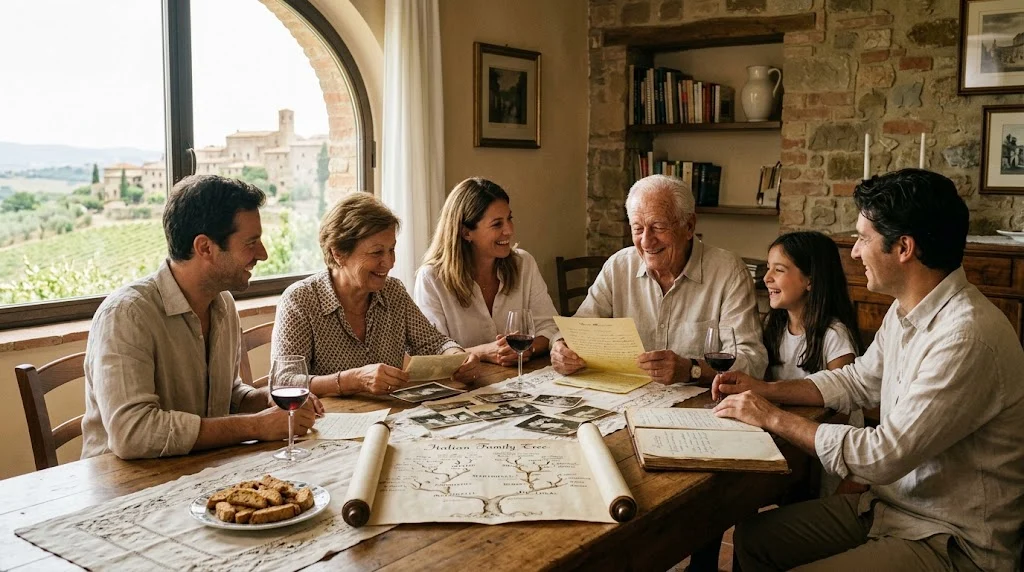
Another growing interest is genealogy. Digital family-history tools have made people more curious about where their surnames came from and a family name can reveal a geographic or occupational connection.
However, a surname alone cannot tell an entire family story. Historical records, birth certificates, marriage documents, immigration records, and local archives provide much stronger evidence.
What Do Italian Last Names Usually Mean?
Italian surnames commonly developed from several broad sources. Some came from occupations, such as Ferrari, which is connected with ironworking. Others developed from physical descriptions, such as Rossi or Bianchi.
Geographic surnames are another major group. Romano, for example, can indicate an association with Rome, while Greco can indicate a Greek connection. Personal names also played an important role, with some family names developing from older given names.
Because surname histories can be complex, one meaning should not always be treated as the only possible explanation.
Why Are Italian Surnames So Diverse?
Italy has a long and varied history, with distinct regions, dialects, city-states, kingdoms, and local communities. These regional differences influenced the development of family names.
A surname could develop differently in northern Italy than in central or southern Italy. Local dialects could also change spelling and pronunciation.
Migration added another layer. Italian families moved between regions and eventually to countries around the world, spreading surnames far beyond their original locations.
This is why two families with similar surnames may have different histories.
How to Research Your Italian Surname
If you are investigating your own family name, begin with the oldest reliable records available in your family.
Useful sources can include:
- Birth records
- Marriage records
- Death records
- Church registers
- Immigration documents
- Census records
- Military records
- Local archives
- Cemetery records
- Historical newspapers
Do not rely on surname meaning alone. A surname dictionary can provide a useful starting point, but genealogy requires connecting the name to specific people, dates, and places.
FAQs
What are the most common Italian last names?
Rossi, Russo, Ferrari, Esposito, Bianchi, Romano, Colombo, Ricci, Marino, and Greco are among the widely recognized Italian surnames. Exact rankings can vary by source, region, and the population being measured.
What is the most famous Italian last name?
Ferrari is one of the most internationally recognizable Italian surnames, while Rossi is also extremely familiar. “Famous” is subjective, however, and recognition can depend on country, culture, and context.
What does Rossi mean in Italian?
Rossi is generally associated with rosso, the Italian word for “red.” Historically, the surname could have described someone with red hair or a ruddy complexion. Different family branches can have different histories.
What does Bianchi mean?
Bianchi comes from bianco, meaning “white.” It likely developed in some cases from a nickname or physical description involving light coloring. The exact origin of a particular Bianchi family requires genealogical evidence.
Is Ferrari an Italian surname?
Yes. Ferrari is an Italian occupational surname associated with ironworking or blacksmithing. It is related to words and surnames derived from ferro, meaning “iron,” ultimately connected with the Latin word ferrum.
Are Italian surnames connected to occupations?
Yes. Occupational naming was one important source of Italian surnames. Ferrari and related names are associated with ironworking, while other Italian surnames developed from trades, crafts, and professions practiced by ancestors.
Can an Italian surname tell me where my ancestors came from?
Sometimes it can provide a clue, particularly when the surname has a geographic meaning. However, surnames can spread between regions over generations, so records are needed to confirm a family’s actual place of origin.
Why do some Italian surnames have different spellings?
Regional dialects, historical spelling practices, transcription errors, migration, and changes made when records were created in other countries can all contribute to surname variations.
Conclusion
Italian surnames carry pieces of language, geography, work, family history, and cultural memory. From Rossi and Bianchi to Ferrari and Romano, each name can open the door to a different story about how family names developed.
The best way to understand common Italian last names is to look beyond the sound of a surname and explore its linguistic and historical background. If you are researching your ancestry, treat surname meanings as clues rather than final proof.
Pick the surname that interests you most, explore its regional history, and see what stories it may reveal. If you enjoyed this guide, share it with someone interested in Italian heritage or family history, and leave a comment with your favorite Italian surname.
Discover More Related Articles:
- 345 Arch Angels Names | Beautiful Heavenly Names & Meanings In 2026
- 200 Archangels Names | Beautiful Heavenly Names In 2026
- 150 Irish Baby Names | Beautiful Picks For 2026